Thailand Footprint: The People, Things, Literature, and Music of Thailand and the Region

Posts by Kevin Cummings

Slim


One week from today, Thailand Footprint will be one year old. That is a big deal to at least one person – me. I’ll recap the year a bit and publish one of the first things I wrote way back then – 365 days ago. I’ll tell you what I’ve learned and what I know. Whether you read it or not is, of course, always up to you. Thanks for stopping by as often as you have.

An interview with Tom Vater will be the last interview in this inaugural year. As I’ve said before, when Tom Vater talks, I listen. In this case I think you’ll want to read what he has to say. Look for that interview this coming Thursday.

Until then, here is a little ditty by Slim Dusty, a singer-songwriter from one of my top three favorite countries, Australia. Slim is no longer with us, reminding us we only get to look forward and back for so long.

Leave a comment

MWF Ang_portrait (1)s

Thailand Footprint is pleased to welcome Angela Savage to our Fast Track interview. Angela has strong ties to Thailand that go back almost thirty years. Like inaugural Fast Track interviewee, Andrew Nette, she resides in Melbourne, Australia. That’s not a coincidence as Angela and Andrew are partners and they chose The Lucky Country in which to raise their daughter. Angela has three novels set in Thailand in the Jayne Keeney P.I. series. They are: BEHIND THE NIGHT BAZAAR, set in Chiang Mai, THE HALF CHILD, set in Pattaya and THE DYING BEACH set in Krabi. She is a writer with a social conscience. You will get a good crime story and at least one message in an Angela Savage novel. Here is how Andrew Nette described Angela’s work ethic:

“She works incredibly hard to give readers an insight into what it’s like to live in Thailand, for foreigners and Thais, with all the blood, sweat, tears, beauty and – as is usually the case for expatriates – embarrassing social faux pas that this can entail.”

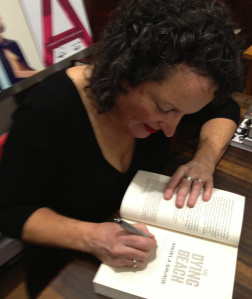
angela-signing_ellie-marney_crop

Angela Savage at the book launch for The Dying Beach

Welcome, Angela Savage:

TF: Is Australia still The Lucky Country and if so, why?

AS: The simple answer is yes – provided you’re not Indigenous, homeless or an asylum seeker. Among the non-Indigenous population, Australia’s health and wellbeing indicators are up there with the best of them; life expectancy is among the highest in the world. We’ve weathered the GFC better than most – all of which begs the question, why are we so damn mean? Our current treatment of asylum seekers is shameful. Peace and prosperity appear to have made Australians paranoid rather than comfortable, a situation not helped by the absence of visionary political leadership.

End of rant.

TF:  What book(s) or music influenced you growing up?

AS: My grandfather, nicknamed ‘Banjo Savage’, worked as a musician on cruise ships in the 1920s, and taught me to sing what my mother referred to as ‘drunks’ songs’ – ballads about passion, pain and death – when I was still a toddler. Mum attempted to counter these early influences with liturgical music, but somehow Kenny Rogers managed to slip through the cracks, bringing more songs about passion, pain and death. The ideal musical education for an aspiring crime writer, really.

TF: What’s the last record or book you can remember listening to or reading?

Among my most memorable recent reads are two collections of short stories: Sightseeing by Rattawut Lapcharoensap, set in Thailand; and Holiday in Cambodia by Laura Jean McKay, set in Cambodia.

Music-wise, I’ve been listening to Bruce Springsteen and the E Street Band live at the Hammersmith Odeon in London, 1975. They sound remarkably like they did in Melbourne in February, 2014.

TF: Is there a book out there or laying around your home that you’ve been meaning to read but haven’t gotten around to it yet?

AS: I’ve been meaning to read Vikas Swarup’s Six Suspects, the sequel to his excellent Q&A, which was made into the film Slumdog Millionaire. Timothy Hallinan’s The Queen of Patpong is also towards the top of my TBR [To Be Read] pile.

TF: Complete this sentence: Amazon.com is …

AS: …a convenient place for Kindle users to buy books. I do use a Kindle for travel, but I still read mostly paperbacks.

TF: Make the case for fiction over non-fiction in 100 words or less.

AS: Non-fiction is only ever as strange as the truth, and can only take you places that exist. Fiction is not bound by such limitations. Fiction sets you free.

TF: Please tell me your three favorite dead authors? Or if you are feeling confident you can throw some live ones into the mix?

AS: Favourite dead authors: Angela Carter, Raymond Chandler, Oscar Wilde.

Favourite authors still living: Barbara Kingsolver, Simone Lazaroo, Honey Brown, Wendy James, Megan Abbott, Garry Disher, David Whish-Wilson and Andrew Nette.

TF: How important is setting in a crime novel? What is it about Thailand in general and Chiang Mai in particular that makes it such a great setting for a crime novel?

AS: I think it was the events of 1992 that first fired my imagination about Thailand as a setting for crime fiction. After spending several idyllic days on Koh Samet, my partner and I happened to be in Bangkok in May when the Thai army opened fire on demonstrators at Sanam Luang. The fact that the surface calm and beauty of the country could erupt so suddenly into violence proved irresistible to me as a writer. In addition, the coexistence in Thailand of old and new, tradition and modernity, religion and consumerism, parochialism and globalisation provides so many riches for a fiction writer to mine.

Thailand is not merely the backdrop to my crime novels, but a character. the stories I write couldn’t take place anywhere else.

As a non-Thai writer, I challenge myself not to only expose Thailand’s seedy underbelly but to also showcase the beauty of the country. Chiang Mai was the setting for my first novel, Behind the Night Bazaar, because it has both. My Australian expat PI character, Jayne Keeney, alludes to this towards the end of the novel when she reflects that, “while Chiang Mai might have an ugly side, the light that afternoon was at its most flattering.”

Behind the Night Bazaar cover (1) (1)s


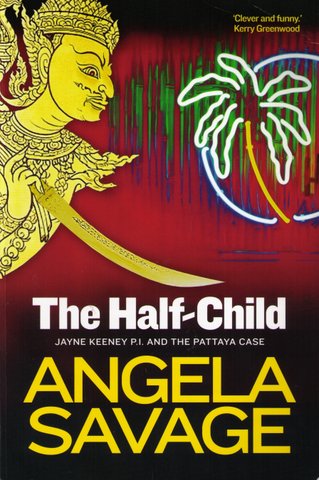
I set my second novel The Half-Child in Pattaya, which is not the country’s most attractive location—one character refers to it as ‘Thailand’s own Sodom and Gomorrah’. I balanced this by having a character come from Kanchanaburi, allowing me to take the reader to some Thailand’s ‘wild west’.

The Half Child cover (1)s


By contrast, my third novel, The Dying Beach, is set in Krabi, a stunning location. I don’t know what it is about crime writers that sees us visit beautiful places and start mentally populating the landscape with dead bodies, but that’s what happened when I visited Krabi on holidays. I guess it’s our way of paying tribute to a place.

The Dying Beach_large_cover (1)s


TF: What does The Year of the Horse have in store for you?


AS: As someone born in The Year of the Horse, I am looking forward to 2014.

Angela in Krabi 2011 (1) (1)s

 Setting is important to crime fiction author, Angela Savage

AS: I’ve recently enrolled in a PhD in Creative Writing in order to spend the next three years writing full-time. I’m working on a novel set in Australia and Thailand that deals with commercial surrogacy between the two countries. I’m also hoping to finish off the fourth book in the Jayne Keeney PI series, set in Bangkok during the financial crisis of 1997.

TF: Thank-you, Angela for being our guest at Thailand Footprint. I hope you get a chance to put your feet on Thailand sand again in the near future. 


Angela Savage is a Melbourne-based crime writer, who has lived and traveled extensively in Asia. Her first novel, Behind the Night Bazaar won the 2004 Victorian Premier’s Literary Award for an unpublished manuscript and was shortlisted for the Ned Kelly Award for Best First Book. Her second novel, The Half-Child, was shortlisted for Best Crime Fiction. Angela is a winner of the Scarlett Stiletto Award for short crime fiction. Her latest novel is The Dying Beach.

Leave a comment

Robert Carraher

I learned today that Robert Carraher died recently of cancer. We shared some things in common. He liked music and books. Timothy Hallinan was one of his favorite authors. It was just a little over one year ago that it was suggested by author Lisa Brackmann that I contact Robert after I shared with her my desire to start a blog about books and music and people. “You should talk to Robert Carraher.” Lisa Brackmann said. So I did. And I was glad I did. Because he was very helpful. He was an accomplished book reviewer. I enjoyed his reviews, a lot. My first review on this blog was for Zero Hour in Phnom Penh. Robert took the time to leave a positive comment. A short and affirmative, positive comment. At the time I replied, it was like being a stand-up comedian and having Jerry Seinfeld nod his head up and down after your routine and say, “Funny.” It meant a lot to me. And he took the time. So now I am returning the favor. We had many private messages back and forth. He shared his advice. I listened. One bit of advice I remember in particular: “It’s not about us, Kevin. Always remember that.” It tied in perfectly with the Henry Miller tag line I use often, “Forget yourself.” I never met Robert Carraher face to face, although it would have been welcome by me and likewise by him. He was a smoker. I wish he wasn’t. I have friends that have smoked and quit. I’m glad they have quit. I have others who still smoke. I wish they would quit. Thank-you, Robert Carraher for your sage advice and humor. And your passion for books and music and living. It was all very much appreciated.

Robert

Leave a comment

HENRY-MILLER-444-OCAMPO-DRIVE-PACIFIC-PALISADES-LOS-ANGELES-CA-17-APRIL-1976-1-c31459


”Tomorrow I will discover Sunset Boulevard. Eurhythmic dancing, ball-room dancing, tap dancing, artistic photography, ordinary photography, lousy photography, electro-fever treatment, internal douche treatment, ultra- violet treatment, elocution lessons, psychic readings, institutes of religion, astrological demonstrations, hands read, feet manicured, elbows massaged, faces lifted, warts removed, fat reduced, insteps raised, corsets fitted, busts vibrated, corns removed, hair dyed, glasses fitted, soda jerked, hangovers cured, headaches driven away, flatulence dissipated, limousines rented, the future made clear, the war made comprehensible, octane made higher and butane lower, drive in and get indigestion, flush the kidneys, get a cheap car-wash, stay-awake pills and go-to-sleep pills, Chinese herbs are very good for you and without a Coca-Cola life is unthinkable.” Henry Miller (1891-1980), U.S. author. “Soirée in Hollywood,”

5 Comments

Thailand Footprint is pleased to introduce a new feature. The Fast Track Interview. Any resemblance to Paul D. Brazill’s Short Sharp Interview feature found at  PaulDBrazzill.wordpress.com  is purely coincidental. Any alternative theories will be defended vigorously, in a court of law or circus depending on country of jurisdiction.

Thailand Footprint is even more pleased that Australian pulp fiction writer, Andrew Nette is our inaugural Fast Track interviewee. Andrew has strong ties to Thailand, Cambodia and the region although he currently resides in a country I like a great deal, and a city I would like to visit one day, Melbourne, Australia.

His web site, PULP CURRY – where he writes about pulp, culture and crime among other topics, makes my Top Five Favorite crime fiction sites to visit on the world wide web.

Andrew Nette is one of the founders of Crime Factory Publications, a small Melbourne-based press specialising in crime fiction. He co-editors its magazine Crime Factoryand co-edited its publication Hard Labour, an anthology of Australian short crime fiction, and LEE, an anthology of fiction inspired by American cinema icon Lee Marvin.

His short fiction has appeared in a number of print and on-line publications, including Beat to a Pulp, Hardboiled 3Shotgun Honey Presents: Both BarrelsBlood and TacosThe One That Got AwayPhnom Penh Noir and Crime Factory Hard Labour. 

Andrew is also on the committee of management for the Australian Crime Writers Association. He has been known to tip a pint at Queen Victoria Pub and make an appearance at Check Inn 99 when visiting Bangkok, Thailand. I am pleased to welcome Andrew here today:

AndrewN

 Pulp fiction author and scholar, Andrew Nette


TF: Is Australia still, The Lucky Country and if so, why?

AN: It’s important to note it has never been the lucky country for some, particularly our Indigenous people who are the original inhabitants of Australia, many of whom still live in Third World conditions.

That said, yes, Australia is still one of the luckiest and most comfortable countries in the world. At the same time, I’ve thought for a while now that we are slowly becoming a much more unequal country. A lot of the values and structures we see as uniquely Australian, for example, our sense of egalitarianism, are started to slip away. With respect to my USA friends, we are starting to see some of the emergence of many of the not so positive trends we see in the States, such a growing inequality in income distribution and polarized, increasing shrill political debate.

It’s important to note that when it was first coined in the sixties, one strong aspect of the term ‘the lucky country’, related to Australia’s abundant natural resources. This is a positive in that it has enabled us to weather economic storms that have engulfed other Western countries. There’s also a negative connotation. Our reliance on being a quarry for overseas nations has stifled our ability to plan ahead and think of more innovative solutions to maintaining our economy, and has engendered complacency in our outlook.

TF: What book(s) or music influenced you growing up?

AN: Without doubt, the books that most influenced me growing up were the pulp and crime novels read by my father.

Along with a lot of men in the fifties and sixties, Dad loved Carter Brown and Larry Kent. He also had a thing for Mickey Spillane, John MacDonald and Ian Fleming. I still have his collection of early James Bond paperbacks, saved from what would no doubt have been one of Mum’s frequent op shop culls. I’ve read them all several times.

Even as a child, Dad’s collection of crime paperbacks fascinated me. Their lurid cover art, the seamy cadence of titles like Nobody Loves a Loser and Bid the Babe Bye-Bye.

I spent many hours in my teens thumbing through all these books. This, in turn, led to progressively longer forays on my bike in search of second hand bookshops to feed my desire for paperback thrills. These shops seemed to be almost always hidden down a side street or deep in the bowels of a suburban arcade. They were darkly lit and smelt musty. The more crammed and chaotic, the happier I was. It gave me a chance to rummage. A curtained off section where the adults only stuff was kept was even better, adding to the furtive and mysterious nature of my expeditions.

All this contributed to my joy in reading. Certainly it’s responsible for my particular love of crime fiction. It also led, eventually, to my interest in the history of pulp publishing.

TF: What’s the last record or book you can remember listening to or reading?

AN: I recently saw Bruce Springsteen in Melbourne and was listening to a lot of his stuff in preparation for the concert. The album that really stands out is Bruce Springsteen and the E Street Band, Hammersmith Odeon, London, ’75. It has all the classics, including my favourite Springsteen tracks, ‘Tenth Avenue Freeze-Out’ and ‘It’s Hard to be a Saint in the City’ (I also love the version of that song done by David Bowie).

TF: Is there a book out there or laying around your home that you’ve been meaning to read but haven’t gotten around to it yet?

AN: There’s many, but the one that comes to mind is Ryzard Kapuscinski: A Life by Artur Domoslawski. Kapuscinski was a globe trotting Polish journalist in the seventies and eighties. In addition to, literally, going where others would not or could not go, his writing developed a wonderful magical realistic quality in order to get around the Polish censors. He was one of my heroes, a hard-edged humanist and a wonderful journalist.

He was also the subject of great controversy. As with virtually anyone in the former Soviet Block who was able to undertake significant creative endeavors that attracted positive attention in the West, without running foul of the authorities, some claim he was a spy for the Polish Government. There may be some grain of truth in this, although not in the way people who make this accusation mean it. Kapuscinski, and people like him, lived under an all-consuming police state. I doubt there were many prominent intellectuals and writers who did not, at some time, have to feed something to the security services, it’s the nature of living under a dictatorship. That’s very different from being a conscious and active ‘spy’ or intelligence operative.

TF: Complete this sentence: Amazon.com is…

AN: Both an opportunity and a threat for writers. It’s also probably an inevitable development so we need to learn to live with it. Personally, it’s been positive for me in that it’s given me a chance to help spread the word about my 2012 book, Ghost Money.
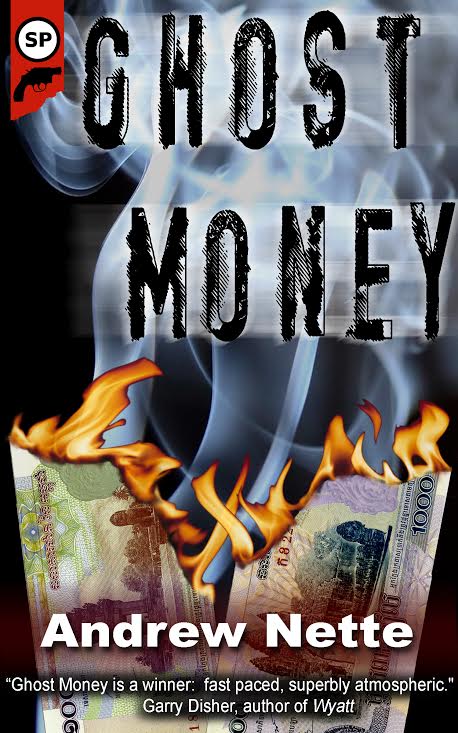
Ghost Money


Personally, I see Amazon as no better or worse than any other big company. I think the concerns about Amazon, such as its labour standards and impact on bookshops, are important and need to be debated. I find it amusing, however, when people criticize Amazon but think nothing about doing their shopping at a major supermarket chain or using some other major commercial operation for a good or service.

TF:  Make the case for fiction over non-fiction in 100 words or less.

AN: Both are important. Both have their place.

TF:  Please tell me your three favorite dead authors? Or if you are feeling confident you can throw some live ones into the mix?

AN: In terms of dead authors, I can’t go past Charles Willeford, Jim Thompson, James Crumley and Donald Westlake. Westlake’s Parker books, which he wrote under the pseudonym Richard Stark, probably remains my favourite all time crime fiction series

There’s a long list of contemporary crime writers whose work I admire, but special mention would go to Megan Abbott, David Peace, James Ellroy, Dennis Lehane and Donald Ray Pollock. In terms of the Australian end of things, I am a huge fan of Garry Disher and the West Australian crime writer, David Whish Wilson.

TF: Tell me about your publishing house. What are the challenges of a boutique publisher in an Amazon age? 

 AN: Crime Factory was first launched as a print magazine in 2000. It went for nine issues and was incredibly influential before a combination of factors resulted in the editor pulling the plug on it in 2003. It was rebooted as on-line magazine in PDF, Kindle and print on demand format in early 2010. Crime Factory Publications has three Australian editors, Cameron Ashley, Liam Jose. Another guy, Jimmy Callaway, is based in the US.

We decided to establish as a small publishing house in late 2011 because we think there’s a gap in the Australian market for darker crime fiction. We put out longer form material, anthologies and novellas. Eventually we want to move into novels, but we’re a long way from that.

 Our material is niche and primarily digital. While that eliminates a lot of problems, distribution is still a challenge, as is marking our selves out from the pack. A lot of complexities also arise as a result of the fact that we are small and try and work in the USA and Australia.

TF: What does the The Year of the Horse have in store for you?

AN: In the next month or so I’ll finish my second novel. I don’t talk about work in progress and won’t make an exception here except to say it’s a totally different main character to the one that appeared in my first book, Ghost Money, and a totally different setting (although part of the book is set in Asia). There’s also a few other projects in the pipeline which will hopefully see the light of day soon.

TF: Thank-you, Andrew Nette for your time. Best of luck in 2014. 

Andrew Nette is a Melbourne crime writer, reviewer and pulp scholar. He is one of the editors at Crime Factory Publications. His short fiction has appeared in a number of print and on-line publications. His first novel, Ghost Money, was published in 2012. His online home is www.pulpcurry.com You can find him on Twitter at @Pulpcurry



Leave a comment

I like Chris Coles. The artist and the man. It’s been over 10 years since we first met at a meeting place less than a football field away from Baccara Bar on Soi Cowboy, where James A. Newman, Alasdair McLeod and I recently went to see Chris and his art on Friday the 14th. I wrote a previous piece about Baccara Bar last week partially titled: The Art of Seduction or the Art of the Deal?

ChrisColesDancer

That first meeting occurred because I had stumbled upon the art of Chris Coles on one of his web sites: Chris Coles Gallery Expressionist Art. I found the art interesting a decade ago. I still do, today. I surmised the man painting about the bright lights and big city of Bangkok might be equally interesting. We arranged to meet. When Chris arrived for that initial meeting I was sitting with a group of 5 or 6 guys around a table. I introduced Chris to the others and conversation ensued. Some interesting. Some mundane. It was always lively, to me, when Chris spoke. I remember thinking, “This guy is the smartest guy in the room.” The fact that the room was the outdoor bar at Tilac on Soi Cowboy, which had 50 or more people scattered about, drinking fluids under a polluted Bangkok night sky didn’t matter. Chris talked about his time in California and the movie business. The big budget film, Cutthroat Island, brought him to the Island of Phuket and eventually Bangkok, where the former Maine resident now calls home. Chris is like the carriage horse of a different color in the movie, The Wizard of Oz. Chris Coles pulls his own weight. There is only one of him and he is it.

Painter of the Bangkok Noir

Meetings with Chris are always memorable. There was a mid-day meal at SUDA restaurant years ago where Chris informed me at our lunch table, “You need to buy, VERY THAI.” A book written by Philip Cornwel-Smith and now in its second edition, with additional photographs by John Goss. After we finished eating we walked to the Time Square Building on Sukumvit 12 and went up the escalator to Asia Books on the second floor. That Asia Books store is now gone. But I still own VERY THAI thanks to Chris Coles. It is a great book about everyday popular culture in Thailand.

BlueDancer

Three years ago, Chris Coles had his art shown at Koi Gallery on Sukhumvit 31. An art exhibition called: Color of Day/Color of Night. One half of the gallery was filled with traditional impressionist paintings of trees and flowers. The other side was filled with the large and loud expressionist art of Chris Coles, in the self described style of  Emil Nolde, Otto Dix and George Grosz. Coles’ art made the more favorable impression, on me. Chris was spread pretty thin that evening but still made time for me and I met some interesting people on a hot Bangkok night.

Another time I took my wife to hear Father Joe Maier speak, the American Catholic priest that lives and works in the Klong Toey slums. We had a dinner table reservation. Chris Coles was sitting at the bar in the packed Foreign Correspondent’s Club of Thailand. After Father Maier finished his very entertaining speaking engagement, Chris came over to our table, despite the fact he probably knew over 50% of the people in the large room. He spent thirty minutes talking to my wife about painting, colors, medium, style and art. My wife appreciated it and so did I. She had begun taking art classes at our community college in California. Chris had seen some of her work and shared his experiences and enthusiasm. Memorable table conversation, again.

Chris Coles Painting - 2:00 a.m. Street 51 Phnom Penh Night

Chris Coles Painting – 2:00 a.m. Street 51 Phnom Penh Night

More recently, I was just about to leave the Check Inn 99 in the early hours of the evening on a Sunday, after listening to Jazz for many hours, when in walks Chris Coles carrying one of his large acrylic paintings. Chris stood for awhile, holding the painting, looking for the owner, Chris Catto-Smith. They went and hung the painting and Chris eventually came back and joined our table. This is an image of the painting Chris Coles brought with him on that Bangkok night, which is displayed at Check Inn 99:

Sexy Bar acyrlic 10_8 300dpi

That prompted a call to my wife, “Honey, I’ll be home later than I said. Chris Coles just arrived.” She understood. She likes Chris too. Chris is the kind of friend that will let you know when you have put on an extra 10 pounds. He’s also encouraging – to my wife, to me and to others. As Chris puts it in the video interview with James A. Newman, “You need to bring something to the Bangkok night. And then make something out of it.” I appreciate Chris Coles. I also like and appreciate the fact that he has some critics. Show me a man with critics and I will show you a man with accomplishments.

ChrisColesBaccara

Chris Coles stands next to one of his accomplishments at Baccara Bar in Bangkok, Thailand

Fast forward to Friday the 14th. Our group of four had just finished eating our dinners at Queen Victoria Pub. Big dinners. Bangers and Mash kind of dinners. We were to meet Chris at Baccara on Soi Cowboy. One of three infamous Entertainment Zones catering to foreign tourists and expats living in Bangkok. Someone joked that no one has ever seen Chris eat dinner, which may explain how he maintains his weight better than most in the City of Angels. Chris is not a starving artist, by any means. But he certainly knows how to paint the overweight, contrary and even the ugly side of life. Chris Coles paints Bangkok realities, not American fantasy. Thomas Kinkade he is not. The art made by the Ivy League  graduate and father of an M.I.T grad daughter has been exhibited in at least four countries. His clientele is diverse, ranging from Baccara owner Patrick to people close to the Royal family, well known authors, art collectors and even a blogger or two.

MakeUpGirl

“I like using distortion, sharply contrasting, often rather ugly images, disharmonious colors and a rough technique.” Chris Coles – artist and author of Navigating the Bangkok Noir

CC7

The above Chris Coles painting is not one of the four that hangs in Baccara Bar on Soi Cowboy. It depicts the front porch of Baccara at 2:30 a.m., after Soi Cowboy  has mostly finished being what Chris describes as another, “long, hot, frenzied night.”

Chris Coles was waiting outside when we arrived, at a table in front of Baccara Bar, wearing one of his trademark plaid shirts and Levi 501 jeans. We had permission from the owner, Patrick to photograph inside and videotape outside; we had Chris Coles for a tour guide, he had agreed to a video interview and it was Friday night in Bangkok City. No one was talking politics and no one was complaining.

We went to the second floor of Baccara, where three of Coles’ paintings are showcased. The first floor and second floor of Baccara are quite different in atmosphere. If you have trouble making up your mind where to spend your time you need only look through the glass ceiling or glass floor, depending on your point of view. To get to the second floor one must climb up a spiral staircase, where at the top you will see this Chris Coles painting: [Addendum: fire on 2nd and third floor of Baccara Bar in early May, 2014 destroy three of four Chris Coles paintings – see them here].

Jim and Cris

Author, James A. Newman on the left. Artist, Chris Coles on the Right. Painting of the Bangkok night – center stage at Baccara Bar in Bangkok, Thailand. (Photograph by Alasdair McLeod)

James A. Newman, who writes about the entertainment zones in entertaining fashion interviews Chris Coles on video, in the thick of the Red Night Zone. Sit back and enjoy this revealing segment from the interview put together by Alasdair McLeod. You’ll learn what motivates Chris Coles to paint the Bangkok night, whether he goes looking for his subjects or makes them up at times? The thought behind the atmosphere at Baccara and whether a pulp fiction writer drinks white wine or red? The Bangkok night can be a big nightmare or a big party. But like any good party you are invited to, as Chris Coles suggests, it’s never a bad idea to bring something to it.

You can learn more about Chris Coles and his art at his blog: BANGKOK NOIR – CHRIS COLES EXPRESSIONIST ART IN THE BANGKOK NIGHT

CityLife

This post may also be seen at Chiang Mai City News by clicking the above banner

6 Comments

Interesting reblog from Melissa Ray’s Muay Thai on the Brain. About Muay Thai fighters, convicts and an appearance by, Happy Thailand Guy. Melissa has been interviewed and profiled twice at Thailand Footprint.

Melissa Ray's avatarMuay Thai on the Brain

Nai Khanom Tom Nai Khanom Tom

Every year the World Professional Muay Thai Federation (WPMF) holds a show to commemorate the birthday of legendary fighter Nai Khanom Tom, or National Muay Thai Day, on March 17th.

This year, the show was held on the slightly earlier date of March 11th, at a venue in the Lad Krabang area of Bangkok, with a line-up that included Berneung Topkingboxing (Thailand) defending his 168lb WPMF title against Thomas Carpenter (England/Thailand), Saiseelek Sitsuperman (Thailand) taking on Marik Kiatgorwit (France) for the 175lb WPMF title, Kwanjai Sor Por Lor Chaiyaphum (Thailand) defending her 118lb WPMF title against Sayfa Sor Suparat (Thailand), and a bout between WPMF favourites Jos Ingram Gym (Brazil) and Alex Chiangmai Muaythai (Switzerland).

My gym was to be represented on the day by former Lumpinee and Channel 7 Boxing Stadium champion Tapaothong Eminent Air—a veteran of more than 300 fights, though absent…

View original post 1,085 more words

Leave a comment

Soi-Cowboy-Baccara-Club

Last Friday pulp fiction writer, James A. Newman, Bangkok Night of Noir photographer and videographer, Alasdair McLeod and I were granted access to Baccara Bar on Soi Cowboy in Bangkok, Thailand for the purpose of photographing the art of Chris Coles and hanging out with the artist during our time there. Four paintings were recently purchased by the owner, a Frenchman named Patrick. Patrick gave us just one caveat,  “No photographing the girls”. We complied. In addition to owning Baccara, which most consider to be the premier Go Go bar on Soi Cowboy and all of Bangkok, he also owns the former Insomnia Disco (now called Insanity), Bangkok Beat, Baccara A-Go Go on Walking Street, as well as 4 other popular venues in Pattaya City. Patrick is the exception to the expat bar-owner scene.

As Bangkok 8 author John Burdett recently pointed out in an excellent video interview, prostitution in Bangkok benefits from being illegal. It remains by and large a cottage industry, run much like a Mom and Pop store. Baccara and Patrick run things quite differently in the Kingdom. He would be the equivalent to the mansion on the hill owner. Baccara sees roughly 1,000 people go in and out their doors, most every night of the year. The numbers add up.

Patrick is creative. In a big way. Paying attention to lighting, layout, costumes, audio system, the rules of engagement or what I would call, the art of the deal. The women earn large monthly pay. Baht 200,000 a month and up for the elites. That is more money in one month than their father’s, if they come from Issan, make in years.

Patrick is a collector of Chris Coles’ paintings. The businessman showcases the original paintings depicting the Bangkok nightlife, along with 200+ dancing girls every night, at Baccara. Baccara a Go Go has distinguished itself from the crowd. High season or low season, the good times roll every night at Baccara, for a price.

PULP FICTION

The 1994 $5.00 milkshake in the movie, Pulp Fiction has been replaced with the 2014 $6.00 Coke at Baccara. Stay tuned at Thailand Footprint for an interview between pulp fiction writer, James A. Newman and Bangkok noir artist, Chris Coles in the next few days. In addition, you’ll get an inside look at Baccara Bar and the paintings in the neon world of the artist. Here is that post and video interview: Chris Coles – Bringing it to the Bangkok Night

Baccara 11 (1)

Photo by Alasdair McLeod – Painting by Chris Coles

1 Comment

When I say, Hallmark Greeting Cards, can you think of their tag line? It is, “When you care enough to send the very best.”

Hallmark

Now, have you given any thought as to who decided that Hallmark was and is the “very best”? For 70 straight years, no less. Was it a poll? Was it an independent greeting card association? Was it decided by their peers? No. Actually, Hallmark decided they were the very best. One of their sales executives came up with that conclusion right around the time World War II was ending. They were ahead of their time. People may have been too distracted by other things to question it, then. Humility seems to be a 20th Century characteristic. It doesn’t want to fit into a 140 character world.

Thailand Footprint will be 1 year old in mid-April. So I am very pleased to announce that we are the recipient of an award. The Best Blog Ever Award.

And if you need to see proof, well, here it is:

best-blog-ever

Because if we see it written on the internet, it must be true. Right?

And in case you are wondering, who selected Thailand Footprint as, Best Blog Ever? Well, I did. But it still looks good, dontcha think?

If you got this far, thanks for reading Thailand Footprint. Seriously. I appreciate it. I don’t know how much longer I will stick to it but it has been a lot of fun. If I have created a little entertainment for any of you readers out there, then so much the better.

Sincerely,

Kevin Cummings

Creator of, Best Blog Ever

2 Comments

Steve Irwin would have turned 52 years old last month. He died, tragically, at the age of 44 years. Stung by a giant stingray around 8 feet long. The photographer with Steve that day is giving interviews, which puts Steve Irwin, The Crocodile Hunter, back in the news.

It turns out his last words were, “I’m dying.” That must have been a startling and shocking realization for Steve. I feel sorry for his wife, a former American citizen and now a proud Aussie along with their son and daughter, whom Steve left behind.

First impressions are a funny thing. As the saying goes, you never get a second chance to make one. I remember the first time I saw Steve Irwin on television in the USA. I got an unfavorable first impression. I was probably the only one. But I remember thinking, clearly, “Leave the poor crocodile alone.” As he was jumping on its back, tying it up, hooding its head and carting it away somewhere for some good reason in the middle of the night. Steve Irwin won me over with time. He was a likable bloke. He really was. My favorite video image of him is when he was a young boy, shown with his dad. He’s rolling around in the dirt, having fun and there was some kind of animal involved. I cannot remember which kind but it wasn’t a puppy. Among the things I got to like about Steve Irvin, a lot, was his friendship for the ocean’s sharks and his outspokenness about the deplorable shark fin harvesting that still goes on to this day. I believe less shark fin harvesting goes on now, because of people like Steve Irvin.

Steve Irwin has been dead 7 1/2 years. He had a scheduled trip to Thailand the month after he died. He never made it here for that planned trip. The elephant camp that he was to visit paid a tribute to Steve as only elephants can do. Here is a picture from that tribute.

Steve Irwin

We are all dying at one rate or another. We don’t always think about it or say it aloud like Steve Irwin, but maybe we should more often? I have a couple of planned trips in the next three months. I hope I make it to the destinations. I only have so much control over that. I’ll do my best. But we can all plan to go somewhere or do something to cross off the bucket list before the bucket is kicked. It’s the thinking about the dead and the dying that reminds me to live as best as I can, while I still can. Thank-you, Steve Irwin for living the life you wanted to live.

Steve_Irwin

Steve Irwin. Born February 22, 1962 – Died September 4th, 2006

.

CityLife

This post also ran at Chiang Mai City News and may be seen there by clicking the banner above

Leave a comment