Thailand Footprint: The People, Things, Literature, and Music of Thailand and the Region

Posts from the ‘Writing’ category

Everybody has biases. Mine involve Check Inn 99 and Chris Catto-Smith. Watch the video produced by the video team from BangkokNightlife.com and click the link at the top of the video to take you to where you can vote for Chris for Expat Entrepreneur of the Year  by clicking Like. You can also go to the Facebook link at http://lnkd.in/bhcZg_R    

CheckInn99CC

1 Comment

This time each month I post a quote by American writer, Henry Miller. And we will get to that. But this post is about a trip I took this week to The Henry Miller Memorial Library in Big Sur, California. Few places on earth remain timeless but Big Sur comes as close as it gets. Located only 77 miles south of my home, the trip takes a little under two hours of coastal agricultural views before morphing into a turning and twisting drive of beautiful Pacific Ocean panoramas, small creeks, scenic bridges and tall redwoods. It’s impossible for me to take that drive without getting flashbacks of being a young boy on family trips in the family vehicle, a 1954 Buick.

The Henry Miller Memorial Library is located 100 yards south of the well known Nepenthe restaurant.

HenryMillerSign

This is the sign upon arrival. Henry Miller was against memorials, in general and for him specifically. For Henry the best testament of a man was how he lived, not how he was remembered by others.

Library1

Just through the gate after a short walk through tall redwoods one is greeted by a simple redwood structure with a grove to the right with a stage and viewing screen.

HenryMillerA

Inside one finds books, books and more books many written by Henry but other notable authors as well such as Jack Kerouac’s 1962 novel titled Big Sur.

Library

There are also plenty of paintings and prints by and of Henry but I saw no originals, probably because of their value. An original Henry Miller watercolor which he routinely gave away while at Big Sur and later sold or took a tax deduction of $300 per now fetch a few thousand dollars or more.

HenrySculpture The above bust sculpture of Henry is located by the cash register, along with a sign noting that with a $5.00 donation a book about the museum is included.

Typewriter

An old Underwood typewriter was one of many interesting artifacts to be enjoyed. You cannot get much further from the hustle and bustle of Paris, France where Henry Miller lived prior to moving to Big Sur in 1948 but in both cases Henry was opting out of conventional wisdom.

Tea

I bought a couple of Henry Miller books and brought them outside where tea and coffee were served under the honor system, which I am sure Henry would have approved.

PingPong

Around the back is where they keep the ping pong table for staff and visitors alike to play, which brings us to the Quote of the Month:

I keep the Ping Pong table for people I don’t want to talk to. You know, it’s simple, I just play Ping Pong with them. – Henry Miller

BigSurTrees

It’s a peaceful and timeless environment. There were only five other people enjoying the museum and I saw only one laptop open.

Kevin Cummings Thailand Footprint Big SUr Santa Cruz CA

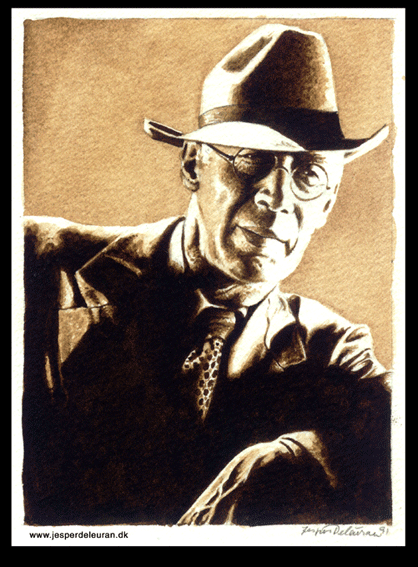
Here I am forgetting myself just enough not to look into the lens of a rare Kevin Cummings selfie. A portrait of Henry Miller looms above my head.

WriteOn

Some of the staff that work at the library live and camp on the premises. This sign reads: STAFF ONLY – WRITE NOW

EmilMailBox

The library was previously the residence of Henry Miller’s longtime friend, Emil White. Henry once wrote about Emil: “One of the few friends who has never failed me.” Henry Miller lived about 5 miles from the library, up on a mountain top. The property is inaccessible to the general public. Emil set up the library to honor Henry’s life after his passing.

Another great author, George Orwell wrote in his 1940 essay, “Inside the Whale,” of Henry Miller:

“Here in my opinion is the only imaginative prose-writer of the slightest value who has appeared among the English-speaking races for some years past.”

In the 17 months I have been writing this blog a few people have wondered why I include Henry Miller? It’s a fair question. Weaving in Henry Miller throughout this Thailand based web site is one of the things I like best about it, and the quotes always rank high in traffic and the almighty, Likes. But for the answer you need look no further than one of my all time favorite Bangkok fiction novels, Missing in Rangoon by Christopher G. Moore. Like many of my good ideas it was not original. Borrowed is how I like to think of it, kindly. There is a Henry Miller thread woven into Missing in Rangoon, which adds greatly to the story. As timing would have it just yesterday Christopher G. Moore wrote about Henry Miller and George Orwell and the Missing in Rangoon and The Marriage Tree passages involving the two authors, in an essay titled, Obey, at Reality Check found at his excellent blog, InternationalCrimeAuthors.com . It is well worth the read as he discusses how two authors went about the near impossible but worthy endeavor of, writing about truth. Each one in his own and distinct way.

Big Sur Coast

I hope you enjoyed this photo-essay on my visit to The Henry Miller Memorial Library. If you find yourself within a 300 mile radius of the library consider the journey for yourself. The ride back is even better for some reason.

Leave a comment

A very interesting blog post detailing that no matter whether you take a fast VIP bus from Chiang Mai or a slow 2 day day boat ride from there to Luang Prabang, accidents happen in the Land of Smiles …

Shereen's avatarWe take to the open road

From Chiang Mai, we headed straight to the Thai/Laos border and caught a two-day “slow boat” down the Mekong River to Luang Prabang. We were looking forward to a couple of quiet, scenic days on the water. For the most part, that is exactly what we experienced.

There were about ten other people in our group who were making the same trip. On the way to the border, we had a quick stop in Chiang Rai to see the very modern Wat Rong Khun (the White Temple). It was spectacular to see! (We’ve since learned that the temple was damaged by an earthquake in early May. It’s anticipated to take a couple of years to repair the damage.)

Wat Rong Khun (the White Temple) Wat Rong Khun (the White Temple)

Wat Rong Khun (the White Temple) Wat Rong Khun (the White Temple)

Our group, along with several others, stayed overnight in Chiang Khong, Thailand which is right at the border. The next…

View original post 769 more words

2 Comments

A blog post by Muay Thai Champ, Melissa Ray on an evening at the FCCT with Thai politican Chuvit Kamolvisit. It was written six months ago but I found it still entertaining today. Melissa has been featured at Thailand Footprint twice (see links below) and still holds title of most read blog post here. Enjoy.

Melissa Ray's avatarMuay Thai on the Brain

Image source: facebook/ชูวิทย์ I'm No.5 Image source: facebook/ชูวิทย์ I’m No.5

Outspoken pimp turned politician, hotel owner, and crusader against corruption, the “bathtub godfather” Chuvit Kamolvisit is arguably the most interesting character in current Thai politics.

Never far from the limelight, most recently he created headlines after a (staged?) street fight with a man believed to be an anti-government protester on the way to a polling station in Din Daeng on Election Day earlier this month.

While browsing my Twitter feed last week, my eyes were drawn to a Tweet informing that Chuvit would be speaking and taking questions at the Foreign Correspondents’ Club of Thailand (FCCT) on Thursday 13th February.

Although I am far from knowledgeable on Thailand’s politics, in recent months I have become increasingly interested in the country’s political scene, and with Chuvit renowned for his candid nature, I figured the opportunity to hear his thoughts on the current standoff between the government…

View original post 719 more words

2 Comments

A reminder and reblog from Crime Thriller Girl …

crimethrillergirl's avatarSteph Broadribb

Dagger in the Library logo Dagger in the Library logo

The Crime Writer’s Association (CWA) 2014 Dagger in the Library Award gives the chance for us, the readers, to nominate our favourite British crime fiction authors for the prestigious award.

Sponsored by Dead Good Books, the Dagger in the Library is given in honour of the author’s entire collection of work to date rather than one specific book. Previous winners include Belinda Bauer, Steve Mosby and Stuart MacBride.

Nominations close on 1st September 2014, so make sure you hop on over to http://www.deadgoodbooks.co.uk/index.php/dagger/ and nominate up to three of your favourites.

What’s more, you’ll be automatically entered into a draw and in with a chance of winning £200 worth of crime books!

View original post

Leave a comment

Excellent interview by the Crime Thrilla Fella of Colin Cotterill. THE AXE FACTOR, third in the Jimm Juree series is discussed. “I believe that whatever genre you choose, despite the fact that there are millions of bloggers and short story posters and homepage entertainers, the cream will float to the top. If you’re any good, you’ll get noticed.” – Colin Cotterill

SSA1's avatarCrime Thriller Fella

Colin Cotterill Photo credit: Christina Körte

As you toil away writing in the back room of your two-up two-down spare a thought for poor old Colin Cotterill, who pens his crime novels in a small fishing village in southeast Asia. Colin’s the author of the Dr. Siri mystery books – he won the CWA’s prestigious Dagger In The Library Award in 2009 – and the third in his trilogy of Jimm Juree novels, The Axe Factor, comes out in paperback on Thursday.

Born in London, Colin has travelled the globe since 1975. He’s put all his experiences of the region – including working in child protection in Laos and Thailand – into his novels. In this fascinating intel interview Colin tells us about Jimm Juree, scribbling his first book on the back of bus tickets — and his life writing and illustrating in the shade of papaya trees.

Tell us about The Axe Factor…

The Axe Factor is the…

View original post 1,866 more words

Leave a comment

Arthur Hoyle Nature

Arthur Hoyle

I am pleased to welcome writer, educator, and independent filmmaker Arthur Hoyle. His documentary films have won numerous awards and have aired on PBS. Arthur received Bachelors and Masters Degrees in English from the University of California, Los Angeles. He taught English, coached tennis, and served as an administrator in independent schools. He currently volunteers as a naturalist in the Santa Monica Mountains National Recreation Area, leading interpretive walks on Chumash Indian culture. He lives in Pacific Palisades, California. Arthur Hoyle’s biography of Henry Miller, The Unknown Henry Miller: A Seeker in Big Sur, was published in March 2014 by Skyhorse/​Arcade, which I listened to and reviewed in July of this year at Chiang Mai City News (Click here to read review). Arthur’s biography of Henry Miller is the subject of this interview today.

Arthur Hoyle Henry Miller

KC:  Curiosity was one of Henry Miller’s strengths. I am curious about how your decision to do a comprehensive biography of Henry Miller came about? A biography is an enormous undertaking, particularly when researching someone who has at least three existing biographies, as is the case with Miller. You promise the reader in your title an unknown Henry Miller. What were your objectives as you began your research and why did you choose Henry Miller as your subject? 
.
 AH: I had been reading Miller since the mid 1990s. Discovered him by chance, browsing in a book store. Though I did graduate work at UCLA in English, I had never been assigned to read Miller. I read most of his books, and the three biographies. I came to the conclusion that he had not been fully understood by his  previous biographers. I also felt that critical perceptions of him placed too much emphasis on his sexual content, and not enough on his spiritual content, and many critics failed to see the connection between his interest in sexuality and his spiritual quest. For all of these reasons, I felt he was “unknown” and I decided to make him more visible through my biography. I also discovered through the research that there were two Millers: the fictional Miller of the Tropics and The Rosy Crucifixion, and the Miller who is revealed in his correspondence.
.
 KC: Let’s expand on Miller’s spiritual side. Particularly God and his interest in Astrology. Did you find a clear picture of Henry’s belief in God during your research or was he conflicted on the subject? Is it possible to define Henry’s God? What do you feel was appealing about Astrology to Henry? I came away after listening to The Unknown Henry Miller surprised at how much he depended on it at times. Finally, how would you summarize Henry’s spiritual side?
.
 AH: Miller did believe in the existence of God, but not the God of any organized religion. He was on a  mystical quest to experience union with the cosmos, and this is why he was interested in astrology and other occult traditions. Astrology is a system that links the inner self to the universe; it is a metaphorical language. But Miller did turn to it for guidance, in spite of his disclaimers to the contrary. Miller believed that God was accessible to all human beings and could be reached through individual effort, work on the self. Part of this work was disengaging from the norms and conventions of society in order to become detached. He was influenced by Zen Buddhism and the Taoist philosophy. Also by the American transcendentalists.
.
 KC: A lot of focus on Miller’s life has been given to June, his second wife, and Anais Nin. Rightfully so. They are more about the known Henry Miller and the Paris years. I’d like to focus  on a less discussed woman: Janina Lepska, Miller’s third wife and the mother of two of Henry’s three children. What did you learn about Henry’s Big Sur years concerning Miller’s family life that you were unaware of going in?
.
 AH: I knew nothing about Lepska before I began work on the book. The first thing I did was interview her. At the time of the interview, which extended over a period of six months at her home in Santa Barbara, she was 84 years old and still very alert, with a strong memory. It was clear that she had been unhappy with Miller and deeply regretted her decision to leave her academic fellowship at Yale to come to Big Sur as his wife. Miller was a selfish husband who expected his wives to mother him, and showed little interest in their needs. His unsuccessful marriages could all be traced to his dysfunctional relationship with his own mother. Nin saw this aspect of Miller very clearly, which is why she eventually broke with him.
.
 KC:  Another important person in Henry’s life was Barney Rosset, the publisher of Grove Press and The Evergreen Review. Can you talk about Barney’s persistence in pursuing Henry’s work for publication in the USA? Henry came across as ambivalent, at best, about making legal challenges. Can you explain the differences between Miller’s thinking and Rosset’s?
.
 AH: Rosset had been pursuing Miller for the rights to Tropic of Cancer since the late 1950s. Miller was not interested in bringing his banned books out in the US at that time. He didn’t want the controversy, and he didn’t need the money. He also feared that people would read the banned books for the wrong reasons—sensationalistic reasons. He changed his mind because of his relationship with Renate Gerhardt. He needed money if he was going to set up a new life with her in Europe. As it turned out, he was correct in his expectations for America’s reception of the banned books. And his relationship with Renate fizzled out. The publication of the banned books made him a celebrity, a role he had mixed feelings about. The flood of money that came in also caused him problems he would rather not have had.
.
 KC: Miller’s writing style was unique at the time. Henry Miller blurred the line between fact and fiction, often. He could embellish facts or omit them completely in his novels. I found the research you did regarding Henry’s correspondence one of the most interesting aspects of your biography. What stands out among the volumes of letters Henry wrote during his lifetime? What did he reveal in his letters or conversely what did he hide about himself in his books?
.
 AH: Miller wrote expressionistically in his autobiographical novels. It was his way of reaching the truth, a truth found only in art. There is no way to know how much of Miller’s fiction is “factual” or “representational” and how much is embellishment. He was writing from his own experience, but using language to transform that experience and, in the process, to transform himself. What you see in the correspondence that you do not see in the novels is Miller’s insecurity and vulnerability about his mission as a writer. He was trying to perform a magical act with his writing, and in his correspondence, especially to Durrell, you see him wondering if he is not deceiving both himself and his readers.
.
KC:  Can you talk about Henry’s relationship with books? As you note, one of his more accessible publications is The Books in My Life.  What did you learn about the importance of reading versus the importance of life experience according to Miller?
.
 AH: For Miller, everything was life experience, including the reading of books. Miller believed that through certain books he could absorb the life experiences of great men whom he admired, men he called “exemplars.” His literary heroes were Dostoevsky and Whitman, writers who he believed had brought the fulness of life into their books. Miller’s experiences as a reader shaped him as a writer and as a man, which is why he wrote The BOOKS in My LIFE. The two are really inseparable. But for Miller, only certain types of books were worth reading, and each person had to discover what they were—the books that would illuminate the reader’s life.
.
 KC: Lets move to Miller’s Southern California years. A territory you know well. What year did he move south from Big Sur? These were Henry’s full blown celebrity years. Henry seemed to enjoy some, but not all, aspects of being a celebrity artist. Tell me about that time for Henry? Was it a period of contentment or discontent? And please work in the subject of his water colors, if you can.
.
 AH: Miller moved permanently to Pacific Palisades in 1961, though he kept his house in Big Sur. On the advice of his accountant, he bought a house in an upscale neighborhood known locally as The Huntington. For a time, Lepska, divorced from her second husband, moved in with him along with Tony and Val. It was a mixed time for Miller. His health was deteriorating, he was not in a romantic relationship of any significance (though he did make a foolish marriage to a young Japanese woman who took advantage of him), and he was pretty much played out as a writer. He hobnobbed with celebrities, was lionized by the media, and became somewhat of an oracle for the countercultural upheavals going on all across American society. He was painting a lot of watercolors during the 1960s, but he sometimes felt like a drudge doing it because the paintings were being used to obtain tax write-offs. He went into serious physical decline in the 1970s, but remained a spirited presence until his death in 1980, in part due to his passionate attachment to the beautiful Brenda Venus.
.
 KC: Your biography shows that Henry Miller was a seeker and on a journey of discovery. Miller also showed ample disdain for the USA periodically. What, specifically, did Henry Miller discover about himself or the world that you haven’t already mentioned above and what in particular did Henry find so unappealing about his birth country and the American people in general?
.
 AH: Miller reacted against two influences: his mother’s bourgeois conventionality, that he associated with her humorlessness and joylessness; and the materialism and consumerism of mainstream American life. It is important to remember that Miller was born in Brooklyn at the height of the Gilded Age, and he matured during World War One and the Roaring Twenties. Given the literary influences on him mentioned above, he was moving in a personal direction that was opposed to the direction of American life. He saw spiritual desolation in the American scene, and he expressed this most directly in his book The Air-Conditioned Nightmare. But there are also abundant passages in the Tropics and The Rosy Crucifixion that express his dismay with the values most Americans choose to live by. He opted out, first by going to Europe, then by secluding himself in Big Sur.
.
 KC: What is next for Arthur Hoyle? If you could choose only one writer, living or dead, to research for another biography, who would it be and why? 
.
 AH: I think if I were to write another literary biography, I would do it on the English writer John Berger, a fascinating man, and a brilliant one. I am writing a non-fiction book now, portraits of American men and women who, like Miller, have made significant but overlooked or under appreciated contributions to our culture.
.
KC: Thank-you, Arthur. I very much enjoyed listening to The Unknown Henry Miller: A Seeker in Big Sur. It helped fill in a lot of the blanks about his life for me. Your next book sounds equally interesting. I look forward to that publication. Thanks again for taking the time to talk about an often misunderstood and under-appreciated writer.


HenryMillerUnknown
The Unknown Henry Miller: A Seeker in Big Sur by Arthur Hoyle is available at many chain and independent bookstores as well as Amazon.com and Audible.com


CityLife

This interview may also be read at Chiang Mai City News by clicking the banner


3 Comments


“If I were reading a book and happened to strike a wonderful passage I would close the book then and there and go for a walk. I hated the thought of coming to the end of a good book. I would tease it along, delay the inevitable as long as possible, But always, when I hit a great passage, I would stop reading immediately. Out I would go, rain, hail, snow or ice, and chew the cud.”  Henry Miller – Plexus


Henry-Miller


 Henry Miller – The Paris Years

1 Comment
Jim Algie has done what many do not believe in and fewer still achieve. He has reincarnated himself and stayed alive in the process. The former punk rocker from Canada, known in those days as Blake Cheetah, spent eleven years playing bass guitar and touring with various bands before deciding to change careers at the tender age of twenty-eight. An age that Jimi Hendrix and Jim Morrison never reached. After a two year stint in Spain, where his focus on writing accelerated, Algie found himself in Bangkok, Thailand with the intention of heading to Taipei. In Jim’s case the road to Bangkok was paved with good intentions as Thailand has now been his home for over twenty years. During that time he did a lot of observation and investigation of all things not mundane in the kingdom. As with any good detective, he hit a few dead ends along the way. But as the saying goes, patience is its own reward. Jim Algie patiently studied what was in front of him and sought adventures off the beaten path. The outcome produced enough material to publish a variety of short stories, earning the writer several awards, including a Bram Stolker Award – a recognition presented by the Horror Writers Association for “superior achievement” in dark fantasy and horror writing.  Jim Algie has had two books traditionally published, BIZARRE THAILAND: Tales of Crime, Sex and Black Magic (Marshall Cavendish 2012) a collection of non-fiction stories and his recent collection of  fictitious writing, THE PHANTOM LOVER and Other Thrilling Tales Of Thailand (Tuttle Publishing 2014). Jim’s also an accomplished journalist, editor and travel writer; he has contributed to many periodicals and travel guidebooks. Jim  is the author of “Tuttle Travel Pack Thailand.” I am pleased to welcome Jim Algie here today.
.
Algie2000
TF: What makes Southeast Asia a good setting for writing?
.

JA: It’s all the myriad paradoxes and extreme juxtapositions. You’ve got these ancient sites like Angkor Wat and the Temple of Dawn, as well as hyper modern malls; there’s incredible hospitality jostling with every sort of barbarity; you’ve got arcane superstitions counterbalanced by a whole new wave of thinkers and artists; some of the most colourful festivals I have ever seen in stunning contrast to the shabbiest urban blight. And then there’s the hotpot of ethnicities and all sorts of eccentric expats. So you’re never short of stories, backdrops and characters.

TF: What books and or music  influenced you growing up?

JA: My first writing influences were Edgar Allan Poe and Jack London. My taste in tunes also strayed towards the darker side of the spectrum, with Alice Cooper, Black Sabbath and the New York Dolls leading the savage wolf pack. Even today I still revere those bands and authors.

TF: What’s the last record you can remember listening to?

JA: I’ve been listening to Wilco again, and their scandal-plagued magnum opus, Yankee Hotel Foxtrot. It’s one of those rare instances when a group actually took no shit from the corporate rectums of the music business. Their label dropped them because they thought the album was anti-commercial, then the band sold it back to a different subsidiary of the same company for even more money and it became the biggest-selling album of their career. To my ears, Wilco is the best American band of the past 20 years, and Jeff Tweedy is America’s greatest singer and songwriter since the late Kurt Cobain and Paul Westerberg of The Replacements.

TF: Tell our readers about the musical chapters of your life. Your ability allowed you to travel a bit. Where did you go? What did you experience that stays with you from that time?

JA: For the first out-of-town shows we played with a surf-punk band called the Malibu Kens, we had to drive 200 miles to the city of Calgary in western Canada, to play four sets a night for seven nights in a row at a skidrow tavern called The Calgarian to largely hostile or indifferent crowds of truckers, junkies, alkies, wretched-looking prostitutes and a few punks who also hung out there. All four of us stayed in a small, mildew-smelling room, full of silverfish and other vermin, in the hotel. During one gig, a guy got stabbed to death in the bathroom and his bloody handprints could be seen on the walls for months afterwards. Another night there was a 20-men-and-4-whores brawl in the bar with people smacking each other over the head with chairs and tables while we played. For a bunch of middle-class boys, still only 18 and 19, that was our indoctrination – our baptism of hellfire – and real life on the dark side of the street.

Blake Cheetah

Jim Algie (far right) during his Blake Cheetah days

TF: Is there a book laying around your home that you haven’t gotten around to reading?

JA: Many, but the new biography of China’s Great Reformer, Deng Xiaping, is especially huge and daunting.

TF: Complete this sentence.  I write to

JA:  … communicate something to the world and myself that cannot be communicated in any other way or through any other medium.

TF: Make the case for fiction over non-fiction in 207 words or less.

JA: What’s missing from so much journalism and non-fiction is a sense of humanism and heart. When journalists strain for superlatives they resort to the same geriatric clichés about “triumphs of the human spirit” or “tragic demises” or “losing battles against cancer” while labeling serial murderers as “monsters.”  Dead language does not elicit any lively reactions. One of my favorite parts of Timothy Hallinan’s Breathing Water, a superbly suspenseful Bangkok thriller in his Poke Rafferty series, is how the Thai cop and his wife deal with her terminal illness. In journalism these days, human-interest stories are disappearing in place of celebrity gossip and business stories. By contrast all great works of fiction put people first and human concerns at their core.

To borrow another example from Breathing Water, Tim has a great paragraph about how the light in Bangkok around dusk, which is the protagonist’s favorite time of day and mine too, changes about five different times. I sensed that was true, but it really opened my eyes to something that I hadn’t seen before. In this way, fiction and poetry enrich our lives and perceptions. By contrast, in most non-fiction – except for maybe memoirs – the editor would cut all those descriptive details as irrelevant.

TF: Tell us about your latest collection of stories, The Phantom Lover and Other Thrilling Tales of Thailand, and why book lovers should read it?

phantom-lover-455JA: If they don’t read it I can’t say their lives will be greatly impoverished or they will come down with any loathsome diseases, but those who are interested in Thailand and SE Asia will find a different set of stories and characters, often with Thai protagonists, that deliver some different insights into the lives of young high-society women, ancient folklore with modern twists, the rural downtrodden, and what will probably remain the biggest natural disaster of our lifetimes, the 2004 Asian tsunami.

TF: Please tell me about your current favorite dead author.

JA: Raymond Carver. I just reread a kind of greatest hits’ collection of his short fiction called Where I’m Calling From. He was the most heralded short fiction author when I was studying Creative Writing in the late 80s. So I wanted to revisit those stories to see how he achieved those incredible effects with the most unadorned prose and lack of sensationalism combined with very ordinary characters caught up in entirely plausible situations. “Errand,” his story about the death of Anton Chekhov, whom was the writer he was most often compared to, and which he wrote while dying of a similar disease, is one of the great masterpieces of contemporary literature. It’s most likely way beyond anything I could ever achieve, but there’s no point in aspiring to mediocrity. There’s already enough of that on TV as it is.

TF: What is your approach for a book launch? You’ve had two now – for Bizarre Thailand and The Phantom Lover. Were they similar or different?

JA: I am not an orator. I don’t do readings or impersonations. So my approach is similar. I present a slide show of travel pics, book covers, personal shots, “Hell Money Banknotes” from the Chinese Festival of the Hungry Ghosts, and talk about all sorts of influences that were melded together to form some of the stories, from serial slayers like Ted Bundy and Jeffrey Dahmer, to lesbian erotica, European artworks, snake-handling shows in Thailand and black magic from the time of Angkor Wat.

Jim Algie Shadow

Jim Algie and shadow at The Phantom Lover Book Launch at WTF Bar

TF: Let’s talk about shadows and demons.  Just because they are fun to discuss. How important are they to a writer? Are they one and the same thing? Should a writer have demons of his own in order to create fictional ones? If a writer hasn’t struggled with his shadows or demons is he/she in denial? 

JA: Everyone has their own shadows and demons. Since we can’t talk about them in polite company we have to find other outlets like books, music, TV shows and films. From any artist’s perspective the demons are slippery and the shadows immaterial, so they are not easy to write or sing about. Either it comes off like macho bravado or like self-pitying whining. Ultimately, you need to strike a balance between the two and not give any easy solutions or sermons about conquering them. For the most part, I try to stay away from those first-person confessional sorts of stories, though I did write one long novella, “Obituary for the Khaosan Road Outlaws and Imposters,” in the last book that features some demon wrestling and shadow hunting.

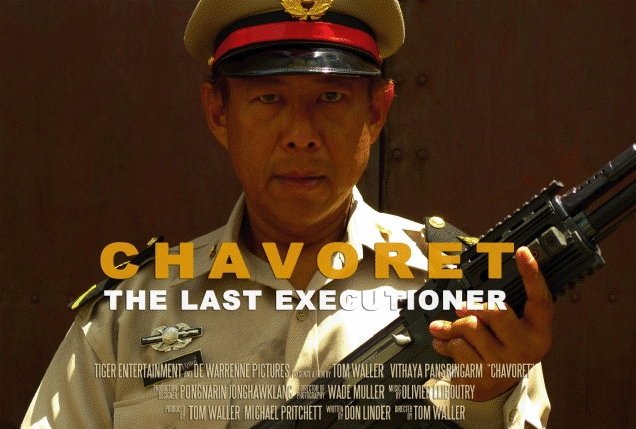
TF: You were a drinking buddy of Thailand’s last executioner, Chavoret Jaruboon and attended his funeral in 2012 after he died of cancer. Chavoret was personally responsible for executing 55 inmates. I understand a movie about his life has just been released; can you tell me about it?

lastexecutioner

JA: I just reviewed the film for the Bangkok Post. (Biopic Takes No Prisoners) It’s a pretty accurate depiction of his life from being a teenage rock ‘n’ roller to becoming a prison guard, so he could take care of his family, and then working his way up to executioner. As I mentioned in the review, “conflicted characters make the best protagonists and hinges for dramatic tension,” so that’s why I’ve written about him in Bizarre Thailand: Tales of Crime, Sex and Black Magic, as well as the Phantom Lover collection. He was a fascinating man,  deeply tormented by guilt and karma, but in Thailand, and this is not mentioned in either the film or in my books, the executioner can be seen as an heroic figure, too, freeing prisoners from their bad karma to be reborn again. Tellingly, the death chamber at Bang Kwang Central Prison is referred to in Buddhist terms as the “room to end all suffering.”

TF: Any plans for the Year of the Horse?

JA: As with every previous year I am trying really hard not to die, and to finish some new books and a bunch of stories. Here it is July already and I’m still breathing, making toast and typing words on a keyboard, so I take these gifts as good omens.

TF: I’ll toast to all that. Thanks, Jim.

ALgie One Foot

An inquisitive Jim Algie

For more information about Jim Algie and his writings go to: www.jimalgie.club


CityLife
This post may also be seen at Chiang Mai City News by clicking the above banner


Leave a comment

(Photography by Eric Nelson)

Introduction by Kevin Cummings

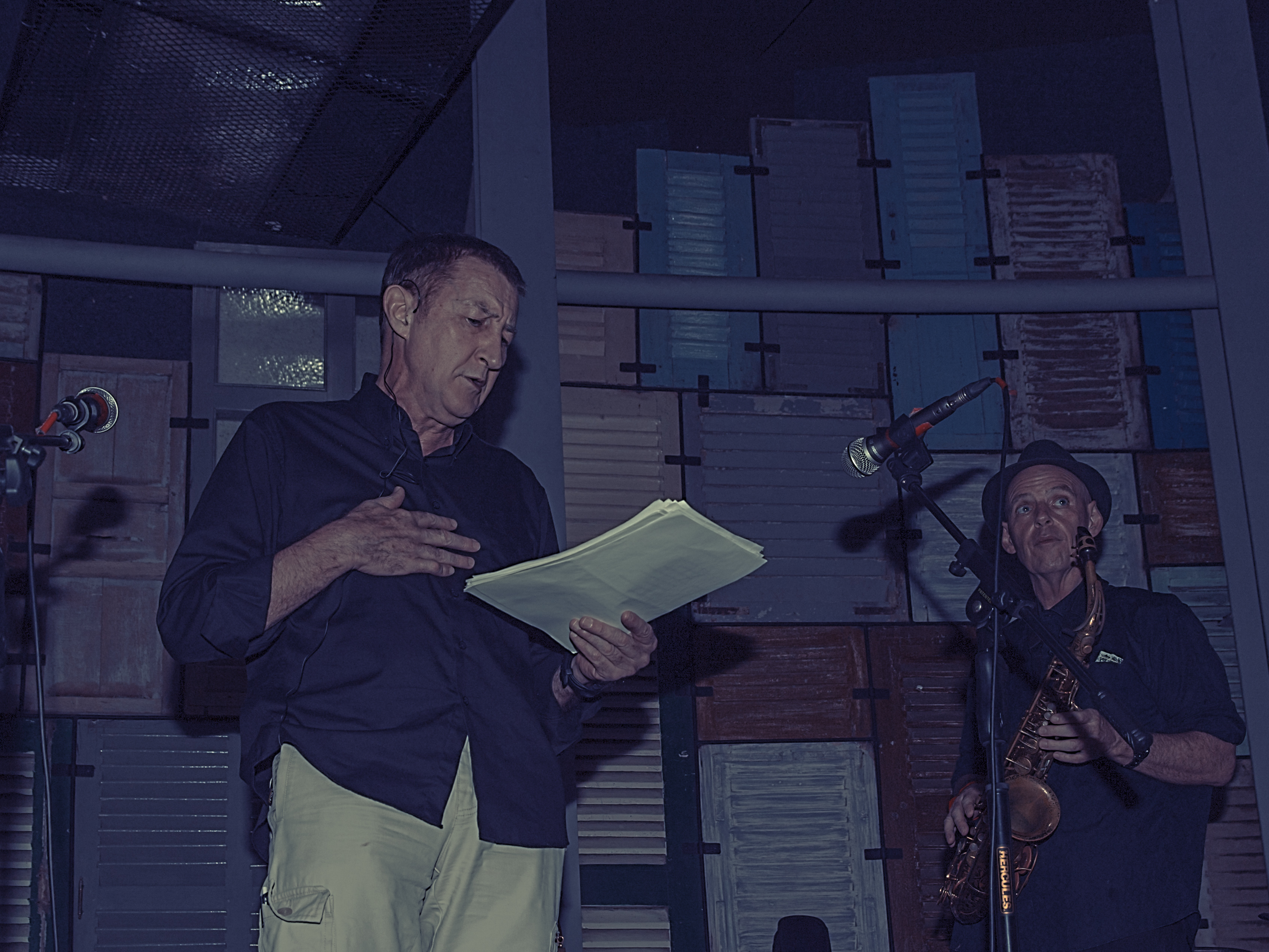
I offer a short introduction to a superb long piece written by performance poet, John Gartland. For those taking the journey to the end, a reward awaits. For those who don’t you were not the intended audience. And that is okay. The focus of the writing is poetry and two performances John Gartland gave in Phnom Penh, Cambodia on May 31st and June 1st of 2014. On the latter date Christopher Minko and saxophonist Jimmy B were musical accompaniment at the renowned Meta House.

Things are as they are. Looking out into the universe at night, we make no comparisons between right and wrong stars, nor between well and badly arranged constellations.

Alan Watts

JOHN GARTLAND IN PHNOM PENH: POET AS PROJECTIONIST


From…..POETRY ESCAPES DURING QUESTIONING.

Formerly, the better‑prepared students of literature

absorbed some well‑turned definitions of the art.

Quotations from Aristotle’s Poetics, Coleridge and Keats;

some gem of Wordsworthian self‑examination,

or glittering couplets from Pope;

an apercu from Hazlitt;

enough poetic rope to hang out any sensibility to dry.


Now, having been de‑constructed,

they lie in pieces like self‑assembly furniture,

awaiting someone with instructions

and a tube of something undefined that,

sniffed, will make you high.

Discuss…..

2014. Two poetry readings in Phnom Penh, the first, on May 31st. as the guest of Chris Minko, and his band Krom, at Doors Club, the second, on June 1st. at Meta House Arts Centre, with Chris on guitar, and his sax sideman, Jimmy Baeck in support. Recently arrived from Bangkok, I’d been to Cambodia, before, briefly, but this was my first time in Phnom Penh.

A poetry reading is always a leap in the dark, but reading in a strange city, in a new country, where nobody’s heard you, or knows what kind of thing you do… that is like free-falling, it’s solo stuff, risky and exciting.

From…..SOCIAL FREE FALL

Abandoning the stable position

you fell through my evening

and out the other side,

still talking of sky diving

and cocaine, and trying out a new rig

(some flying aerobatic triangle

of a parachute you’d described).


You’d toss your curls

and flash a seen‑it‑all smile,

dropping in from the empyrean,

a mile still on your altimeter

and charlie in reserve.

Perhaps that’s why

I saw that flimsy triangle

bikini black, in silk; an arch,

coquettish come‑on to the sky.

And who, the hell, you may ask, listens (voluntarily) to poetry readings, anyway? Poetry? What has that got to do with anything, these days? Most people haven’t a clue what it’s for. Inscriptions on tombstones? Anthologies that induce paralysis quicker than a snakebite? So, as a visiting poet, you’re generally seen as about as relevant as a vacuum cleaner salesman in the desert. You’d better offer something of interest, pretty quickly, or they’ll be taking selfies and grooming their social network on a smartphone before you can say, “Alfred Lord Tennyson”. Challenging? I’ll say. Even hack writers dismiss poetry. They don’t generally understand it, or see any use for it. For god’s sake, what’s the point? It doesn’t even pay! Isn’t it obsolete?

Writing, and then performing your poetry, is equivalent to riding the Wall of Death in public. You’re glued to the moment by vertigo and risk, with an audience (if anyone bothered to show up) just wondering how long it will be before you fall off, and become another stain on the upholstery.

The poetic imagination is a twenty four hour newsreel of historical fragments, persistent memory and wandering orchestras, a cultural junkyard, a burned library, an amphitheatre of nameless heroes squandered in cynical enterprises. It’s fractured beauty, wounded justice, hypnotic mantras sold to gullible masses by politicians, priests and whores. It’s, lucidity, history dissolution and confusion, an epic of poisonous icons, X ray vision, contempt, defiance, sound and fury, signification and nothingness. It’s free-fall joy, love, and, of course, death. It’s, non-stop …

                      PROCESSING

Of all the landmarks of the Forbidden City

which embellish this ruined quarter,

the Tower of Yearning still crackles

with lonely life.

Stored hereabouts is Dowland’s Lachrimae

and other melancholy data.

Here, gloomy church interiors,

journals of half‑forgotten wars

and maps of vanished cities crowd

the great soliloquies.

There, a Roman amphitheatre

vibrating to the late quartets,

a pocketful of lunar rubble,

huge with silence, older than God.

For ages, keeping this from crumbling

into other data, bleeding into becoming,

I’ve tried sealing off the entire sector.


But it leaks remembrance, unconsoled;

like old reactor rivets,

hot for another quarter million years.

When they give me my exit ticket, no need to say I was a worker in chemical factories, warehouses, steel mills, or was a student of Shakespeare, and Elizabethan drama, a driver, sales director, professor,  father,  swimmer, traveler, radical …. Just say, “Poet”.

It’s a life which is critique and  concert, never still, never bored; irreligious and holy, outrageous and awed.


from…The Market in Cheongju. Night


A spring night in Cheongju.

A thousand mysteries

in the elixir of cold oranges.

Korean seamstress in the closing market,

floor littered with remnants of others’ finery,

your head is bowed, machining quiet hours

into a wrap of restfulness we slip on

like a comfortable coat.

We stare, the dreaming needle flies,

and you, peace-working,

never lift your eyes.


Chris Coles Wired Phnom Penh

 WIRED – A photograph in Phnom Penh by Chris Coles

A thousand obscure roads, a portfolio of oceans, crossed beneath skeptical stars, a jostle of passport stamps and a trove of encounters; love, and loss, history given an individual voice. The phantom of ambiguity is the keynote of poetry ….

From… LETTER TO JOHN WILSON

Vancouver Island. From this window at the forest’s edge, enjoy the

view; green, timbered islands, miles of glittering ocean,  way back to

B.C.’s. Pacific coast.  Sal manages the cement plant and plays a mean

jazz keyboard; fought with Castro and his forces in the old days.

When Batista and his cronies fell, he get another job, to run the

Ministry of Oil Resources, for Fidel. This long afternoon spent

drinking brandy, in a kind of seminar on jazz piano styles, George

Shearing through Thelonius Monk… I got more than a little drunk

but listened to the tale he had to tell.

Krom_Phnom Penh_Cambodia_mag_2014_154-Edit 4

John Gartland in Phnom Penh, Cambodia (Photograph by Steve Porte)

So, to Cambodia, many tales, and treks later; processing a new city, arriving through shabby, crumbling outskirts, still haunted with nightmare. The newsreel is running, projected on the trappings of modernity, on the cafes,  the sudden, lockdown traffic  jams, the insect swarms of motorcycles. Fear still occasionally crackles like background radiation; for, just decades ago,  a black hole of communist terror sucked in civilization here.  Often during my trip, there will be flashbacks of the torture and ideological madness imposed on these people by Paris-educated marxists; ideologues whose social engineering killed twenty-five percent of Cambodia’s population, and who made murderers and torturers out of children.

Their psychological clones, armchair commissars, infect the internet, with the same po-faced certainties. Mountains of victims’ skulls in Pol Pot’s  blood-spattered torture centres are not allowed to sway glib Marxist certainties. When their political correctness is questioned, wait for reflexive smears straight out of Mao’s little red catechism. Mao was better at mass murder than Pol Pot; he killed some thirty million in the “Cultural Revolution”. When I was working in South Korea, I also met, and talked with refugees from the North Korean communist madhouse, with its death camps, starvation and terror. Sound like a  familiar marxist recipe? They understand the communist’s “inevitability of history” there, all right. It long ago morphed into the inevitability of tyranny. The  blood-stained newsreel is still  running,  and running….

Yes, Phnom Penh is a haunted house, a puzzle palace full of tormented shadows; but the survivors have their face forward. The night is Noir. The streets are busy, and the music is played loud in the big, crowded night- space and girlie bars  of the Beer Garden, Phnom Penh’s sexual equivalent of a food court. At the height of the proceedings, the beat seems loud enough to drown the collective memory; loud enough for an exorcism; and the beat goes on..


2:00 A.M. Street 51 Phnom Penh by Chris Coles
 
Anna Jet


Anna glides among the drinkers

and her girls at Anna Jet.

The customers pay tribute with their eyes.

Her girls are young,

available and beautiful, and yet,

as she irradiates the storyline

of evening with her smile,

and lets her hand rest lightly

on some shoulder for a while,

her backless dress of silken gold’s

as tight as gilt upon

an art collector’s statuette.


Her girls are young,

available, and beautiful and yet,

it’s Anna with her silken style

who dances in the memory

while we cross the floating world

to Anna Jet.


Hot night, the bar that’s open

to the dealings of the street,

the techno music, short-time girls,

a DJ who is seemingly determined

to defeat our death in this

sublime apotheosis of the dance.


I think of Wagner talking about Beethoven

and glance at strangers

rediscovering their stolen lives.

Here in the floating world, the dream survives;

drink deep, and dance, and banish sleep

for Anna shines among her girls

like some erotic statuette,

and it’s always short-time, you can bet,

golden short-time.


And the bass is driving nails

into the past in Anna Jet.

Minko

Chris Minko is a laid back Australian expat, a musical perfectionist, who, in Phnom Penh, has put together his unique band, Krom. Chris’s ornate guitar style, originally inspired by John Fahey’s work, interweaves with the eloquent sax of Jimmy Baeck, and the exquisite Khmer vocals of Sophea Chamroeun and Sopheak Chamroeun. There’s something haunting and addictive about Krom’s music. It’s poignant, often, almost impossibly beautiful, but the material the band covers in songs, both English and Khmer, is dark and jagged. It’s a yearning and wounded blues that tells of the exploited and the abandoned. It is a multi-layered “noir” music, growing directly out of the Khmer landscape. And it’s fed by both its idyllic beauty and its hellish years under totalitarianism. Chris, who, in another incarnation, does invaluable work rehabilitating victims of Cambodian land mines, calls it, “Mekong Delta Blues”. It’s a unique sound from a unique band; music that speaks for our time, music that grabs you by the heart, and doesn’t let you go.

MinkoKrom1

SLIDE


The heart’s manifesto

cradled in static,

her smell on your sheets,

and a hurt

automatic as waking.

Hypnotic the highway,

uncaring the ground,

the clichés of loneliness

fresh as a wound.

And a dawn cut with death

and the blue fog of yearning;

the slide of her absence,

the dirge of a steel string.


Here I am again, I’ve just once more done the artistic equivalent of jumping through the aircraft door, and stepped forward to the microphone to read, on a new planet, but with the familiar excitement. It’s the Doors club, Phnom Penh, and I’m reading some of my poetry before the Krom gig, on the last night of May. Alongside are Chris and Jimmy, injecting their musical expertise, to add to the impact of the poetry (poetry and music is a formidable cocktail) “Why, poetry?” You know someone is asking; no time for questions now. It’s time to DO poetry.

Krom_Phnom Penh_Cambodia_mag_2014_134-Edit 2

John Gartland and Jimmy B (Photograph by Steve Porte)

From…….WEIGHTLESS

He’s got a quiet excitement, here alone,

sky-diver in the free-fall door;

his rig is clean, his harness is secure,

breathing a chill promise of vacant heaven,

new life composed before him on

earth’s tilting manuscript.

I wave, and he is gone.

The lonely rush; the poetry of falling

cuts away the nondescript.


June 1st, The Meta House reading; blessed with an excellent audience. A fine, spacious upstairs room with good acoustics and an adjacent bar. Poetic free-fall…. You’ve got the audience hooked, your newsreel is running. You, for “your masterpiece of minutes”, are part of that select band, that Shelley called, ” the unacknowledged legislators of the world”. You’re the voice of poetry. You’re not on anybody’s payroll; nobody owns your words. Your skills don’t go whoring with P.R. cut throats or advertising copy writers. You serve the art, and what Leavis, the English critic, once called, “The Great Tradition”. You stand “… on the shoulders of giants” (to borrow Newton’s words)  and there’s no need to explain, here at least, to sleepwalkers and pygmies, that there’s something more to life than football and shopping.


from…… PRESTON TO PINNACLE HILL


Autumnal fire across the ancient scarp

would break a landscape painter’s heart.

Your masterpiece of minutes soon is gone,

but  you, a breathless audience of one

for several moments have it stark and clear.

The puzzle palace vanishes, the moon looks on,

and this is why you’re here. The air bites:

you race the thrilling onset of the dark.


That is our life; a constant race against , “the onset of the dark”; the darkness of dusk, or the advancing darkness of our own mortality. Equally, it’s a race against the darkness of fanaticism, that pitchy, scream-haunted nightfall of tyranny. Here in Phnom Penh, the untold stories of lives destroyed by communist zealots, and  the sense of all humanity degraded by their brutality, ripple like feedback behind the House music, the  partying and the pole dancing hookers.  When it comes down to it, and life throws the big issues at us, when we try to come to some terms with that madness, don’t look to the self-interested falsehoods of PR men or advertising hacks. You’ll need the utterances of poetry. You’ll need ..……….

THE COMPANY OF POETS


You’ve heard a kind of clown

dismissing  poetry,

as rarefied and precious, not real life;

till, cut and sliced by love’s

exquisite and inexorable knife,

he’ll find the bottle comfortless enough,

and fumble in his misery for rhyme.


Still craving for some vanished stuff of rapture,

attempting to contain the heart’s decline,

and learning there’s no science that will capture

or can resurrect a passion. It’s a sign that life

will seek out rhythms, incantations, dreams,

to celebrate its stature, and  to wonder at itself.

Each dances, in his fashion, to that driving score it seems;

but poets live the fuller, by their nature, beating time.


And I’ll seek out the company of poets,

the company of poets I’ll make mine.

When poetry has bitten you you’ll know it;

it’s just an arc of words but in the overall design

of things, there’s everything in life laid out below it;

from birth to love, and death, and celebration;

and before the robot reaper  can consign

you to your headstone you will ride imagination’s

launcher high above the milling cities,

be the Process speaking, for a time.


So I’ll seek out the company of poets,

the company of poets I’ll make mine.

They’re taking passion’s pulse

and they are signalling the future,

they’ve freedom for a mistress

and they’ve history for a tutor,

and they can image water into wine.

Each new day is their holy book,

and apparatchiks hate them

for scoffing at all priesthoods

while embracing the divine.

So give to me the company of poets,

the company of poets I’ll make mine.


Those black flags of mourning, who better to fly them?

The tender intrigues of the aspirant heart,

that life-shaking love that you have for your children,

how better to tell them? Where better to start?

Where else but the company of poets?

whose alchemical pilgrimage sets them apart…

Where else but the company of poets?

Those ephemeral fires of the beacon lights,

on the century’s headlands, glowing;

like poems, are markers we leave to rite

our passage and our going.

Bright seeds on the wind that flower despite

the perennial cloud of unknowing,

and they’re sown by the company of poets,

the indelible company of poets.


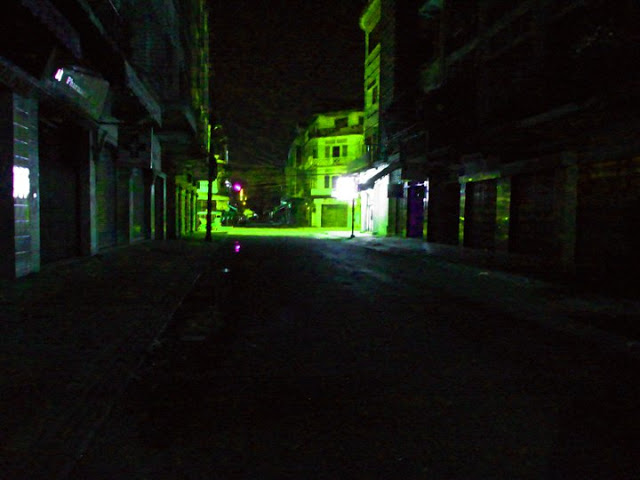
Chris Coles Phnom Penh Street at Night

 Phnom Penh Night by Chris Coles

John Gartland is returning to Phnom Penh in November, 2014 to work again with Chris Minko, and to read at Meta House and elsewhere. Krom’s forthcoming new album, “Mekong Delta Blues” will feature a track, with the lyric by John Gartland and music by Chris Minko.

Find more of his poetry at the Facebook page, Poetry Universe,  and the website  below. Some of his published works, now out of print, such as “Gravity’s Fool” (2009: Fourth edition) can be downloaded from his website, where tracks from his audio album, “Hologram Heart”  (2014) can also be heard, with him reading some of his poems, accompanied by top Bangkok musicians and producers, Keith Nolan and Chris Healy.

Poetry Universe has landed.

Take me to your reader….

http:www.facebook.com/pages/Poetry/Poetry-Universe/168195569406

http://www.johngartland.net
http://www.facebook.com/pages/Poetry/Poetry-Universe/168195569406


CityLife

This post may also be viewed at Chiang Mai City News by clicking the above banner.
Leave a comment