Thailand Footprint: The People, Things, Literature, and Music of Thailand and the Region

Posts by Kevin Cummings


“If I were reading a book and happened to strike a wonderful passage I would close the book then and there and go for a walk. I hated the thought of coming to the end of a good book. I would tease it along, delay the inevitable as long as possible, But always, when I hit a great passage, I would stop reading immediately. Out I would go, rain, hail, snow or ice, and chew the cud.”  Henry Miller – Plexus


Henry-Miller


 Henry Miller – The Paris Years

1 Comment
Jim Algie has done what many do not believe in and fewer still achieve. He has reincarnated himself and stayed alive in the process. The former punk rocker from Canada, known in those days as Blake Cheetah, spent eleven years playing bass guitar and touring with various bands before deciding to change careers at the tender age of twenty-eight. An age that Jimi Hendrix and Jim Morrison never reached. After a two year stint in Spain, where his focus on writing accelerated, Algie found himself in Bangkok, Thailand with the intention of heading to Taipei. In Jim’s case the road to Bangkok was paved with good intentions as Thailand has now been his home for over twenty years. During that time he did a lot of observation and investigation of all things not mundane in the kingdom. As with any good detective, he hit a few dead ends along the way. But as the saying goes, patience is its own reward. Jim Algie patiently studied what was in front of him and sought adventures off the beaten path. The outcome produced enough material to publish a variety of short stories, earning the writer several awards, including a Bram Stolker Award – a recognition presented by the Horror Writers Association for “superior achievement” in dark fantasy and horror writing.  Jim Algie has had two books traditionally published, BIZARRE THAILAND: Tales of Crime, Sex and Black Magic (Marshall Cavendish 2012) a collection of non-fiction stories and his recent collection of  fictitious writing, THE PHANTOM LOVER and Other Thrilling Tales Of Thailand (Tuttle Publishing 2014). Jim’s also an accomplished journalist, editor and travel writer; he has contributed to many periodicals and travel guidebooks. Jim  is the author of “Tuttle Travel Pack Thailand.” I am pleased to welcome Jim Algie here today.
.
Algie2000
TF: What makes Southeast Asia a good setting for writing?
.

JA: It’s all the myriad paradoxes and extreme juxtapositions. You’ve got these ancient sites like Angkor Wat and the Temple of Dawn, as well as hyper modern malls; there’s incredible hospitality jostling with every sort of barbarity; you’ve got arcane superstitions counterbalanced by a whole new wave of thinkers and artists; some of the most colourful festivals I have ever seen in stunning contrast to the shabbiest urban blight. And then there’s the hotpot of ethnicities and all sorts of eccentric expats. So you’re never short of stories, backdrops and characters.

TF: What books and or music  influenced you growing up?

JA: My first writing influences were Edgar Allan Poe and Jack London. My taste in tunes also strayed towards the darker side of the spectrum, with Alice Cooper, Black Sabbath and the New York Dolls leading the savage wolf pack. Even today I still revere those bands and authors.

TF: What’s the last record you can remember listening to?

JA: I’ve been listening to Wilco again, and their scandal-plagued magnum opus, Yankee Hotel Foxtrot. It’s one of those rare instances when a group actually took no shit from the corporate rectums of the music business. Their label dropped them because they thought the album was anti-commercial, then the band sold it back to a different subsidiary of the same company for even more money and it became the biggest-selling album of their career. To my ears, Wilco is the best American band of the past 20 years, and Jeff Tweedy is America’s greatest singer and songwriter since the late Kurt Cobain and Paul Westerberg of The Replacements.

TF: Tell our readers about the musical chapters of your life. Your ability allowed you to travel a bit. Where did you go? What did you experience that stays with you from that time?

JA: For the first out-of-town shows we played with a surf-punk band called the Malibu Kens, we had to drive 200 miles to the city of Calgary in western Canada, to play four sets a night for seven nights in a row at a skidrow tavern called The Calgarian to largely hostile or indifferent crowds of truckers, junkies, alkies, wretched-looking prostitutes and a few punks who also hung out there. All four of us stayed in a small, mildew-smelling room, full of silverfish and other vermin, in the hotel. During one gig, a guy got stabbed to death in the bathroom and his bloody handprints could be seen on the walls for months afterwards. Another night there was a 20-men-and-4-whores brawl in the bar with people smacking each other over the head with chairs and tables while we played. For a bunch of middle-class boys, still only 18 and 19, that was our indoctrination – our baptism of hellfire – and real life on the dark side of the street.

Blake Cheetah

Jim Algie (far right) during his Blake Cheetah days

TF: Is there a book laying around your home that you haven’t gotten around to reading?

JA: Many, but the new biography of China’s Great Reformer, Deng Xiaping, is especially huge and daunting.

TF: Complete this sentence.  I write to

JA:  … communicate something to the world and myself that cannot be communicated in any other way or through any other medium.

TF: Make the case for fiction over non-fiction in 207 words or less.

JA: What’s missing from so much journalism and non-fiction is a sense of humanism and heart. When journalists strain for superlatives they resort to the same geriatric clichés about “triumphs of the human spirit” or “tragic demises” or “losing battles against cancer” while labeling serial murderers as “monsters.”  Dead language does not elicit any lively reactions. One of my favorite parts of Timothy Hallinan’s Breathing Water, a superbly suspenseful Bangkok thriller in his Poke Rafferty series, is how the Thai cop and his wife deal with her terminal illness. In journalism these days, human-interest stories are disappearing in place of celebrity gossip and business stories. By contrast all great works of fiction put people first and human concerns at their core.

To borrow another example from Breathing Water, Tim has a great paragraph about how the light in Bangkok around dusk, which is the protagonist’s favorite time of day and mine too, changes about five different times. I sensed that was true, but it really opened my eyes to something that I hadn’t seen before. In this way, fiction and poetry enrich our lives and perceptions. By contrast, in most non-fiction – except for maybe memoirs – the editor would cut all those descriptive details as irrelevant.

TF: Tell us about your latest collection of stories, The Phantom Lover and Other Thrilling Tales of Thailand, and why book lovers should read it?

phantom-lover-455JA: If they don’t read it I can’t say their lives will be greatly impoverished or they will come down with any loathsome diseases, but those who are interested in Thailand and SE Asia will find a different set of stories and characters, often with Thai protagonists, that deliver some different insights into the lives of young high-society women, ancient folklore with modern twists, the rural downtrodden, and what will probably remain the biggest natural disaster of our lifetimes, the 2004 Asian tsunami.

TF: Please tell me about your current favorite dead author.

JA: Raymond Carver. I just reread a kind of greatest hits’ collection of his short fiction called Where I’m Calling From. He was the most heralded short fiction author when I was studying Creative Writing in the late 80s. So I wanted to revisit those stories to see how he achieved those incredible effects with the most unadorned prose and lack of sensationalism combined with very ordinary characters caught up in entirely plausible situations. “Errand,” his story about the death of Anton Chekhov, whom was the writer he was most often compared to, and which he wrote while dying of a similar disease, is one of the great masterpieces of contemporary literature. It’s most likely way beyond anything I could ever achieve, but there’s no point in aspiring to mediocrity. There’s already enough of that on TV as it is.

TF: What is your approach for a book launch? You’ve had two now – for Bizarre Thailand and The Phantom Lover. Were they similar or different?

JA: I am not an orator. I don’t do readings or impersonations. So my approach is similar. I present a slide show of travel pics, book covers, personal shots, “Hell Money Banknotes” from the Chinese Festival of the Hungry Ghosts, and talk about all sorts of influences that were melded together to form some of the stories, from serial slayers like Ted Bundy and Jeffrey Dahmer, to lesbian erotica, European artworks, snake-handling shows in Thailand and black magic from the time of Angkor Wat.

Jim Algie Shadow

Jim Algie and shadow at The Phantom Lover Book Launch at WTF Bar

TF: Let’s talk about shadows and demons.  Just because they are fun to discuss. How important are they to a writer? Are they one and the same thing? Should a writer have demons of his own in order to create fictional ones? If a writer hasn’t struggled with his shadows or demons is he/she in denial? 

JA: Everyone has their own shadows and demons. Since we can’t talk about them in polite company we have to find other outlets like books, music, TV shows and films. From any artist’s perspective the demons are slippery and the shadows immaterial, so they are not easy to write or sing about. Either it comes off like macho bravado or like self-pitying whining. Ultimately, you need to strike a balance between the two and not give any easy solutions or sermons about conquering them. For the most part, I try to stay away from those first-person confessional sorts of stories, though I did write one long novella, “Obituary for the Khaosan Road Outlaws and Imposters,” in the last book that features some demon wrestling and shadow hunting.

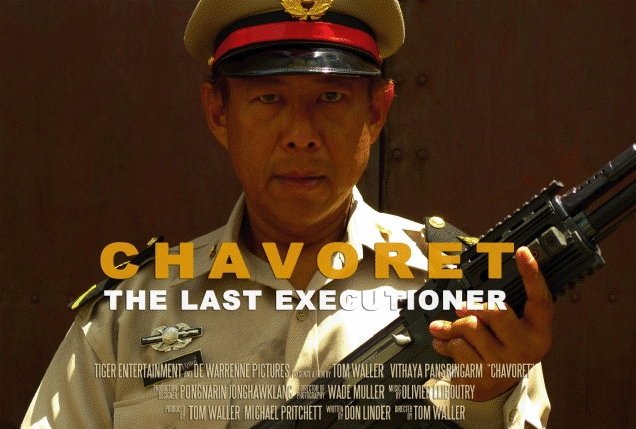
TF: You were a drinking buddy of Thailand’s last executioner, Chavoret Jaruboon and attended his funeral in 2012 after he died of cancer. Chavoret was personally responsible for executing 55 inmates. I understand a movie about his life has just been released; can you tell me about it?

lastexecutioner

JA: I just reviewed the film for the Bangkok Post. (Biopic Takes No Prisoners) It’s a pretty accurate depiction of his life from being a teenage rock ‘n’ roller to becoming a prison guard, so he could take care of his family, and then working his way up to executioner. As I mentioned in the review, “conflicted characters make the best protagonists and hinges for dramatic tension,” so that’s why I’ve written about him in Bizarre Thailand: Tales of Crime, Sex and Black Magic, as well as the Phantom Lover collection. He was a fascinating man,  deeply tormented by guilt and karma, but in Thailand, and this is not mentioned in either the film or in my books, the executioner can be seen as an heroic figure, too, freeing prisoners from their bad karma to be reborn again. Tellingly, the death chamber at Bang Kwang Central Prison is referred to in Buddhist terms as the “room to end all suffering.”

TF: Any plans for the Year of the Horse?

JA: As with every previous year I am trying really hard not to die, and to finish some new books and a bunch of stories. Here it is July already and I’m still breathing, making toast and typing words on a keyboard, so I take these gifts as good omens.

TF: I’ll toast to all that. Thanks, Jim.

ALgie One Foot

An inquisitive Jim Algie

For more information about Jim Algie and his writings go to: www.jimalgie.club


CityLife
This post may also be seen at Chiang Mai City News by clicking the above banner


Leave a comment

(Photography by Eric Nelson)

Introduction by Kevin Cummings

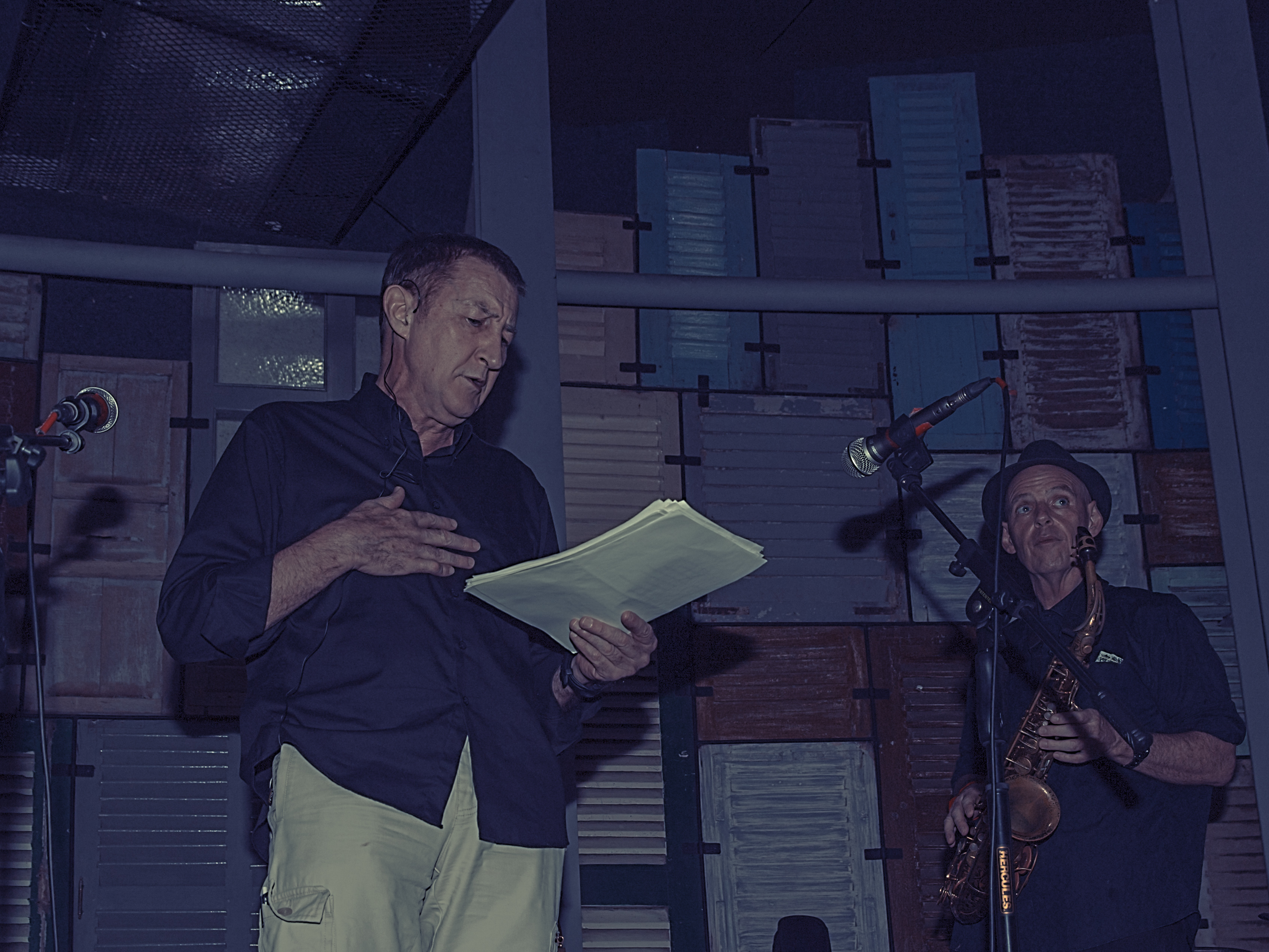
I offer a short introduction to a superb long piece written by performance poet, John Gartland. For those taking the journey to the end, a reward awaits. For those who don’t you were not the intended audience. And that is okay. The focus of the writing is poetry and two performances John Gartland gave in Phnom Penh, Cambodia on May 31st and June 1st of 2014. On the latter date Christopher Minko and saxophonist Jimmy B were musical accompaniment at the renowned Meta House.

Things are as they are. Looking out into the universe at night, we make no comparisons between right and wrong stars, nor between well and badly arranged constellations.

Alan Watts

JOHN GARTLAND IN PHNOM PENH: POET AS PROJECTIONIST


From…..POETRY ESCAPES DURING QUESTIONING.

Formerly, the better‑prepared students of literature

absorbed some well‑turned definitions of the art.

Quotations from Aristotle’s Poetics, Coleridge and Keats;

some gem of Wordsworthian self‑examination,

or glittering couplets from Pope;

an apercu from Hazlitt;

enough poetic rope to hang out any sensibility to dry.


Now, having been de‑constructed,

they lie in pieces like self‑assembly furniture,

awaiting someone with instructions

and a tube of something undefined that,

sniffed, will make you high.

Discuss…..

2014. Two poetry readings in Phnom Penh, the first, on May 31st. as the guest of Chris Minko, and his band Krom, at Doors Club, the second, on June 1st. at Meta House Arts Centre, with Chris on guitar, and his sax sideman, Jimmy Baeck in support. Recently arrived from Bangkok, I’d been to Cambodia, before, briefly, but this was my first time in Phnom Penh.

A poetry reading is always a leap in the dark, but reading in a strange city, in a new country, where nobody’s heard you, or knows what kind of thing you do… that is like free-falling, it’s solo stuff, risky and exciting.

From…..SOCIAL FREE FALL

Abandoning the stable position

you fell through my evening

and out the other side,

still talking of sky diving

and cocaine, and trying out a new rig

(some flying aerobatic triangle

of a parachute you’d described).


You’d toss your curls

and flash a seen‑it‑all smile,

dropping in from the empyrean,

a mile still on your altimeter

and charlie in reserve.

Perhaps that’s why

I saw that flimsy triangle

bikini black, in silk; an arch,

coquettish come‑on to the sky.

And who, the hell, you may ask, listens (voluntarily) to poetry readings, anyway? Poetry? What has that got to do with anything, these days? Most people haven’t a clue what it’s for. Inscriptions on tombstones? Anthologies that induce paralysis quicker than a snakebite? So, as a visiting poet, you’re generally seen as about as relevant as a vacuum cleaner salesman in the desert. You’d better offer something of interest, pretty quickly, or they’ll be taking selfies and grooming their social network on a smartphone before you can say, “Alfred Lord Tennyson”. Challenging? I’ll say. Even hack writers dismiss poetry. They don’t generally understand it, or see any use for it. For god’s sake, what’s the point? It doesn’t even pay! Isn’t it obsolete?

Writing, and then performing your poetry, is equivalent to riding the Wall of Death in public. You’re glued to the moment by vertigo and risk, with an audience (if anyone bothered to show up) just wondering how long it will be before you fall off, and become another stain on the upholstery.

The poetic imagination is a twenty four hour newsreel of historical fragments, persistent memory and wandering orchestras, a cultural junkyard, a burned library, an amphitheatre of nameless heroes squandered in cynical enterprises. It’s fractured beauty, wounded justice, hypnotic mantras sold to gullible masses by politicians, priests and whores. It’s, lucidity, history dissolution and confusion, an epic of poisonous icons, X ray vision, contempt, defiance, sound and fury, signification and nothingness. It’s free-fall joy, love, and, of course, death. It’s, non-stop …

                      PROCESSING

Of all the landmarks of the Forbidden City

which embellish this ruined quarter,

the Tower of Yearning still crackles

with lonely life.

Stored hereabouts is Dowland’s Lachrimae

and other melancholy data.

Here, gloomy church interiors,

journals of half‑forgotten wars

and maps of vanished cities crowd

the great soliloquies.

There, a Roman amphitheatre

vibrating to the late quartets,

a pocketful of lunar rubble,

huge with silence, older than God.

For ages, keeping this from crumbling

into other data, bleeding into becoming,

I’ve tried sealing off the entire sector.


But it leaks remembrance, unconsoled;

like old reactor rivets,

hot for another quarter million years.

When they give me my exit ticket, no need to say I was a worker in chemical factories, warehouses, steel mills, or was a student of Shakespeare, and Elizabethan drama, a driver, sales director, professor,  father,  swimmer, traveler, radical …. Just say, “Poet”.

It’s a life which is critique and  concert, never still, never bored; irreligious and holy, outrageous and awed.


from…The Market in Cheongju. Night


A spring night in Cheongju.

A thousand mysteries

in the elixir of cold oranges.

Korean seamstress in the closing market,

floor littered with remnants of others’ finery,

your head is bowed, machining quiet hours

into a wrap of restfulness we slip on

like a comfortable coat.

We stare, the dreaming needle flies,

and you, peace-working,

never lift your eyes.


Chris Coles Wired Phnom Penh

 WIRED – A photograph in Phnom Penh by Chris Coles

A thousand obscure roads, a portfolio of oceans, crossed beneath skeptical stars, a jostle of passport stamps and a trove of encounters; love, and loss, history given an individual voice. The phantom of ambiguity is the keynote of poetry ….

From… LETTER TO JOHN WILSON

Vancouver Island. From this window at the forest’s edge, enjoy the

view; green, timbered islands, miles of glittering ocean,  way back to

B.C.’s. Pacific coast.  Sal manages the cement plant and plays a mean

jazz keyboard; fought with Castro and his forces in the old days.

When Batista and his cronies fell, he get another job, to run the

Ministry of Oil Resources, for Fidel. This long afternoon spent

drinking brandy, in a kind of seminar on jazz piano styles, George

Shearing through Thelonius Monk… I got more than a little drunk

but listened to the tale he had to tell.

Krom_Phnom Penh_Cambodia_mag_2014_154-Edit 4

John Gartland in Phnom Penh, Cambodia (Photograph by Steve Porte)

So, to Cambodia, many tales, and treks later; processing a new city, arriving through shabby, crumbling outskirts, still haunted with nightmare. The newsreel is running, projected on the trappings of modernity, on the cafes,  the sudden, lockdown traffic  jams, the insect swarms of motorcycles. Fear still occasionally crackles like background radiation; for, just decades ago,  a black hole of communist terror sucked in civilization here.  Often during my trip, there will be flashbacks of the torture and ideological madness imposed on these people by Paris-educated marxists; ideologues whose social engineering killed twenty-five percent of Cambodia’s population, and who made murderers and torturers out of children.

Their psychological clones, armchair commissars, infect the internet, with the same po-faced certainties. Mountains of victims’ skulls in Pol Pot’s  blood-spattered torture centres are not allowed to sway glib Marxist certainties. When their political correctness is questioned, wait for reflexive smears straight out of Mao’s little red catechism. Mao was better at mass murder than Pol Pot; he killed some thirty million in the “Cultural Revolution”. When I was working in South Korea, I also met, and talked with refugees from the North Korean communist madhouse, with its death camps, starvation and terror. Sound like a  familiar marxist recipe? They understand the communist’s “inevitability of history” there, all right. It long ago morphed into the inevitability of tyranny. The  blood-stained newsreel is still  running,  and running….

Yes, Phnom Penh is a haunted house, a puzzle palace full of tormented shadows; but the survivors have their face forward. The night is Noir. The streets are busy, and the music is played loud in the big, crowded night- space and girlie bars  of the Beer Garden, Phnom Penh’s sexual equivalent of a food court. At the height of the proceedings, the beat seems loud enough to drown the collective memory; loud enough for an exorcism; and the beat goes on..


2:00 A.M. Street 51 Phnom Penh by Chris Coles
 
Anna Jet


Anna glides among the drinkers

and her girls at Anna Jet.

The customers pay tribute with their eyes.

Her girls are young,

available and beautiful, and yet,

as she irradiates the storyline

of evening with her smile,

and lets her hand rest lightly

on some shoulder for a while,

her backless dress of silken gold’s

as tight as gilt upon

an art collector’s statuette.


Her girls are young,

available, and beautiful and yet,

it’s Anna with her silken style

who dances in the memory

while we cross the floating world

to Anna Jet.


Hot night, the bar that’s open

to the dealings of the street,

the techno music, short-time girls,

a DJ who is seemingly determined

to defeat our death in this

sublime apotheosis of the dance.


I think of Wagner talking about Beethoven

and glance at strangers

rediscovering their stolen lives.

Here in the floating world, the dream survives;

drink deep, and dance, and banish sleep

for Anna shines among her girls

like some erotic statuette,

and it’s always short-time, you can bet,

golden short-time.


And the bass is driving nails

into the past in Anna Jet.

Minko

Chris Minko is a laid back Australian expat, a musical perfectionist, who, in Phnom Penh, has put together his unique band, Krom. Chris’s ornate guitar style, originally inspired by John Fahey’s work, interweaves with the eloquent sax of Jimmy Baeck, and the exquisite Khmer vocals of Sophea Chamroeun and Sopheak Chamroeun. There’s something haunting and addictive about Krom’s music. It’s poignant, often, almost impossibly beautiful, but the material the band covers in songs, both English and Khmer, is dark and jagged. It’s a yearning and wounded blues that tells of the exploited and the abandoned. It is a multi-layered “noir” music, growing directly out of the Khmer landscape. And it’s fed by both its idyllic beauty and its hellish years under totalitarianism. Chris, who, in another incarnation, does invaluable work rehabilitating victims of Cambodian land mines, calls it, “Mekong Delta Blues”. It’s a unique sound from a unique band; music that speaks for our time, music that grabs you by the heart, and doesn’t let you go.

MinkoKrom1

SLIDE


The heart’s manifesto

cradled in static,

her smell on your sheets,

and a hurt

automatic as waking.

Hypnotic the highway,

uncaring the ground,

the clichés of loneliness

fresh as a wound.

And a dawn cut with death

and the blue fog of yearning;

the slide of her absence,

the dirge of a steel string.


Here I am again, I’ve just once more done the artistic equivalent of jumping through the aircraft door, and stepped forward to the microphone to read, on a new planet, but with the familiar excitement. It’s the Doors club, Phnom Penh, and I’m reading some of my poetry before the Krom gig, on the last night of May. Alongside are Chris and Jimmy, injecting their musical expertise, to add to the impact of the poetry (poetry and music is a formidable cocktail) “Why, poetry?” You know someone is asking; no time for questions now. It’s time to DO poetry.

Krom_Phnom Penh_Cambodia_mag_2014_134-Edit 2

John Gartland and Jimmy B (Photograph by Steve Porte)

From…….WEIGHTLESS

He’s got a quiet excitement, here alone,

sky-diver in the free-fall door;

his rig is clean, his harness is secure,

breathing a chill promise of vacant heaven,

new life composed before him on

earth’s tilting manuscript.

I wave, and he is gone.

The lonely rush; the poetry of falling

cuts away the nondescript.


June 1st, The Meta House reading; blessed with an excellent audience. A fine, spacious upstairs room with good acoustics and an adjacent bar. Poetic free-fall…. You’ve got the audience hooked, your newsreel is running. You, for “your masterpiece of minutes”, are part of that select band, that Shelley called, ” the unacknowledged legislators of the world”. You’re the voice of poetry. You’re not on anybody’s payroll; nobody owns your words. Your skills don’t go whoring with P.R. cut throats or advertising copy writers. You serve the art, and what Leavis, the English critic, once called, “The Great Tradition”. You stand “… on the shoulders of giants” (to borrow Newton’s words)  and there’s no need to explain, here at least, to sleepwalkers and pygmies, that there’s something more to life than football and shopping.


from…… PRESTON TO PINNACLE HILL


Autumnal fire across the ancient scarp

would break a landscape painter’s heart.

Your masterpiece of minutes soon is gone,

but  you, a breathless audience of one

for several moments have it stark and clear.

The puzzle palace vanishes, the moon looks on,

and this is why you’re here. The air bites:

you race the thrilling onset of the dark.


That is our life; a constant race against , “the onset of the dark”; the darkness of dusk, or the advancing darkness of our own mortality. Equally, it’s a race against the darkness of fanaticism, that pitchy, scream-haunted nightfall of tyranny. Here in Phnom Penh, the untold stories of lives destroyed by communist zealots, and  the sense of all humanity degraded by their brutality, ripple like feedback behind the House music, the  partying and the pole dancing hookers.  When it comes down to it, and life throws the big issues at us, when we try to come to some terms with that madness, don’t look to the self-interested falsehoods of PR men or advertising hacks. You’ll need the utterances of poetry. You’ll need ..……….

THE COMPANY OF POETS


You’ve heard a kind of clown

dismissing  poetry,

as rarefied and precious, not real life;

till, cut and sliced by love’s

exquisite and inexorable knife,

he’ll find the bottle comfortless enough,

and fumble in his misery for rhyme.


Still craving for some vanished stuff of rapture,

attempting to contain the heart’s decline,

and learning there’s no science that will capture

or can resurrect a passion. It’s a sign that life

will seek out rhythms, incantations, dreams,

to celebrate its stature, and  to wonder at itself.

Each dances, in his fashion, to that driving score it seems;

but poets live the fuller, by their nature, beating time.


And I’ll seek out the company of poets,

the company of poets I’ll make mine.

When poetry has bitten you you’ll know it;

it’s just an arc of words but in the overall design

of things, there’s everything in life laid out below it;

from birth to love, and death, and celebration;

and before the robot reaper  can consign

you to your headstone you will ride imagination’s

launcher high above the milling cities,

be the Process speaking, for a time.


So I’ll seek out the company of poets,

the company of poets I’ll make mine.

They’re taking passion’s pulse

and they are signalling the future,

they’ve freedom for a mistress

and they’ve history for a tutor,

and they can image water into wine.

Each new day is their holy book,

and apparatchiks hate them

for scoffing at all priesthoods

while embracing the divine.

So give to me the company of poets,

the company of poets I’ll make mine.


Those black flags of mourning, who better to fly them?

The tender intrigues of the aspirant heart,

that life-shaking love that you have for your children,

how better to tell them? Where better to start?

Where else but the company of poets?

whose alchemical pilgrimage sets them apart…

Where else but the company of poets?

Those ephemeral fires of the beacon lights,

on the century’s headlands, glowing;

like poems, are markers we leave to rite

our passage and our going.

Bright seeds on the wind that flower despite

the perennial cloud of unknowing,

and they’re sown by the company of poets,

the indelible company of poets.


Chris Coles Phnom Penh Street at Night

 Phnom Penh Night by Chris Coles

John Gartland is returning to Phnom Penh in November, 2014 to work again with Chris Minko, and to read at Meta House and elsewhere. Krom’s forthcoming new album, “Mekong Delta Blues” will feature a track, with the lyric by John Gartland and music by Chris Minko.

Find more of his poetry at the Facebook page, Poetry Universe,  and the website  below. Some of his published works, now out of print, such as “Gravity’s Fool” (2009: Fourth edition) can be downloaded from his website, where tracks from his audio album, “Hologram Heart”  (2014) can also be heard, with him reading some of his poems, accompanied by top Bangkok musicians and producers, Keith Nolan and Chris Healy.

Poetry Universe has landed.

Take me to your reader….

http:www.facebook.com/pages/Poetry/Poetry-Universe/168195569406

http://www.johngartland.net
http://www.facebook.com/pages/Poetry/Poetry-Universe/168195569406


CityLife

This post may also be viewed at Chiang Mai City News by clicking the above banner.
Leave a comment

Some questions are a lot easier to answer in the affirmative than others. Recently I was asked by Philip Coggan if I could run an interview he did with one of my favorite authors, Timothy Hallinan. The interview will be run on a few blogs simultaneously.  Tim’s a great author and an all around good guy who, like me, splits his time between California and South East Asia. He has a new book out called HERBIE’S GAME. If you have not read a Timothy Hallinan book yet, now is a good time to start. If you have, you know what to expect. HERBIE’S GAME is gathering typical Hallinan rave reviews.

Herbie

HERBIE’S GAME has been chosen as one of the coming summer’s top ten thrillers by ENTERTAINMENT WEEKLY magazine and as one of the ten best thrillers for July by Amazon. It’s also been selected as an IndieNext book of the month by the U.S. association of Independent booksellers. You can read a review of HERBIE’S GAME here at BookPage.com under the heading, A Mentor’s Mystery.

Enjoy the interview with Timothy Hallinan below conducted by Philip “P.J.”Coggan and check out his Cambodia based blog, once you are finished, at pjcoggan.com

INTERVIEW WITH TIM HALLINAN

Tim Hallinan (his excellent Blog Cabin here) began his career as a writer in the 1990s with the distinctly noir Simeon Grist series. In 2007 he began a second series, set in Bangkok and featuring “rough-travel” writer Philip (“Poke”) Rafferty and his attempts to cobble together a family comprising a former go-go dancer and a precocious street urchin named Miaow. In 2011 he returned to the Los Angeles setting for third series starring Junior Bender, the best private detective a mobster could have. The second Junior,” Little Elvises”, has just been nominated for the Shamus Award as Best Private Eye Novel of 2013.

HallinanPic

 Timothy Hallinan

“Herbie’s Game”, the fourth in the Junior Bender series, will be appearing in mid-July, to be followed in November by the sixth Poke Rafftery.


  1. Tim, can you tell us a little about “Herbie’s Game”?

TH: HERBIE’S GAME is the fourth in my series of books about Junior Bender, a first-rate Los Angeles burglar who moonlights (when forced to) as a private eye for crooks.  He’s been the smartest guy in the room for most of his life, and that hasn’t gone unnoticed by the thugs in his (anti)social circle, and when one of them becomes the victim of a crime or a threat, they know they’re not going to get a sympathetic, gee-we’d-better-solve-this-tout-suite reaction from the cops, so they turn instead to Junior. What this usually means that he’s in danger of being killed by the culprit if it looks like he might succeed, on one hand, and–on the other hand–in danger of being killed by his client if he fails.  So in addition to solving the crime, Junior has to pay a lot of attention to staying alive.

In HERBIE’S GAME, a continuing character, a sort of executive crook named Wattles, finds his office burglarized one fine morning, and the only thing missing is a piece of paper on which he unwisely wrote the names of the crooks in a chain he was using to pass along to a hitman the name of the victim and the payment.  The chain guarantees that the hitman has no idea who hired him and it also builds an ideal defence case for Wattles because if things go awry, all the prosecution witnesses will be convicted felons, and as one character says, defence lawyers have a word for such trials: they call them acquittals.  Wattles thinks Junior might have committed the burglary, but Junior knows immediately that the thief was his mentor, the legendary Herbie Mott, who took Junior under his wing when Junior was only seventeen and became a surrogate father to the budding burglar.  And then Herbie shows up dead, with no stolen piece of paper in sight, and Junior knows that he has to follow the names in the chain to get to Herbie’s murderer.  As he does, he begins to find that Herbie may have been a very different kind of man that Junior thought he was, and Junior has to ask himself how much of the life he’s living — a life that frequently leaves him feeling unsatisfied and adrift — is his own invention, and how much of it is just Herbie’s game.  Sorry to rattle on at such length.


  1. “Herbie’s Game” is a very funny book, and the humour derives mostly from the characters. In fact I get the impression that you enjoy writing bad guys more than good guys. What is it about crooks that excites your imagination?

TH: They have a special energy. They don’t have to be politically correct, or even polite.  They can say whatever they want. They can go from A to D without bothering with B and C. Best of all they have highly personal and idiosyncratic moral codes, which they frequently invent on the fly.  In my non-Junior books, I usually have to work to keep the bad guys and gals from taking over.  I decided to deal with that issue by writing a series that’s essentially all crooks, and writing them makes me very, very happy.

Another thing I like about writing the Juniors is that, for all of us, whatever we’re doing makes sense to us. I think much of what the characters in these books do, sometimes on a daily basis, skirts the fuzzy edge of insanity, and part of what makes their characters so much fun to write are the internal justifications and accommodations they’ve made in order to accept the things they do.  But when the tide goes out and they’re old, like Dressler or Burt the Gut, what’s left is just a normal person, usually not very happy.


  1. You also have an amazing rapport with female characters – I’m thinking Dolly’s adolescent beginnings in the movie game in “The Fame Thief”, Rose’s journey from village beauty to Bangkok bargirl, and the daughters of Junior and Poke. 

TH: I have no explanation for that.  Until three Rafferty books ago — Breathing Water, I think — I’d never written two women alone in a room.  I was afraid to — how did I know what women talked about when no men were around?  But then, for QUEEN OF PATPONG, I was stuck writing huge section of the book — 40,000 words or something – that was all women, and women at a very intimate juncture in their lives.  Having been forced into the sex trade, they were trying to find a way to lead their new lives while keeping their hearts and spirits intact and learning to divorce sex from emotion and intimacy.  And the story and characters just came in huge bolts, like yardage.  Geraldine Page, who knew all there was to know about acting, said, “When the character uses you, that’s when you know you’re really cooking. You know you’re in complete control, yet you get the feeling that you’re not doing it.  You don’t completely understand it, and you don’t have to.”

It feels since QUEEN like I’m writing women all the time, and it’s great because it’s opened up a whole range of stories I couldn’t have written otherwise. And as for Miaow, she’s always been the easiest character in the series because she always, always has an agenda.  And I can’t say much of anything about THE FAME THIEF — that whole book arrived by air mail.  I just wrote as fast as I could to keep up.


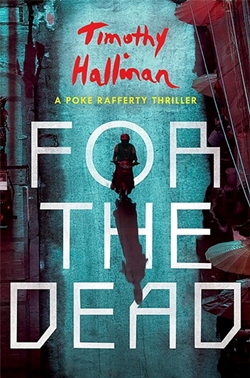
  1. Your second book this year is “For The Dead”, the sixth in the Bangkok-based Poke Rafferty series. Can you tell us something about this?

TH: Well, speaking of Miaow, FOR THE DEAD is largely Miaow’s book.  On the thriller side it’s a story about police corruption, power, and murder on a grand scale, but on the emotional side it’s about what happens to a 13-year-old girl who’s created a new identity to impress the snotty kids in her fancy school when every lie she’s told is suddenly exposed and she loses even the boy she was falling in love with and–she thinks–the security of the home Poke and Rose made for her.  It is, to put as benign a face on it as possible, a major growth experience.  Things also change forever, over the course of the book, for Poke and Rose. (I will say with some astonishment, since the book almost killed me, that it’s getting some of the best early reviews of my life.)

Dead


  1. It seems to me that each adventure in the Poke series centres around Poke’s attempts to create a family in the midst of a world which is essentially malignant. Poke wins every battle, though only just, and with each victory his private world of love and family is strengthened. What’s your own take on the world of the Poke series?

TH: You’re spot on. I think of it as a series about three people who have unexpectedly been given a second or third chance at a kind of life they thought they could never have.  It’s almost an accident that the family is so central.  When I wrote the very first book, I wanted to make it clear from the beginning that this was not a me-love-you-long-time book in which beautiful brown women fall helplessly and inexplicably in love with uninteresting white males. So in our first glance at Poke ever he’s holding his daughter’s hand and following his wife as they go grocery shopping.  And then Miaow takes off after Superman and the center of the book’s interest shifts to that apartment.  I had to fight to keep the thriller moving forward.  If I have my way I’ll write the series until Miaow moves out, at 19 or so, leaving Poke and Rose behind.  One of things I like best about the Pokes is that in the middle of the city of instant gratification you’ve got three people clinging for all they’re worth to the middle-class ideal of a functioning, loyal family.


  1.  Both the LA and the Bangkok series seem to me to be extremely visual and filmable. Who do you see playing Junior – Johnny Depp? How about Poke –give Owen Wilson a try on that?

TH: Boy, you got me.  The Pokes were bought for cable although the experiment failed, and the Juniors have been optioned a couple of times.  I’m hampered in my attempt to answer this question by the fact that I watch almost nothing.  Poke is part Filipino, so someone with some Asian blood would seem to be called for.  Keanu Reeves looks interestingly battered in the fascinating documentary he directed about the transition from film to video.  There’s an actor attached to Junior right now, and while I can’t say who it is (in case it falls through) he’s no one who would come immediately to your mind.  I think he’s got to project intelligence; someone once suggested Joseph Gordon-Levitt, and when I saw him, I thought he’d be great.


  1. With two books out this year, what’s next? I understand you’re working on a return of the main character from your very first series, Simeon Grist, in what sounds like a very novel scenario. Any news on that?

TH: The seventh Simeon, PULPED, has been finished for more than a year but so far it’s unsatisfactory to me, although I think about 80% of it works.  What happens is that Simeon has been banished to a kind of limbo that’s reserved for the heroes of unsuccessful crime series.  When the last unsold copy of the final book in the series is pulped to make paper for a new (and presumably better) book, pop, the character finds himself stranded, possibly forever, in the environment his/her author created as the primary setting, in a kind of gerrymandered neighborhood where everyone else is also the hero/heroine of discontinued crime series.  This is kind of a shock to begin with because fictional characters don’t know they’re not real until they’re suddenly in limbo, severed from the real world. The only connection with the world in which we live is when someone down here opens one of the books in the series, at which point Simeon (or the hero of whatever book it is) can look up, so to speak, through the page at the person who’s reading it.  He’s doing just that when someone kills the reader.  He doesn’t have enough readers to take this lightly, so he has to find a way down there and find out whodunnit.  That gives me a chance to write a lot of (to me) very funny and quite difficult scenes between a real person and a fictional one, including a love affair.  If I had a month I could (and eventually will) rewrite the first 25%, which is where the problems are.

So this July, HERBIE’S GAME comes out, and in November it’s FOR THE DEAD.  At the moment I’m writing the seventh Poke, THE HOT COUNTRIES, and the fifth Junior, KING MAYBE.  God willing, they’ll both be good.


  1. I think it was Dorothy Parker who said something to the effect that she hated writing but loved having written – meaning, I guess, that writing is hard work. P.G. Wodehouse in contrast brought out slightly more books than he had years in his life. Are you a Parker or a Wodehouse?

TH: Writing is very hard work and enormous fun at the same time.  There are days when I’d rather be a lab rat than write, and there are days when writing is the only thing in the world that matters to me.  I hate to do it and I love to do it and I can’t imagine doing anything else.


  1. Every day we see articles about the demise of traditional bookstores and publishers in the face of Amazon and Kindle, and even warnings about the death of books. Joe Konrath, of course, feels that books and writers will get along very well without publishers and booksellers. You yourself brought out Junior as a self-published ebook series before switching back to traditional publishing. Where do you see the future heading?

 TH: I’m no prophet, although I think the growth of online commerce of all kinds is inevitable, barring some absolutely horrific systemic security breach that drives people back to the stores.  But where you buy the book or what format you buy it in–both those things are just delivery systems for the text.  And I think that text is alive and well and will continue to thrive as long as people want to tell and read (or hear) stories.

CityLife


This interview may also be read at Chiang Mai City News by clicking the above banner.
 

Leave a comment

1.henrymiller.b

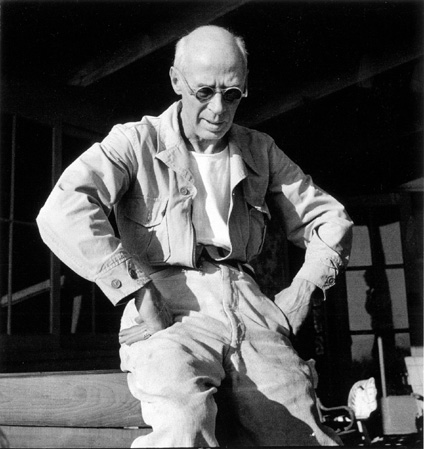
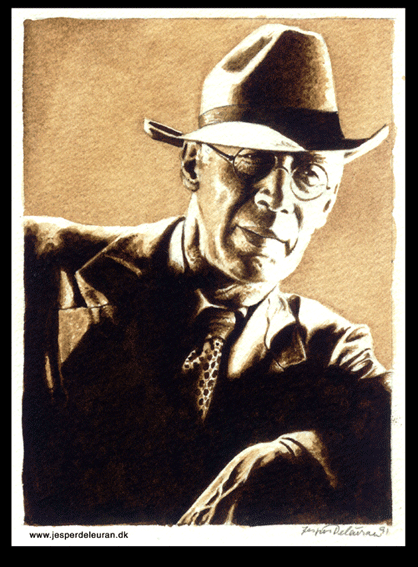
 Henry Miller at Big Sur in the year 1950

“If it be knowledge or wisdom one is seeking, then one had better go direct to the source. And the source is not the scholar or philosopher, not the master, saint, or teacher, but life itself – direct experience of life. The same is true for art. Here, too, we can dispense with “the masters”.
― Henry MillerBig Sur and the Oranges of Hieronymus Bosch

And a bonus quote:

“Actually we are a vulgar, pushing mob whose passions are easily mobilized by demagogues, newspaper men, religious quacks, agitators and such like. To call this a society of free peoples is blasphemous. What have we to offer the world besides the superabundant loot which we recklessly plunder from the earth under the maniacal delusion that this insane activity represents progress and enlightenment?”

Henry Miller
“Air Conditioned Nightmare” 1945

3 Comments

GodOfDarkness2


There has been a military coup in Thailand. Martial law is in place. Tough decisions have to be made. Like what to read? My most recent choice was GOD OF DARKNESS by Christopher G. Moore (Heaven Lake Press 1999 – 2nd Edition, Amazon 2010). The Canadian born author is best known for his Smiles trilogy beginning with A Killing Smile, first published in 1991 and his Vincent Calvino crime series now going 14 strong – the most recent being, The Marriage Tree (Heaven Lake Press 2014). Moore’s stand alone fiction is worth consideration.

When it comes to fiction or movies there is no shortage of choices out there, with many of them being bad or mediocre. As for cinema, you can stay at home and watch an HBO movie, go out and catch a blockbuster with a matching McDonald’s plastic cup or head down to your local art house and view a foreign produced film. Reading GOD OF DARKNESS was like watching an art house film, for me. And that wasn’t always good. Because I have the attention span in those films to wonder if they are still selling the buttered popcorn at the 1/2 way mark or why all theatres don’t save on labor by having the same person who sells you the ticket tear it in half also? I found either the book or my mind meandering at times during my reading of G.O.D.

And yet, just as when you walk home after the conclusion of a good art house film that confused you for a scene or two, I was completely satisfied at the end of this 320 page novel, which I would categorize as both a thriller and historical fiction. What Moore does so well is, like a paratrooper, parachute the reader into hostile territory that would otherwise be inaccessible. In PATTAYA 24/7 Moore takes you into the lush estate of a wealthy concert pianist and the lifestyle that goes with it. In ZERO HOUR in Phnom Penh you are admitted into the despair of a Cambodian prison. In GAMBLING ON MAGIC you are inside the heads of bookmakers, winners, losers, high rollers and low rollers. In G.O.D. you are behind the high walls of a wealthy Thai family compound. One that just happens to make frequent offerings to Rahu, the God of Darkness.

rahu_zps42149040

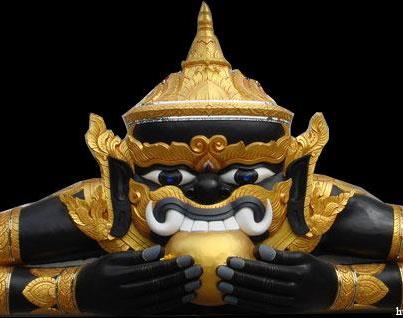
RAHU – THE GOD OF DARKNESS

GOD OF DARKNESS is set in 1997, mostly in Bangkok, during the Asian economic crisis. Thailand is no stranger to crisis as the current times reflect. Moore has written a wonderful time capsule of this roller coaster, crash and burn period. You land in a Bangkok high society family compound where the central character, Hurley has been convinced by his girlfriend’s family to leave the comfort of Seattle, Washington to become part of something he had not anticipated and never experienced in his young life. The drama unfolds when Hurley moves out and it is unclear whether he will return and marry the beautiful May under the heavy handed influence of powerful, potential in-laws. Additional characters include Hurley’s 73 year old former professor flying into Bangkok in order to find a Thai wife, a masturbating monkey, a cold blooded hit man and a ditched mia noi. Moore is not a cookie cutter writer. He takes chances. An example would be his use of settings. A short time motel room is not particularly clever for Bangkok fiction. But Moore chooses to use that scene. Twice. Two years apart. The same mirrored room. Once for the scene of a murder and a great education for the reader in the realities of privilege, face, ranking and Thai Criminology 101. A second time the unlikely room is used as a safe house, a rapid fire courtship and a marriage proposal. It is all believable in the good times and bad times of anything goes Bangkok. Another strength of Moore is examining what is right in front of us every day in Thailand. An example: Ancients. Moore’s term for old people. He uses the word with aplomb dozens of times and each time it seemed better than before. I never tired of it. Moore gives us some of his best writing for last. As Moore puts it: “Life is swimming to shore with cowboy boots on.” We get a good slice of that life in GOD OF DARKNESS. It’s a bit of a reverse Cinderella story with plenty of good intentions and malfeasance to go around.

GOD OF DARKNESS is not for everyone. If you like your protagonist to be 6’5″ and 250 lbs and roam around the United States a lot in lonely fashion only to be played later by a 5’9″ ex high school wrestler on the big screen then there are other choices for you. If, on the other hand, you prefer accurate interpretations of Thai behavior and want insight into the Asian economic crisis of 1997 or just want to know what goes on behind those high walls in those expensive Bangkok neighborhoods while getting a good thriller of a ride then read GOD OF DARKNESS by Christopher G. Moore. You’ll be glad you did.

CityLife

This post may also be seen at Chiang Mai City News by clicking the above banner

Leave a comment

henrymilleronwriting


​”A world torn by indescribable upheavals, a world preoccupied with social and political transformations, will have less time and energy to spare for the creation and appreciation of works of art. The politician, the soldier, ​the industrialist, the technician, all those in short who cater to immediate needs, to creature comforts, to transitory and illusory passions and prejudices, will take precedence over the artist. The most poetic inventions will be those capable of serving the most destructive ends.”

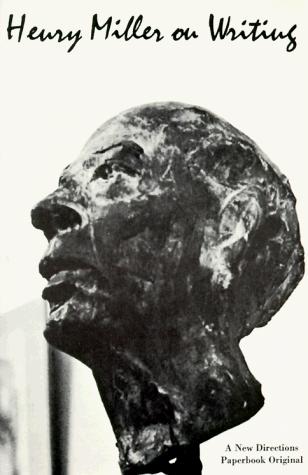
Henry Miller on Writing. First published in 1964, now in its 18th printing.

2 Comments

I don’t make a habit of making commercial endorsements on this blog, but I am making an exception with EXILES. It includes three authors I like and have read: K.A. Laity, James A. Newman and Paul D. Brazill. Plus many more. All stories written from an “outsider” angle. Give it a go. It’s less than a black coffee, only 99 cents. And the profits go to charity benefitting those afflicted with Marfan’s disease. A win / win.

Leave a comment

A reblog from Smoke and Mirrors on Thai politics and culture. He had me at, smoke and mirrors …

Leave a comment

bkk-noir-poet-john-gartland-10_7-300dpi


Portrait of Bangkok Noir Poet John Gartland by Chris Coles

Anyone looking for a respite from the lock down city of Bangkok or anywhere in Thailand for that matter, might want to consider the relative tranquility of Phnom Penh, Cambodia on May 31st and June 1, 2014 respectively. On those dates poet noir, John Gartland will be reciting his original poetry. On May 31st he will be part of a lineup that will include the man in black, Christopher Minko and his Khmer vocalists in Krom. John, Christopher and Krom have all been featured here at Thailand Footprint. Perform a simple search to learn more about them if you are not already aware. On June 1, 2014 John and Christopher will both be performing at the renown Meta House in Phnom Penh. Check them out if you are within a 90 mile radius.

John has allowed me to share some of his original poetry here again. Chris Coles has also, once again, permitted his art to be shown here as well. Enjoy the art and poetry wherever they may find you:

Generals

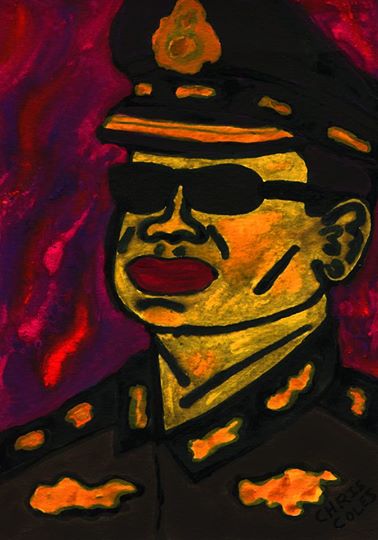
 THE GENERAL in the Bangkok Night by Chris Coles

The Eye:  1


Man,  I’m an ex-Private Eye, I can strike a cool pose

while  listening to others’ production-line prose,

self-published  wunderkinds who believe their own hype,

burned-out  actors on valium  bogarting the mike,

tales of drug-hauls and bar girls and crooked police,

and hard-drinking dicks who’ve adopted the east.

Look!  I‘m old-school detective, I’ve seen the whole bag,

Spillane-heads, in  trenchcoats,  Dash Hammett in drag.

Just  a crime-writers’ gig, at the Mambo hotel,

but outside it’s for real, and they’re guilty as hell.


THE EYE : 2

It ‘s a crime-writers’ gig, at the Mambo hotel,

where  whorehounds  had partied for fifty odd years.

But  life, like a crime scene’s not all it appears;

the  old  cathouse  is cabaret, now; it’s a fact,

and, under new management,  the riskiest act,

would be squeezing the original mama san’s hand,

which once, like the anthem, could make a room stand,

and left a broad smile on the girls in the band,

at the Mambo Hotel.

Two floors of short-time ghosts,

a locked up beauty shop, and dust;

now pulp-writers  rap about crime here,

and must shoot the fictional breeze on stage.

But, as the Eye on the case, I’ll cut to the chase,

the major heist is on the street,

and  there’s  fresh blood on the page.


THE EYE:  3

Bent judges and psychopaths, hustlers and has-beens,

professional  liars, Bangkok is a crime scene.

Hey, I  was  an Eye, wrestled crime for a living,

and  still have a hunch for who’s making a killing.

The patriots and flag sniffers, feeling the force,

play  patsy for billionaires, hit men, and punks,

they’ve  closed down the city and cheered themselves hoarse,

till  the tourists and hookers are packing their trunks.

Man, the hacks know the issue, but no one dares say;

destabilization is sent from upstairs,

since they can’t get joe public to vote the right way.

More generals than doormen, tear-gas everywhere,

there’s gold braid enough here to carpet a whorehouse,

gridlock on the streets, and a coup in the air.


Look, I’m just an Eye, with an odd tale to tell,

at a pulp writers’ gig at the Mambo Hotel.

But, outside? It’s for real, pal.

They’re guilty as hell.

You’d better believe it, they’re guilty as hell.


John  Gartland

John0531

CIRCUMSTANTIAL EVIDENCE

We have your co-ordinates, and know precisely your destination.

It is election time, and in the street of the plastic surgeons,

posters of men in white uniforms and fixed grins flap in unison.

This is a one way street, and a u-turn invokes serious penalties.

Traffic proceeds at breakneck speed through the great arch of autocracy.

By the pantheon of patriarchs, diseased birds slumber on the frozen plumes

of bronze headgear, mildew eating at ceremonial swords. Stay in lane.

The great highway of charlatans is multi-lane, crowded at all hours

and will bring you invariably to hypocrisy monument, where all roads meet.

One way.  Vendors swarm with incense sticks, crystal meth and dreams,

gold leaf to flatter a glowering idol at the revered corner of errors;

a  bottleneck, as many pilgrims buy merit from the four faced god here;

dead slow as beggars kneel in the road, abandoned to divine protection.

Proceed by the grand plaza of pointless purchases, and slow down for

heavy traffic at narcissus mall, street of six names for your inferior.

You must pass through the groveling gate, temple of the abject loop;

this is street of six titles for your superior, leading to the institute

of impregnable ignorance, graced with a royal charter. Take a right

on the grand drive of distracting flags, to the causeway of embalmed kings.

Go forward to the mall of the eternal flame. At karaoke heaven,

superlative banality may cause your ears to bleed. Accelerate away.

Proceed. Traffic circles perpetually round the academy of harlots;

whores, constantly renewed, wind silk around the sacred trees,

disrobe, and leave a mekong to appease priapic spirits.

You must drive through the emporium of envy and unsatisfied desires,

bypass the chaotic terminus of transsexuals for denial drive,

speed on past Guess Wat buddhist  theme park, en route for meth mall,

where it is always rush hour, and the men at Jamaica corner sell oblivion

in small packs to foreigners, who are ransomed by the tourist police.

Near the fountain of corrupted thought, pass beggar children

fishing for coins and fever in the catfish dark of drains:

at last you are near your destination, on a street of fortune tellers.

Here, gamblers with their cards and severed fingers,

taking pains to keep their face white and uncompromised,

play endlessly, and disregard their loss.

Your tinted windows let you pass unrecognized.

This dusty cul-de-sac is yours.  Abandoned

lottery tickets blow across the nameless street,

and withered wreathes are strewn

about  some broken idol’s feet. It is election time.

New posters of the white and smiling uniforms

wallpaper every space. This final cul-de-sac is yours;

self-hatred and the breath of street dogs, foul upon your face.


John Gartland

John0601


JG

 For more information about the poems and performance schedule of poet John Gartland go to http://www.johngartland.net or click picture, above.

CityLife

.

This blog post may also be viewed at Chiang Mai City News by clicking the banner, above:

1 Comment