
The following is a lengthy interview with John Gartland previously published in the book, Different Drummers, which John and I co-wrote and was released on November 8th, 2018. It is now available only as a paperback at Amazon after a brief stint as an eBook as well. The medium is the message. The paperback is currently sold-out at Queen Bee pub on Sukhumvit 26 directly across from the Hilton Double Tree Inn. We hope to remedy that soon after we correct a few typos and get a second edition out in late February. In the meantime, they have live music 7 days a week.
This is a long interview. By that we mean it will take an educated reader 12 minutes or less to read. If you can’t afford that time, best move along now.
Jim Algie in a book review of Different Drummers correctly pegged it when he wrote:
The centerpiece of Different Drummers is an interview with “poet noir” John Gartland, interspersed with selections from his work. It’s a clever way of showing how John’s working-class roots in England, his Shakespearean studies and travel experiences have sculpted his eloquent poems, which range from political diatribes to personal reminiscences about his family and the aftershocks of the two World Wars.
I would only add that the arc of John’s poetry runs a circle that will find a recognizable arc in anyone who has led a meaningful, enjoyable, and at times, of course, painful and aware life.
Paul Dorsey in another review of Different Drummers in The Nation newspaper said of John,
“Gartland is by far the best of all the expatriate writers in Southeast Asia.”
So enjoy the prose and verse of John Gartland or you could see what is going on with the wall and the U.S. Government shutdown over at Twitter. Up to you.
KC: You’re not a young poet any longer but you’ve been a poet, I suspect, in one form or another for at least fifty years. Fifty years ago it was 1968. What advice would the present day poet, John Gartland give to the poet of 1968?
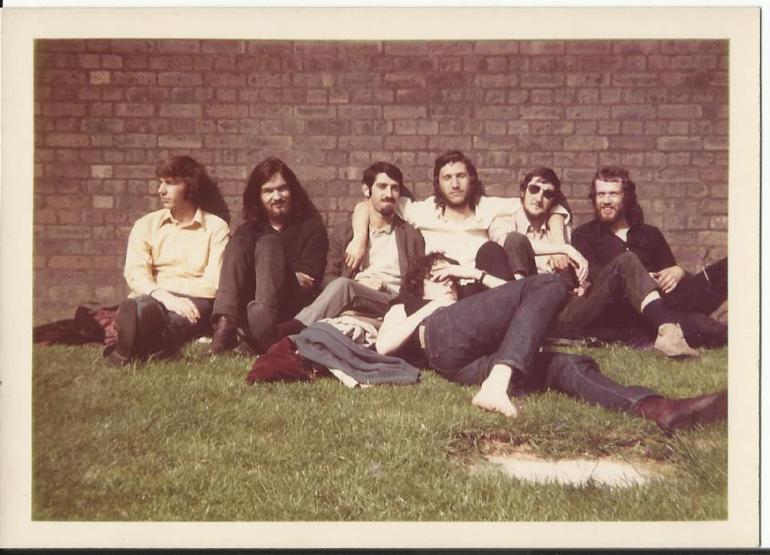
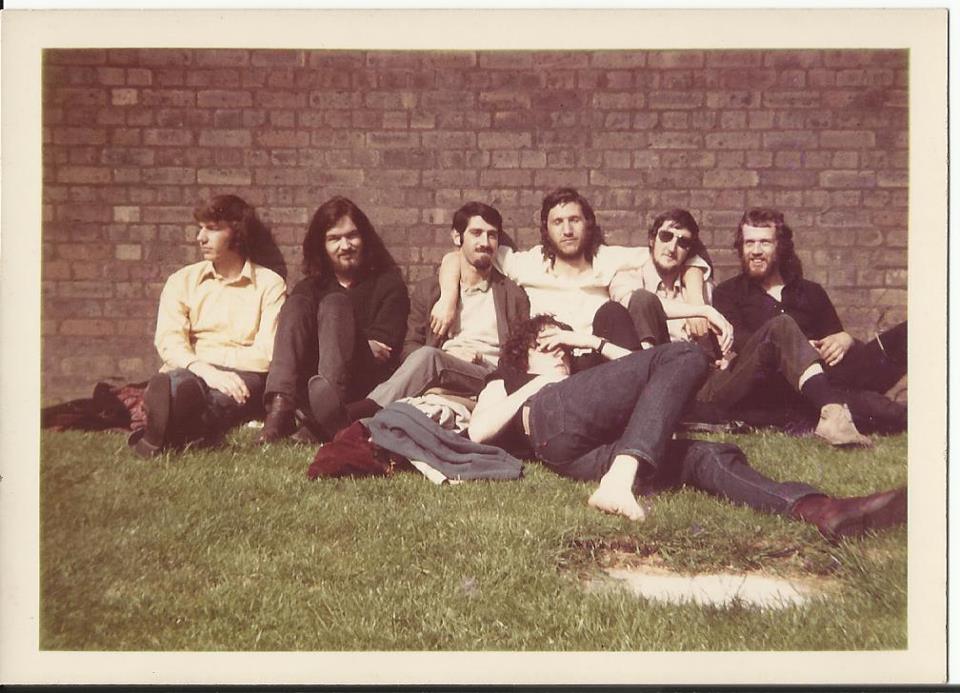
John Gartland (Second from right) back in the day with Neil Murray (second from left)
at Newcastle upon Tyne
JG: That twenty-year-old, in 1968 was studying for a degree in English Language and Literature. at the University of Newcastle on Tyne It was a rich and vital training in the world of belles lettres; of great poetry, and works of prose fiction. It also took in, in the first year, a grounding in Anglo-Saxon literature.
I’d first of all applied, the year before, to the University’s Fine Art Department (where Brian Ferry had been a student). I did the entrance exams, but failed to win a place. I wasn’t much of a painter, though I had sold a few paintings through an art shop in my home town. Following rejection by the Art Department, I‘d attended a teacher training college for a year, re-applied to the University English Department and had been accepted.
It was comparable, in literary terms, to the intensive classical training in drawing and figure work that was once traditional for visual artists. I was a kid from the North West rust-belt. Getting to University was a huge break for me. I was pretty much in awe of the literary “Great Tradition”, as F.R. Leavis called it. I had some poems printed in poetry magazines on campus, and I was writing poetry in a low-profile way, usually getting feedback on it from my girlfriend, who was also an English undergraduate. There was a poetry fellow position, for a poet who would visit the English Department and offer advice on any creative writing that students were doing. One poet in that role, Basil Bunting, offered me the best advice; to get out and “live some more”. I had some talent, but I wasn’t ready yet to write anything much of substance. When I was ready, years later, that early training kicked in. Meanwhile, I’d done a score of jobs, and travelled widely. My advice to me in 1968, with benefit of hindsight, would be, have more confidence, and trust that poetic spark. Bunting was right of course. I needed to grow up. I’m still working on that.
I did have a creative alter ego, however. I wrote a weekly satirical verse column, on politics or university affairs, in the weekly student newspaper, Courier. A friend and fellow English student was a talented caricaturist and painter, and we did this weekly verse satire / caricature in the paper, which worked well for a couple of years. My artist friend went on, in subsequent years, to become Wilko Johnson, rock guitar hero, launching, out of Canvey Island, with the Doctor Feelgood band, to international success.
Looking back on it, the weekly pressure to produce a verse column of a comic / satirical nature, to a deadline, was a useful discipline, and it taught me more than I realized, in basic technical skills.
Poetry ID
All those years ago, on Tyneside,
when we’d asked of Paris between the wars,
of Eliot and Pound, and their meetings of course,
and he’d looked at our fledgling poetry;
Bunting said, “It’s all right, but live some more.
You need to go out and live some more.”
I said thanks, and knew, as I closed his door,
he meant Poetry ID.
I’ve chauffeured cars and worked in bars,
crossed seas and worked illegally;
crashed out in Split, swabbed blood and shit
from floors in Vancouver casualty.
I’ve crossed the Rockies on a train
and jumped by parachute from planes,
drove a Cadillac through the F.M. band
from New York down to Miami.
Met Mozart in Carnegie Hall,
Bix Beiderbecke on Hadrian’s Wall,
got woken up by lightning
on the warm South China Sea.
Been there and back, and gone off track,
put the Darren Mountains in my pack,
I’ve taken stock at Lion Rock,
and swum in Lake Euphoria,
stirred Zen into my tea.
I’ve known apocalyptic trips
and rolled some monumental spliffs,
I’ve rocked to Doctor Feelgood’s riffs,
been frightened, heightened, free.
I’ve laughed a lot and loved my share,
I’ve come round in intensive care,
but many I loved no longer step
the headlong days with me.
I toast their sweet reluctant ghosts,
and all we did together, most
of all, this lush, uncharted coast
of Poetry ID.
Listen; words are the ladder we climbed from the slime.
Words that spring to your lips and sing of your time
are shouts in the throat of antiquity;
old oratory, shrapnel hurled
right out of history.
Magical, fierce, exuberant and sad,
words made us wise and sent us mad.
Rhyme’s a trapeze we swing out on;
out over birth, dissolution and death.
Rhyme, old as the breeze, and mysterious as breath.
Look, out as far as you can see,
there’s love and birth, magnetic north,
the stars, and Poetry ID.
And I’ve come as before are to the old poet’s door,
to pass right through it, as you see.
I greet his shade, then turn once more,
ambiguous, naked, and stubbornly free,
with thanks, and a smile, a fond farewell,
and Poetry ID.
KC: Tell me about the changes you have seen in those fifty years. The Grateful Dead wrote a song titled, “What a Long Strange Trip It’s Been” in 1977. Tell me about your trip.

JG: I suppose my equivalent piece to the Dead’s “Long Strange Trip” would be “Cantos of Cred.”, a flyover of the dozens of jobs I’ve done. That’s printed later in your book.
As regards social changes, I’ve seen a crushing growth in the bureaucratization of life, in the UK, where I was born. It has turned into the most snooped-on, over-regulated and politically-correct nightmare. Free speech has been drastically curbed, an imported religious extremism institutionally protected, and democratic freedoms undermined.
However, my personal life-trip from day one took me through many major historical gateway events. I’m seventy years old now. Consider the exponential rate of change over that period.
Socially, there were huge improvements in health care, nutrition and the standard of living. The National Health Service made doctors’ expertise and antibiotics widely available. Unemployment was an unknown problem in my youth, and there was the possibility of access to higher education for kids (like me) from working class backgrounds, via selective examinations and grammar schools. I remember that, in my State Primary School, in the early 1950’s, we were given pens with steel nibs, to write with. One child had the responsibility of filling our desk ink-wells with black ink, from a large bottle. Shades of Bob Cratchit. (In infant school in 1953 we’d been given special blue souvenir drinking glasses, decorated with the royal coat of arms, to commemorate the coronation of Elizabeth the Second. Exciting, eh?).
My mother was a farmer’s daughter from Galway, in the west of Ireland, who’d had little education. She told me that she and her sisters at one time walked to school barefoot. She came over to England to work in a factory in my home town when she was just eighteen. She was supposed to stay with a distant relative, but they’d turned out bad, so she’d had to go it alone. She’d told me semi-humorously years later, that King George VI came to visit the northern town, in pre-World War Two years, passing through in a motorcade. As a green young country girl, she’d had no idea what to expect. “I thought he’d be like fairy people” she said wryly. That was a very different world. My parents met while working in the same factory. My Dad used to say her family in Ireland rebuilt him, after the war, on farm food and Guinness.We went to Ireland, and the farm, every year in my early days. That two week holiday was the high point of the year.
ON JOLLEY STREET
As we walked into Jolley Street together,
you had slowed your customary pace.
Around the old Infirmary,
streets of houses without doors,
windows without curtains. Dust.
Forsaken rooms lay gutted of all private comfort,
and demolition smoke was in our way.
Around the old Infirmary
they were tearing down the terraces.
The old town we were born in, coming down.
It must be more than twenty years. It must!
And you had slowed your customary pace.
And strange, out there on Jolley Street
I didn’t read the omens straightaway.
Your soldier’s tales had drawn for me
such shattered places.
Anecdotes of war, and close escapes;
your travels, drawn so vividly
on Sunday walks,
across the years, across the town.
The annals of your boyhood days.
Much laughter, up and down, we had!
I was the I little boy you entertained,
and you, the storyteller, loved a beer
and books and poetry; my interesting Dad.
Despite your ragged nerves left by the war;
your hands that sometimes shook as if before
that bygone discharge from a military hospital,
in entertaining rambles you’d amuse and you’d delight.
But something unforgotten is the sight of private tears
on those Remembrance Sundays, in our town.
The way you could flesh out their “Glorious Dead”;
your mad Welsh chum who’d dance the seven veils,
dispensing army boots, a lousy shirt,
each piece of war-stained kit, in lumbering pirouettes,
each time you’d reach a respite and some wine.
He didn’t give a shit
for all the King and Country stuff,
and sang odd bits of opera, like you.
In time the war swept him away,
and many others you would mourn
each time “that bloody trumpet”
(so my mother termed it) blew;
Remembrance Day.
I’d ask my childish questions and she’d stay
beside you, arm about your shoulders,
with her jaw set in that stubborn way;
just hating what the Last Post did to you.
How fierce she was; and Irish, too, those moments;
fighting hard, to keep your marching ghosts at bay.
I’m at the old Infirmary again.
While you’re out in a waiting room
the specialist’s pronouncing on your case.
Incurable, and far advanced, he says;
precise, discreet.
And though I speculated twenty years about it,
still, I ask if I was right;
as we walked out,
to tell the truth on Jolley Street.
But I had no closer friend than you.
And I, you see, had it been me,
would not have wanted you to lie.
I still can see your face and its emotions;
I still relive the anger
as I watched life tear you down.
Soon after you had gone I felt I didn’t
want to see the place we strode about so often.
In any case, with landmarks lost,
what would I recognize about the town?
There was no closer friend than you.
In spite all the other things I’m grateful for,
that’s why
I bitterly regret you had to show me,
prematurely, your ultimate example;
how to die.
My area in the North West, between Liverpool and Manchester, was classic rust-belt, a coal-burning, long heavily-industrialized place, large chemical factories, caustic soda and soap works, flour mills, steel processing plants, wireworks, coal mines, box works, aluminium fabrication, hydraulics factories and gasworks, and many more. There were always factory jobs available, in student vacations, and I did many. We used to get regular dense fogs in winter, before the Clean Air legislation was introduced.
The air was bad in that town, very polluted, and I got pneumonia and a collapsed lung when I was three. There mustn’t have been adequate emergency treatment available in my local hospital, because I was treated in a special hospital, for chest complaints, out near Liverpool and far from my home. My parents had to take a long bus ride to visit me. They were both working, and their jobs simply did not allow them to take such a long trip often, after work, and arrive in time for visiting hours. I remember being the one child, in a cot, in a ward full of bronchitic industrial workers, and coal miners with black-lung. They were very kind to me, but I developed a real case of separation anxiety from my time there, which left its mark for years afterwards.
The local public library was a favourite haunt of mine. Saturdays in my boyhood meant a trip to the swimming baths, a walk around the town museum, and a change of library books. Walking home, I’d be laughing and joking with my pals, crossing the bridge over the railway tracks to Bank Quay station, by the chemical works, along the River Mersey. Liverpool and Manchester were both about an hour away, by train.
There was the arrival of colour television, Rock n’Roll, the Teddy Boys, the spread of popular musical culture, via records, 45’s and LP’s, then stereo sound and hi-fi, reel-to-reel tape recorders, then audio cassettes, then videos and CD’s etc. Movies developed Cinemascope, dynamic sound, Technicolour, and special effects.
There was the availability of more mass-produced cars to buy, and new roads and motorways to drive them on. It was a golden period of new social mobility, when petrol was cheap, and before speed cameras were thought of, and before the road network clogged up with traffic.
There was the landmark introduction of the contraceptive pill (which unlocked sex), affordable international air travel, (which unlocked the world). Feminism kicked off with Germaine Greer’s breakthrough book, “The Female Eunuch”, and liberalization of attitudes grew in many areas, from dress to sexual behavior and the availability of drugs. The outcomes weren’t all uniformly good, but they were truly revolutionary to live through.
Then there was the arrival of the photocopier, the fax machine, and cheaper phone calls via the privatization of the telecommunications industry. Satellites in geo-stationary orbit fulfilled writer Arthur C. Clarke’s predictions, providing instant international communications, for voice, data and TV. Then came mobile phones, plus the arrival of broadband over old voice networks, then fibre-optic cable leapfrogged the bandwidth of old copper-cable phone networks , bringing new rapid voice and data communication, plus Cable TV. There was also the advent of the Personal Computer, the Internet, and Smartphones.
There was nuclear power, lasers, holography, mass- immunization, unlocking the genetic code, the elimination of polio (a disease I remember had once confined a cousin of mine in an “Iron Lung”) the elimination of smallpox, developments in plastic surgery, the availability of cosmetic surgery and organ transplants, and cyber implants, and brain-scans, and new drugs to curtail classical madness.
Rock Around the Clock.
Oh yes, there were also Sputnik, the first orbiting satellite, dogs in orbit, then men (and women) in orbit; first, Yuri Gagarin, circling the globe in a tiny capsule, then John Glenn, NASA’s flights and then the moon landings, and the exploration of Mars by robots, and the building of the International Space Station. There was the development and open testing of the Hydrogen bomb, nerve gases and biological warfare. There was the (first) Cold War and the age of M.A.D. There was Rock n’ Roll, Bill Haley and the Comets, Teddy Boys, Angry Young Men, Elvis, the Beatles, the Stones, Cream, Blues, Dylan, hash, acid, Reggae, the Korean War, Suez, Viet Nam, jogging, yo-yo’s, hula-hoops and Disco. There was the scourge of Aids, the spread of SARS through booming international travel, there was Ebola, flesh eating viruses, mad cow disease, accelerating dementia, and Rap music.
There was the political crucifixion of British M.P. soldier, poet and classics scholar, Enoch Powell, for predicting the future of the UK, memorable assassinations-a-plenty, from the Kennedys to Martin Luther King, and John Lennon, and many, many more. There were endless wars, the rise of militant Islam and the auto-destruction of Europe by demographic conspiracy. We were all expected to worship Globalism.
THE CORPORATION
Lie back and learn to love
the corporation.
Especially on a daily basis
rape means rage and tribulation.
Get wise that such humiliation’s
futile and corrosive;
not to mention an explosive parcel
ticking in your sanity.
You can’t reject the corporate embrace.
To think you can resist
is merely vanity.
Understand, you’re on your back,
my friend,
and they’re right in your face.
It’s macro-economic systems
goosing all humanity.
True, the world’s in corporate pawn,
even the oceans.
So is the air we breathe,
the lakes and trees.
Objections will be neutralised
as weird, subversive notions.
In profit-led inventiveness,
these systems hover over us
from when we’re born
to our assured decease.
It’s wearing, on a daily basis,
we recognize, beyond a doubt.
Admitting you’ve been had’s
just one more burden
you can live without.
We clarify your rights
and we appreciate your trust.
We anticipate your protest and
advise against all self-disgust.
So do yourself a favour,
and accept the situation.
Give all the ins and outs of it
their due consideration,
and go easy on yourself,
for rape is rage and tribulation.
Relax and smile; bend over,
learn to love the corporation!
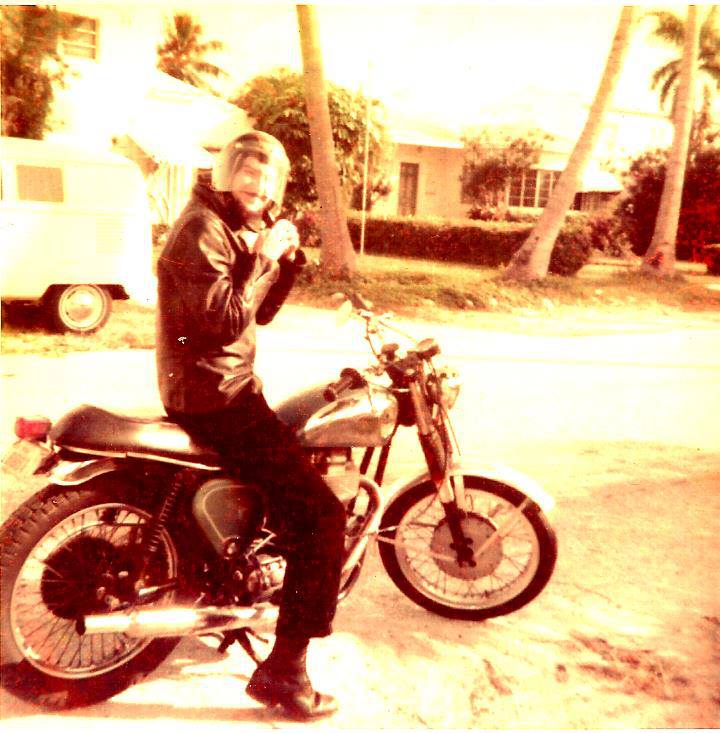
On my life trip I enjoyed motor bikes, many cars, snorkeling, scuba-diving, parachuting, hot-air ballooning, hallucinogenics, and hiking and biking. I’ve always been a keen swimmer, in pools, lakes and ocean. I’ve traveled widely; from the Alps, to the Greek Islands to the Florida Keys, the Prairies, the Rocky Mountains, New Zealand, and the countries of S.E. Asia, to name a few of the places I’ve seen.

Then there were the lovers I’ve known, the painting I tried, the acting I’ve done, the four plays I wrote, and saw produced in the London Fringe, the novels I wrote, the political projects I followed, found were flawed, and sometimes murderous, so abandoned. There were the risks I ran, and the accidents I survived, and some lucky escapes.
And all the time there was a poet in me, watching, wondering, rejoicing in his recurrent good luck, waiting to reawaken, hit the release button and emerge. I can’t think, honestly, of a comparable life-arc, at any point in human history, to match my generation’s trip. That period took in the descent of the Bathysphere, the ascent of the VTOL Harrier jet, and the expansion of Astro-Physics. Big Bang theory replaced Steady State theory. There was the UK’s Jodrell Bank pioneering radio telescope, followed by more of them, internationally; the discovery of dark matter, and quasars and pulsars, and black holes and neutrinos and quarks, and the parallel refinement of rocketry and guidance systems. We saw research satellites, the Voyager spacecraft, exploration of our solar system, and the discovery of water on Mars, and the certainty, now, that a Mars settlement will come within decades.
Way back in my life there were born transistors, and the solid state electronics revolution, and the obsolescence of electronic valves. There was anti-noise, anti-matter, carbon-dating, electron-microscopy, micro-processors, micro dots and Nano-technology, new materials and super-conductivity and super-computers.There were still steam trains taking us on holiday when I was a boy. Then came new diesels, then electric trains, then, abroad, bullet trains and under-mountain and undersea railway tunnels, then there was magnetic levitation technology, fusion reactors, national power grids, hydro-electric, wind, and solar power. Oh, and they built the Channel Tunnel, and I’ve travelled through it by train from London to Paris. I’m merely scratching the surface of a life here.
On my life trip I’ve seen a huge dumbing–down of society in general, and a decline in educational standards. I’m not imagining that. I worked as a supply teacher in comprehensive schools in England, after I was made redundant in the telecoms industry, and I’ve interviewed and evaluated numerous candidates for jobs, in various sales- manager roles I had. Neither was an inspiring experience.
The growth of the Internet, and alternative information sources has, on the other hand, severely dented the influence of Establishment mass-media. It has alerted the general public to the destructive consequences of globalization, and the machinations of a corrupt ruling elite, engaged in ushering in a New World Order against their will. It has begun to trigger revolutions, such as the popular resistance, in the UK, to an EU super state, with Brexit, and anti-EU developments elsewhere in Europe. However, the threat of the aggressive advances of militant Islam into democratic and gullible western nations is serious. Free speech, a right valued as paramount through my life, and through the whole western enlightenment, is now under open threat from Political Correctness, and a political “Newspeak” predicted in George Orwell’s “1984”. CCTV mass-surveillance, facial-recognition software, and satellite communications have made the Orwellian nightmare of Big Brother a technological reality.
The UK is the most spied-on place on the planet. The society that once gave us Speakers’ Corner has morphed into an enemy of free expression, where university students demand “safe spaces” free from the dangerous influence of debate and alternative ideas. Truly bizarre, and possibly, ultimately tragic.
If I were a cynic, I might say I’d seen the best of it.
I’m glad the poet in me stayed the course, and I was hugely amused that, with the amazing launch of AIRSTRIP, at the legendary Heart of Darkness club, in Phnom Penh, in December 2017, I made it into a band before I turned seventy! (pause for hoots of self-mockery).
As I go forward, however, there’s one abiding influence from my lifetime I can be sure will go along with me, the Uncertainty Principle. As the robotics revolution resurrects the Luddites, and ushers in massive unemployment, that age of plentiful, available jobs I knew in my youth, seems as far-off as James Watt, Brunel, and Hargreaves’ Spinning Jenny.
God is dead, but let’s hope Artificial Intelligence knows better.
It’s not over ‘till it’s over. Onwards.
Count your blessings.
You grow old, as you have lived,
among charlatans, thieves, political liars,
talentless poseurs, decriers of the worthy,
running on jealousy. And infestations
of academic commissars,
post-modernist frauds.
It’s the culture of the cockroaches
and The Murderers of Truth Awards,
the era of the brainwashed and the ordure of
the journo-whores.
Betrayed and dumbed-down i-phone slaves
whose clueless, bovine ignorance
ignores the marxist killing floors,
bloodstained dystopias built on bones.
Whose ignorance of history abjures
the corporate criminals, and Maoist-clones,
the gilded movie bawds, the papal puppeteers and
teflon pederasts, the rackets and
the turnover of temples-become-profit-zones,
the mummery of ritual to stupefy the herd.
In the culture of the cockroaches, subjection
is the meaning, and compliance is the word.
So, count your blessings, poet,
you grow old, as you have lived,
amid the virtue-signalling of herds
of posturing tyros to the left of
the absurd.
KC: How does one improve as a poet – and in what ways have you gotten better at your craft?
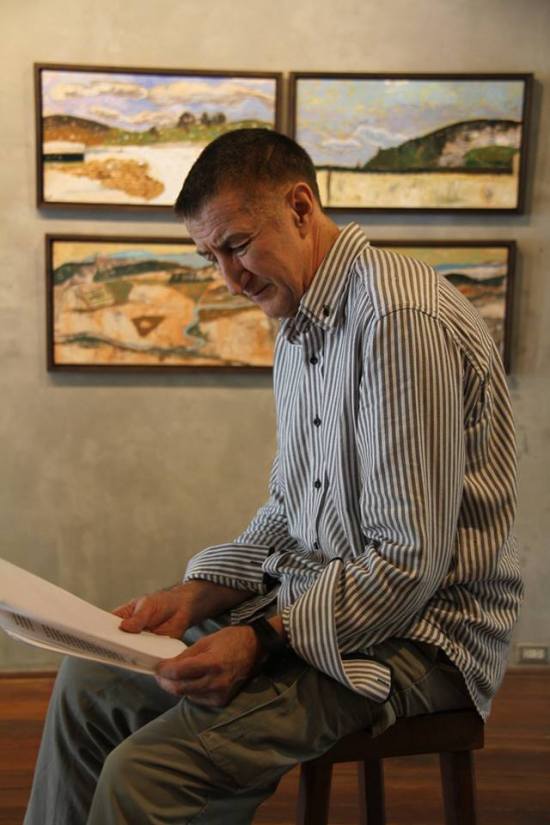
JG: With poetry, like most art, given some basic talent, practice is key to improvement, but read other poets, ancient and modern, learn about the tradition and the revolutionaries. Practice at reading aloud is also important, since poetry, it has often been forgotten, is a performance art. This certainly wasn’t the emphasis in the teaching I received, but it’s an integral part of the bardic and troubadour tradition, literally centuries old. Only recently did I recall my father telling me that he’d often been assigned to give poetic recitations when he was a boy. Apparently he was pretty good at it. As a self-educated man, who missed out on formal schooling, and with an uncaring father forever embittered by the horrors of his soldiering in the First World War, he always encouraged a love of poetry in me. His last words told me to carry on writing it.
Reading aloud builds confidence for the poet, and extends the theatrical dimension of poetic narrative. It does require some acting ability, however; and rehearsal. It’s a way to make a poem pack more emotional punch. It’s a more direct, if risky, form of communicating the piece. Successful experience in reading aloud also feeds back into the style of writing. For example, it developed the narrative thrust much more in my work.
Also, looking back on it, the weekly pressure to produce a verse column of a comic / satirical nature, to a deadline, was a useful discipline in student days. It taught me more than I realized, in basic technical skills.
Studying for my Master’s Degree in Elizabethan and Shakespearian Drama, I had a year of total immersion in the works of Shakespeare and his contemporaries, which had to have a significant formative effect on my own creative development.
After I started writing poetry again, I reached out, about twenty five years ago, to other local poets, in Hertfordshire UK, and started a poets’ group which met every week to read and critique members’ work. The group, which I believe is still in existence, is called Poetry I.D. (after one of my poems of the same name) and proved very helpful to a number of poets in developing their writing, and gaining confidence in their art. The group organized readings and workshops, and produced an annual poetry collection.
Public readings, with this group, and subsequently, gave me valued experience in delivering and projecting my work. The feedback I received strengthened my self-belief as a poet.
I say, in all seriousness, Poet was a title I was reluctant to adopt lightly. After all my study, my reading, and as a student who had absorbed the ideas of T S Eliot and F R Leavis, the role of poet, to me, was a mantle, sanctified by tradition, something to be earned, rather than claimed. I’ve seen many people claim it with an embarrassing lack of any skill.
My Facebook page, and Lizardville Productions FB @lizardvilleproductions page, have served for some years now, as outlets for my poetry. It has been like being able to give a reading whenever I want to, often several times a week. The positive feedback I’ve received from a loyal following has been a real stimulus to me as a poet, and I take this opportunity to thank those people for their support.
Though I have had work consistently published, in magazines and websites in the UK and the USA, my adopting the role of “Performance Poet” in S.E. Asia, put the emphasis strongly on live readings. I started live readings at various venues in Bangkok, beginning at a performance evening I started at Assumption University when I was teaching there. I continued in clubs in Bangkok, and still later, Phnom Penh. In the process I got noticed; some called me the ”Poet Noir”. For me, all this period was one of practice and development in my writing and its delivery.
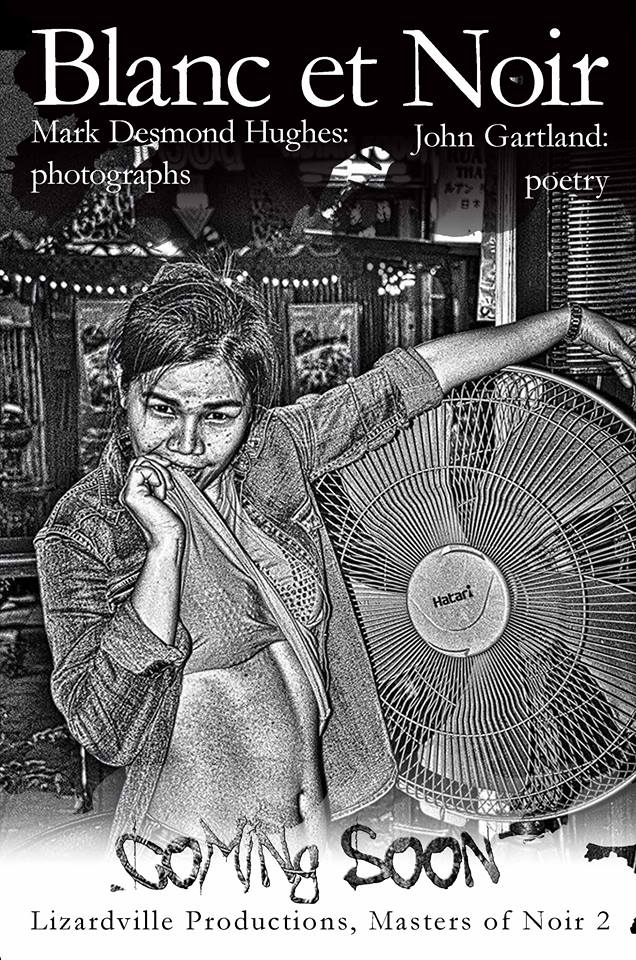
As my workflow continued, and I was better known, I published two collaborations at Lizardville Productions. “Bangkok, Heart of Noir” was a poetic collaboration with Expressionist painter, Chris Coles. “Blanc et Noir” was a poetic collaboration with photographer, Mark Desmond Hughes.
Working with great talents in other disciplines means you must produce of your best to merit the partnership, I greatly enjoyed complementing my poetry with the impressive output of these two guys.
A final note regarding improving and sustaining one’s poetic output, is a simple one. Be attuned and receptive for new ideas, images, inspirations. Always have a notebook with you. Some of those ideas can take months or years to gel.
KC: What has Southeast Asia gotten right that the West never learned? What do you miss about England?

Kevin Cummings, Alan Parkhouse, and John Gartland at The Jazz Club in Phnom Penh
JG: I feel no empathy with the brand of Buddhism in Thailand and Cambodia, even though I’ve been very influenced and sustained by Zen Buddhism, in my life and thinking.
I’ve always enjoyed the more tolerant attitudes to some aspects of life, that one found in Thailand. Such open-mindedness seems to be in decline these days, under military dictatorship. However, since Thai tolerance also extends to thoroughgoing social corruption, it’s not always a positive thing.
What do I miss about England? Landscapes where I used to go hiking, like The Lake District, Dartmoor, Exmoor, the Yorkshire Dales, and Northumberland.
I miss mountain-biking in a cool climate. I’m also an Irish citizen, and I miss Ireland even more. I go back when I can.
from.. Thoughts from the West
But driving
to the reading up in Donegal,
re-visiting the windy West,
as rapt as any lover,
best redeems a poet,
weaver without witnesses,
invests in me a landscape green
of ancestry and memory.
The straight road to old friendships,
and the boundless zest
of childhood wait within
the healing whisper of the trees.
So, under rolling Sligo skies,
through Drumcliffe, northward,
by Ben Bulben’s side, I’m breathless
in the land’s embrace,
this stormy blessing of a place
we cried so often, leaving,
lives ago.
KC: You and John Burdett had some major differences over Brexit. I believe you got a nice blurb from John out of it. Explain Brexit. What do the critics not get? What are your biases and blind spots that are toughest for you to own up to?
JG: Brexit is about the British people waking up to the fact that their agreement to participate in a European Common Market has been hi-jacked by a totally different agenda, to become part of a European super state. The following recent press report about recently released government documents, puts it in a nutshell. It describes a political conspiracy against the British public.
“We were lied to!
A SECRET document, which remained locked away for 30 years, advised the British Government to COVER-UP the realities of EU membership so that by the time the public realised what was happening it would be too late.
Almost all of the shocking predictions – from the loss of British sovereignty, to monetary union and the over-arching powers of European courts – have come true.
But damningly for Tory Prime Minister Edward Heath, and all those who kept quiet about the findings in the early 70s, the document, known as FCO30/1048, was locked away under Official Secrets Act rules for almost five decades.
The classified paper, dated April 1971, suggested the Government should keep the British public in the dark about what EEC membership means, predicting that it would take 30 years for voters to realise what was happening, by which time it would be too late to leave.
That last detail was the only thing the disgraceful paper – prepared for the Foreign and Commonwealth Office (FCO) – got wrong.
The document, known as FCO30/1048, was locked away under Official Secrets Act rules.
This 1971 document shows exactly what the plan was.
The unknown author – a senior civil servant – correctly predicted the then European Economic Community (the EEC effectively became the EU in 1993) was headed for economic, monetary and fiscal union, with a common foreign and defence policy, which would constitute the greatest surrender of Britain’s national sovereignty since 1066.
He went on to say “Community law” would take precedence over our own courts , and that ever more power would pass away from Parliament to the bureaucratic system centred in Brussels.
The author even accurately asserts that the increased role of Brussels in the lives of the British people would lead to a “popular feeling of alienation from Government”.
But, shockingly, politicians were advised “not to exacerbate public concern by attributing unpopular measures… to the remote and unmanageable workings of the Community”. “
After David Cameron, the former Prime Minister, through a combination of arrogance and incompetence, stumbled into offering a referendum on Britain’s membership of the EU, the Establishment’s absurdly exaggerated warnings against leaving (now derided as “The Big Fear”) became comic legend. Increased unemployment was the least there was to fear, according to this huge propaganda campaign. From the lock-stepped apparatchiks of the BBC to pop-music has-beens like Bob Geldoff, to political-has beens like John Major, to soon-to- be’s like Hillary Clinton and Barrack Obama, there were dire warnings of disaster, toil and trouble, if their beloved New World Order was disrupted. The UK Chancellor, Osborne made predictions of such spookily dire outcomes that the biblical plagues of Egypt seemed preferable to leaving the EU. This arch- black-propagandist, whose fictitious predictions patronized and insulted the public’s intelligence, was fired from the cabinet after the vote to leave. However, he has since been appointed the Editor of London’s mass circulation daily paper, The Evening Standard. As my American friends would say, “Go figure!”
The cost has been huge. In addition to an eye-watering slice of taxpayers’ money, the government also gave away the UK’s right to make its own laws and determine its own tax rates, gave away its rich fisheries, and surrendered a thousand years of English Common Law to the European Court.
Unregulated immigration of unskilled workers drove working class wages down, swamped the National Health Service, and flooded schools with non-English speakers.
About 1.95 million European nationals have moved to Britain since Poland and nine former Soviet bloc countries joined the EU in 2004, giving them freedom to come and work in the UK.
This compares to 1.49m migrants from countries outside the EU settling in Britain in the same time.
This means Britain’s population has increased by about six percent, due solely to non-British immigrants, in a decade.
People who drew attention to these alarming figures were smeared as racists, extremists, nationalist, and right-wingers, in a full-on BBC and mass-media onslaught, reminiscent, in its ruthless thoroughness, of Doctor Goebbels, or Senator McCarthy.
However, as we saw, the British public were not fooled. They voted to leave the EU, because they had real personal experience of a drastic fall in the quality of life for ordinary folk, which fat-cat supporters of the EU membership did not.
Since that fateful vote to leave, we’ve seen the full weight of the UK establishment, from the BBC to the Lords, and ranks of rich media airheads, and patronizing EU hirelings, employed in an anti-democratic effort to deride, thwart, and possibly reverse the decision of seventeen and a half million Britons, to leave the EU.
Their masters, in Berlin and Brussels, urge them on, clearly alarmed at the imminent loss of the UK economy and its riches, from their super-state game-plan.
That, in brief, is the reality of Brexit. Escape from a masterpiece of lies.
KC: Can you separate your life from your poetry? How are they separate? How are they intertwined?

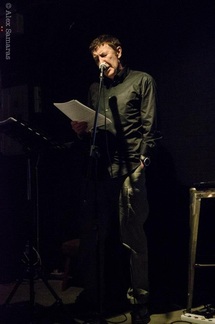
John Gartland at a poetry reading at Queen Bee in Bangkok
JG: They are inseparable. Writing a poem that works well is one of life’s high-order pleasures. It is completely habit-forming.
PROCESSING
Of all the landmarks of the Forbidden City
which embellish this ruined quarter,
the Tower of Yearning still crackles
with lonely life.
Stored hereabouts is Dowland’s Lachrimae
and other melancholy data.
Here, gloomy church interiors,
journals of half -forgotten wars
and maps of vanished cities crowd
the great soliloquies.
There, a Roman amphitheatre
vibrating to the late quartets,
a pocketful of lunar rubble,
huge with silence, older than God.
For ages, keeping this from crumbling
into other data, bleeding into becoming,
I’ve tried sealing off the entire sector.
But it leaks remembrance, unconsoled;
like old reactor rivets,
hot for another quarter million years.
“Ordo Ab Chao” is the Latin expression that defines why writing poetry is addictive. It means Order out of Chaos. Poetry is a rich discipline that allows you to visit life events that might otherwise be overwhelming, scary, inspiring; as a poet, to come back with something to say, to process them, into art. Poetry always did that.
If you get to the stage of delivering your poetry in public, and you are successful, you additionally get the actor’s or musician’s performance feedback. So, yes, poetry, among other things, is life therapy. It’s also a craft, of course, so without that skill component, and practice, it will be bad poetry.
It’s pretty scary thinking about drying up.
Creative cold turkey would be a serious hurdle to manage.
Here is the Muse
And when she saves your lucky skin again,
incredibly she opens to your tentative embraces,
and has you, in the hallway of the treasury,
some happy fool, exalted to be chosen, momentarily;
allowed to see her naked faces,
intimate, contemptuous, by turns.
She’s left you in the empty morning,
grateful, and alone again,
her number smeared like lipstick in your notebook,
and seems a fragrant phantom then,
till evidenced by carpet burns.
Short of a Beethoven string quartet, few art forms have the emotional depth, eloquence, and richness of poetry at its best. An awareness of a place in the long literary tradition enriches a writer and supplies a kind of empowering alchemy. Isaac Newton famously wrote in 1675: “If I have seen further it is by standing on the shoulders of Giants.”
That’s exactly the way the Great Tradition can elevate and empower you, as a writer, if you can also bring something special of your own to the party.
TRUE DETECTIVE.
On the client’s balcony,
an answer hit me, vertigo high,
“One bad attitude’s
enough to find damnation.”
Sure; that’s why I slid through
those realities that evening
on his tuner, found this
case had grown impossibly big.
Heard the laughter from inside….
“Was just radio noise”, he testified,
“until I stumbled on the integrator switch,
and the whole gig went harmonic.”
Subversive hospitality; party-lover.
Said he’s seen too much now,
can’t go back there.
Batshit crazy;
or may just be a Buddha.
Altered and illegal states cheat
fiction, I told my client, later.
Naked laughter from the room behind.
“We’re locked into this caper,
brother. We score by bringing
something special to the party;
one way, or another”.
Time to go back, inside.
KC: The legacy of many a great poet includes the fact there is little to no money derived from the art. How would John Gartland like to be remembered? What do you hope readers of your poems, including the ones in this book, Different Drummers, will learn from their reading in the year 2068?
JG: Remembered for and by the work only. Oblivion is much more likely.
Oblivion to Bang Wa.
I’m looking, for the thousandth time,
down from this commuter line
at a weedy Chinese graveyard,
sliding by.
It says memory’s a shaky act.
Oblivion Junction to Bang Wa.
The rush-hour train is packed,
approaching Saleh Daeng;
our Skytrain, slowing down
now, for the station.
And over crumbling vaults,
the ring of corporate giants
looms in stainless expectation
of a drop-dead valuation,
for this real-estate of tombs.
And suddenly, statistically,
you know that someone
on this train, will get off
at big Junction O, today;
will never have another
job to sweat about, or have
another monthly pass to pay.
And in another hundred years, or less,
say seventy five, not one aboard
Oblivion to Bang Wa now will be alive,
and many here today can’t know,
that they’re already booked to go,
express.
No one stayed top-dog, fatcat,
mad-ass, high-so, in-crowd.
No one stayed hot, stayed high,
stayed strong, stayed up-and-coming,
loaded, or knew why they didn’t give
a fuck for any of it, anymore.
Of course, long dead, or ga-ga,
they’re guaranteed not to.
But some are heard laughing,
Oblivion to Bang Wa,
some are still laughing
in books that they left you.
KC: Talk about humility. What does it mean to you, if anything.
JG: As the Ancient Greek writers knew well, hubris invites nemesis.
In the face of the abiding mysteries of life and death, the philosopher knows humility is the wisest virtue.
Witness Statement
Lost beauty, and lost self-respect, lost scope.
Lost joy, lost peace, lost self-belief, lost hope…
And owning
the pathology of moral dissolution
is revolving-door to wisdom
(when self-knowledge realigns us).
There’s no impartial witness statement
here, in life’s bargain self-a-basement.
It is our naked suffering defines us.
In the time of slippage,
insincerity and drift,
he’d lived in many places,
gathering up the thoughts of man,
embracing the forbidden,
and concealed behind an actor’s faces.
A Jungian meditation saved him.
Analysis the fix began…
“Lost love and lost compassion and lost pages.
Lost chances, and lost promise and lost ages.
I squandered all my assets and rejected every boss.
Though often high, and sometimes drunk,
I know I was a pilgrim monk
for Fragments of the True Loss.
I write a witness statement
from the pit of Purgatory, brother.
I write a hack of self-discovery,
a true confession, and no other.
Lost passion, and lost confidence, lost heart.
Lost pity, lost integrity, lost freedom, and lost art.
Each humbling profanity,
each annihilating breath
are assassins to our vanity,
and naked dress-rehearsals
for the opening-night of death.
I owned self-hatred as my name,
the peace of understanding was the prize.
No glitz or lies can mar my game,
no cataclysm, wound or dross.
Redeemed the world with different eyes,
I guard the Fragments of True Loss.”
No fix, no hold, no grip
and no abiding plan,
the slide into the
mystery of True Loss
distinguishes, then
levels every man.

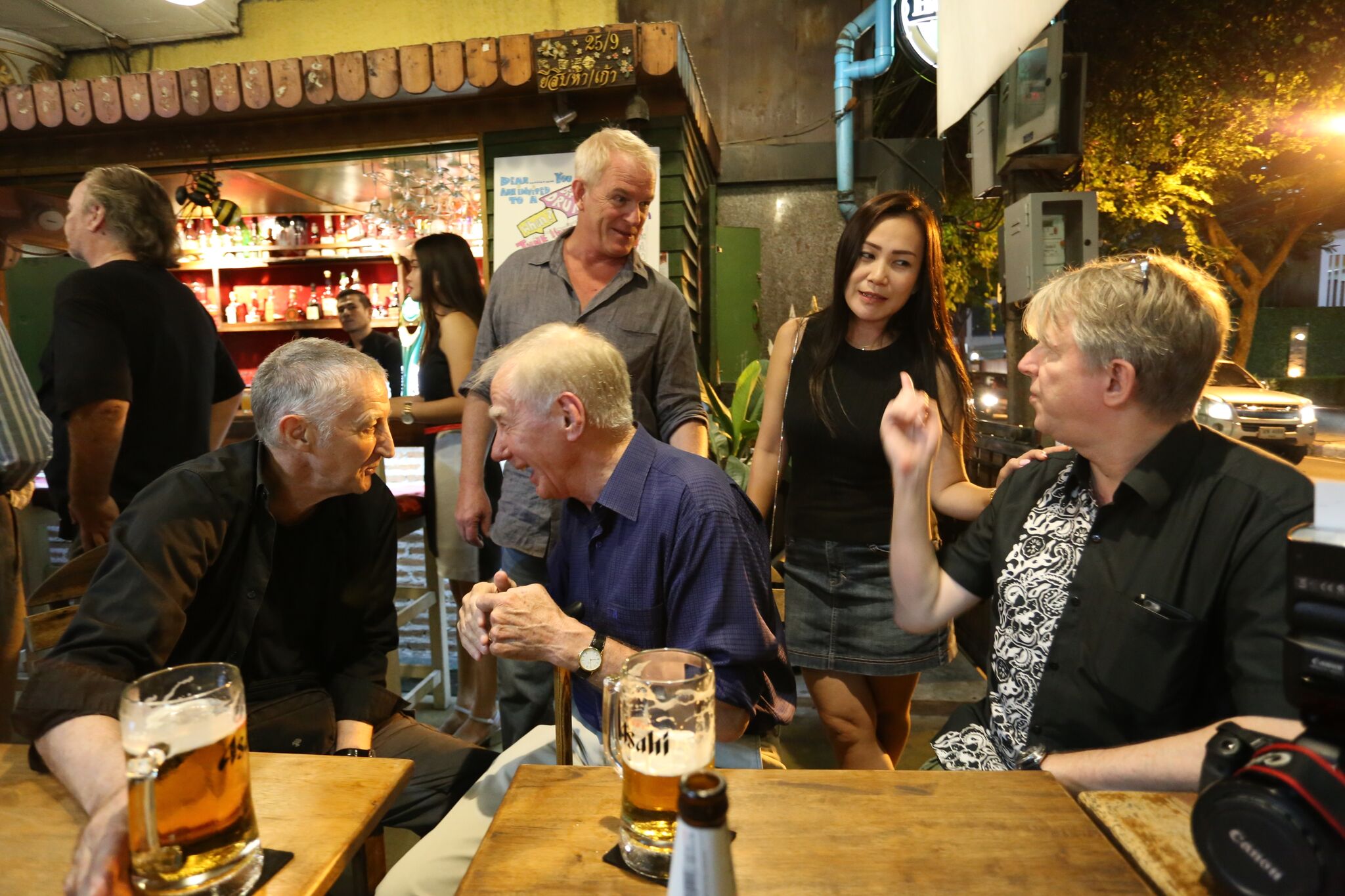
John Gartland, David Armstrong, John Fengler, Prewa, and Eric Nelson
(Photo by ALsdair McLeod)
To learn more about John Gartland’s poetry go to:
amazon.com/author/amazonjohngartland











 Thailand Footprint: Impressions left by the books, people, places and music of Thailand and South East Asia