Tales of Derring-do by the Dynamic Duo – The World According to Gop Featured Footprint

Click to Enlarge
Do what you can for who you can while you still can.

Click to Enlarge
Do what you can for who you can while you still can.
Introduction by Kevin Cummings:
The Beauty of Isaan is a non-fiction short story which first appeared in the book, Bangkok Beat published in June of 2015. It is being republished here with the permission of the author.

The Beauty of Isaan
By Thomas Hunt Locke
I jumped on the skytrain. “Exit at Nana, directly opposite the Landmark Hotel, you can’t miss us. Look for the sign, Checkinn99.”
The ‘you can’t miss us’ comment I later understood as Aussie humor. A glance at my watch showed I was early. I grabbed a beer and retreated back to the long entranceway I had just passed through. A Marlboro was torched. The photos lining the tunnel had not been missed. I now gave them the attention they deserved. A story, somewhat haunting, was on display.
The story of my appearance is worth noting. Stuck at a crossroads in my book, 450 pages in yet no ending in sight. Actually, the ending was clear, but how to get there? I’m a sleuth. No stranger to the labor of historical research, the answer lay close. A day or two, perhaps, and an article, an interview was found. The blog was titled ‘Stickman Bangkok’. I had never read it but the name was not unfamiliar. A name came to my attention. Mama Noi.
It would have been easy to walk into the bar, call her over, ply her with drinks, and get the information I was seeking. But, I had come down to the Big Smoke from up north. I needed to make sure the elderly mamasan would be on the premises. I needed to make sure she’d talk. Plus, an introduction to the owner seemed the polite course of action. My characters are often brusque. I am not.
Luckily I acted prudently. A friendship was born. The owner, Chris Catto-Smith, enthusiastically approved my request and encouraged Mama Noi to sit for the interview. A certain photo caught my eye. My mug was refilled. I lit up another stick. Bob Hope, a half-smirk caught in time, a stunning lady on his lap with an ample cleavage on display, acknowledged my presence. “This is a Sam Collins’ type of joint,” I murmured. An idea clicked in my mind. The ending to Jim Thompson Is Alive! crept ever closer.
The butt stubbed out, I was ushered to a shabby chic lounge chair and settled in. I had conducted several interviews to try to develop a sense of the times within which Jim Thompson maneuvered. One such interview, with a former US State Department official, had been quite helpful. Another, with a person prominent in the Thai art world, much less so. Both had been engaged with significant preparation. Mama Noi I would wing.
The interview actually began as I followed her movements around the club. The lady known as the Beauty of Isaan glided from one corner of the club to the next, four pillars observed, at each one a Buddhist ritual conducted. Strangely, I was taken back to my altar boy days at St Agatha’s. The thought then struck me, wryly, that back in her day Noi had likely taken many a lad not far removed from the frock. My mind was clicking. Sam Collins too was a Boston boy. Would a part of his past emerge leading him to Jim Thompson?
“Sir, would you like a drink?”
I noted Mama Noi walk past. “Sure, a jug of Heineken please. And what does the mamasan prefer?”
The comely young waitress smiled with a wink. A hint of Kampuchea (Cambodia) shone through her Thai eyes. My order arrived with my interview subject.
“Can I help you, darling?”
Dark tantalizing eyes bore into me. They seemed so familiar. Had I come across her before? Indeed I had. I was looking at the sexy young lady who had occupied Bob Hope’s lap those many years ago. Beauty fades. It does not desert. I was sitting with one of the most beautiful women I had ever encountered. My heart skipped. I fumbled with my words, an awestruck kid trying to find just the right tone of seduction. A shot of Crystal Head Vodka made its way to me.
“Chris, boss, sorry he late. Here, drink up, on the house.”
The shot of courage helped me find my groove. Mama Noi was funny, a fountain of information, and so at ease with her place in life.
“I came down to Bangkok from Ubon Ratchatani. Only 17, maybe 1960, and I found my way into this life.” She waved her arms around the room. “It was different then,” she said. Her voice was resigned yet not sad.
“Different how?” I asked.
“The name in those days was the Copa. The club I mean,” she clarified. “My name always Noi.” Mama flipped her head back in a deep laugh. She then squeezed her breasts. “Noi mean little. But the boys liked these, big.” I joined her revelry.
“Tell me about Bing,” I prodded. It was time to dig deep. Mama Noi was legend. She had seduced and been swept away by Hollywood royalty. When I exited out of the tunnel of memories, I wanted to know the story. I wanted to feel 60s Bangkok. Noi wasn’t just some girl in some club. The Isaan beauty was the girl in the club.
“We Thai do not, cannot, talk about people from a higher status. And it was so long ago…” Her voice faded away. “My memory is not so good.”
The waitress came to tend to our drinks. She refilled my mug. Another lady drink was ordered for Noi. The Crystal Head was smooth and quickly washed down.
“Where are you from?” she asked, her eyes beaming back to life.
“Boston,” I replied.
“Ah,” she laughed. “I remember the snow! The Boston Park Plaza. Bing loved to spend time there – ’66 or ’67, not too long before I returned.”
She seemed to relax into her reminiscence, and events of another era came flowing back to life. And it was quite a whirlwind adventure she had enjoyed with her Hollywood icon. Atlantic to Pacific, trips to Mexico and a bit of mischief in Paris. A lifetime in a fling. I let her go, us both enjoying the ride.
She finally, abruptly even, stopped. “You’re writing a book.” Her voice contained a dash of suspicion.
“I am.”
“Surely not about me.”
“No. I am writing a novel around the disappearance of Jim Thompson. Did you know him?”
“Oh no. But Bing and Bob would visit him at his house, you know, now a museum, from time to time.”
“And you never joined?”
“I was the mia noi, the second wife. I knew my place. But, even if I had, Thompson, from what I heard, wasn’t the type you got to know.”
I was puzzled at what she said. Cryptic. I tried to get her to elaborate but she danced easily away. Finally she held up her hand. “You see, every night I visit the four corners of our home. It is to keep the spirits happy so they will keep the ghosts away. Darling, you talk of a ghost.”
Mama Noi looked deeply in my eyes, then leaned over the table and kissed me gently on the cheek. “I hope you find what you are looking for. He is not here.” With that she was off.
In that respect Mama Noi was wrong. In that evening, within that moment, Noi led Sam Collins exactly where he needed to go. My voila moment had arrived.
Mama is now a friend. I always look forward, on my trips to the Big Smoke, to a night at Checkinn99. My first order of business is to buy the Beauty of Isaan a drink and sit for a chat. There is no talk of ghosts, just two acquaintances catching up. But, on your next trip, or if it is your first walk down the tunnel, buy a drink for the lovely lady from Ubon Ratchatani and let yourself be escorted into yesteryear.
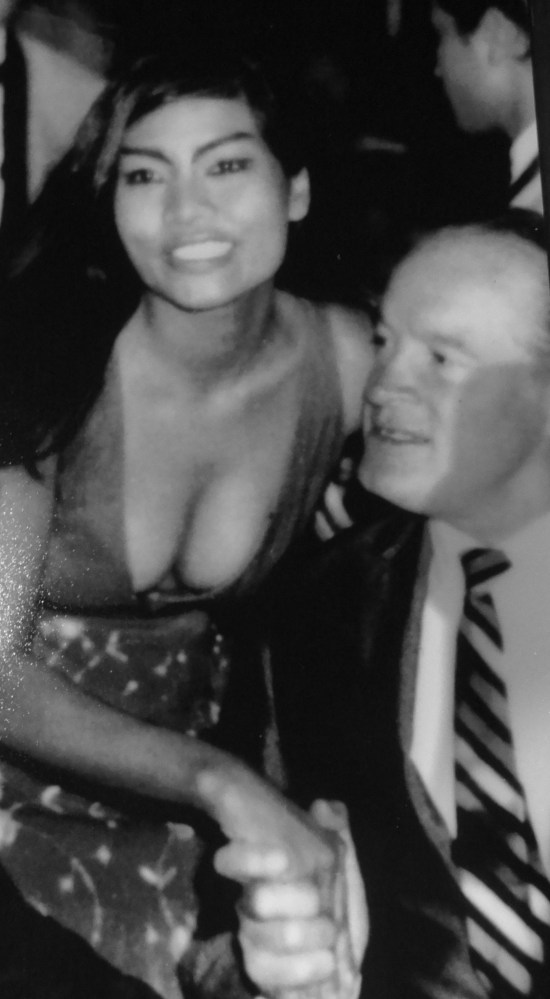
Noi seen with Bob Hope in 1968. (Picture published with permission by Chris Catto-Smith and Checkinn99.)
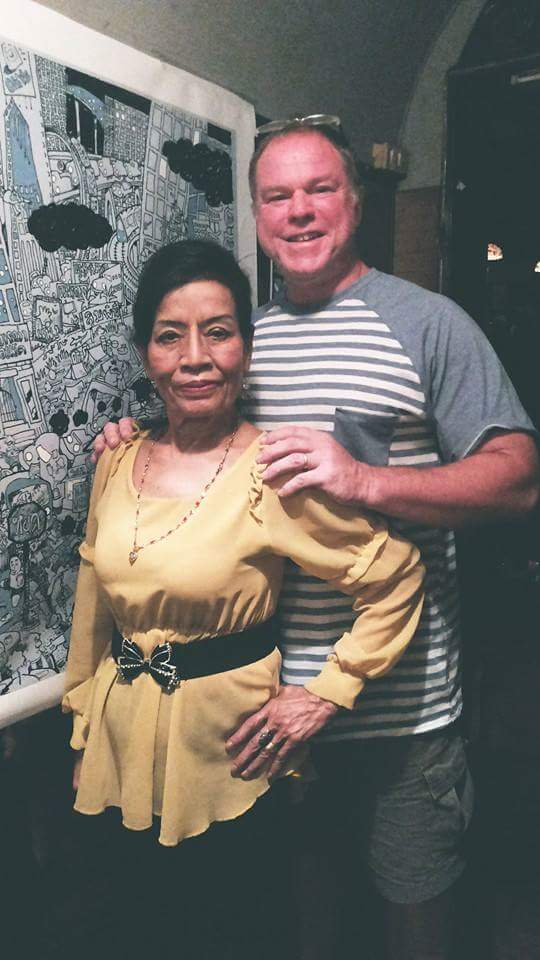
The present day Legend, Mama Noi seen with author Thom Locke in the picture laden and history filled tunnel entrance to Checkinn99
T Hunt Locke is the author of four novels to date: Jim Thompson is Alive; The Ming Inheritance; The Chiang Mai Chronicle; and his latest Vinland – A Dan Burdett Mystery.
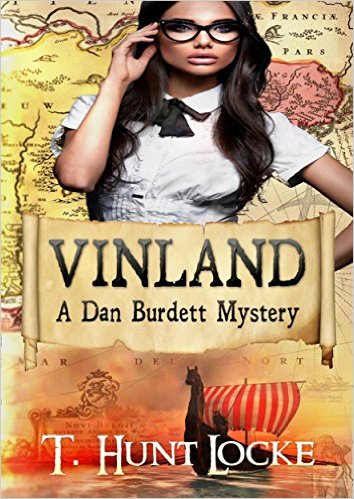
Click picture to go to the Amazon Author’s Page
You can connect with Thom on Facebook, here.
Or follow his WordPress Blog, The Locke Report by clicking the banner below:

Avoid the rush and learn about author Jack Fielding, now, at Thailand Footprint. Jack’s not particularly into self-promotion, which may be one reason I had not heard of him, until recently. My first thought after reading his writing: life isn’t fair. But we all knew that already, right? Jack currently resides in London and has spent a considerable amount of time living, writing, and working in Thailand. Jack enjoys the theatre, particularly if it is of the absurd. The strange worlds of Jack Fielding can be found on his blog, where he takes a satirical look at films, books and other things with a Zen point of view: http://jackfieldingauthor.blogspot.com

From his author web site found at jackfieldingauthor.com: Jack Fielding has worked and traveled throughout the world. Always drawn to the absurd and improbable, Jack has modeled cowboy hats in Tokyo, dined with General Franco’s English interpreter in Paraguay, informally coached Bangkok’s premier Elvis impersonator and once starred in a German travel commercial with a plastic dinosaur called Bernard. In his darker moments Jack describes himself as a “not terribly strident Zen Buddhist.”
Thailand Footprint welcomes Jack Fielding with mild trepidation.

KC: Greetings, Jack. I like your style. Your writing style. Your blog style. You even pull off wearing a hat and glasses with a certain panache. It’s been said you write absurdly entertaining fiction, often with a Zen edge. How would you explain your writing style to those unfortunates out there who are unfamiliar with it?
JF: Thank you and its great to be on Thailand Footprint! I seriously love books and everything to do with them – especially when they’ve got some kind of connection with Thailand. Digital books or trad I don’t mind. Just so long as they’re creative and out there!
For my One Hand Clapping stories, I guess I write in a minimalist fast-paced style. Hard-hitting. Less is more. When I’m actually writing I visualize the narrative being played out as a Tarantino or spaghetti western movie. I suppose I’m writing what I see. So my style is definitely born out of that. With Zen Ambulance I’ve tried to pare the narrative down even further, to give a stronger ‘Zen’ kick. I’ve also made up my own words, to help create a unique ‘one hand clapping’ world, fusing East and West.

I write across genres. So Shadows and Pagodas – an outrageous gothic tale set in Old Siam – has a more traditional style. I’ve even thrown in the odd archaic bit of English and Thai vocab – really love the idea of breathing life into long-forgotten words! Plus plenty of literary and movie references, too. With Neville Changes Villages I’ve stuck to a contemporary and relaxed style, reflecting the fact it’s a straightforward comedy about a guy in real-life Thailand in the 90s.
KC: What is the focus, if you have one, for your very original blog, Pulp Zen?
JF: Because I write across genres I thought my readers would enjoy a blog devoted exclusively to the ‘pulp Zen’ concept. Like the books, Pulp Zen draws in a lot of things really. Not only Zen Buddhism but samurai and spaghetti western movies, nikkatsu cinema and American / British noir. Teddy Boys, rockabilly. Retro streets. Vintage comics. Also very much about retro Thailand, you know back to 50s Bangkok and much earlier. I’m really fascinated by it, especially as there’s so little physically left. Zen City is particularly hot on breathing new life into all that long lost social history.

KC: Talk about death, just for the fun of it.
JF: One of the themes in my books is death and absurdity – always a laugh a minute around here – so I’ll share what I think by way of a true story:
At one time I was keeping a low profile in a fleapit river town called Concepcion in Paraguay. Every damned night I was plagued by the same dream: I was a young German guy called Nobby Tirpitz, working on a giant airship as a lavatory attendant in 2nd class. I had this special mop, given to me by my grandfather Othmar who had run a public convenience in Hamburg railway station. Anyway, I was in terrible danger in that airship. Trapped in the lavatory while a terrible fire raged outside, acrid smoke pouring in and the airship listing badly. Using my penknife I just had time to carve a message on the handle of the mop then shove it through a tiny porthole. There was an awful roaring noise…then I woke up.
Years later I was living in Thailand and teaching English. Porntip was one of my best female students and one night she invited me to her family house in Don Muang (where the old international airport used to be). Her dad was a colonel in the air force. Well, I met the folks and had fantastic meal. Then her dad took me into the garage to see his collection of memorabilia. Medals, a WW2 Japanese flag and an oxygen mask, that kind of thing. And then I noticed what looked like a wooden pole. It seemed out of place so I asked him about it. He explained it was a broom handle from the Hindenburg, the airship that had exploded in 1937. Said it had some writing on it but it was in German. Well, I knew German and picked it up. I went all cold. The handle seemed strangely familiar. Then I read the writing. Incredibly it was the message I’d written in the dream – ‘Anyone want to buy a cheap airship!’
You know, I’ve never forgotten that uncanny dream and the mysterious mop handle. Death, rebirth and multiple lives. I suppose it also explains why lavatories keep appearing in my books. In Zen City, Palmer is in one when he experiences the ghastly dream sequence at the end. Milo the assassin-monk emerges from a weird roadside toilet in Zen Ambulance and Neville’s family keep surprising him when he’s sat on the bog inVillages.
One thing’s for sure – ever since, no matter where I am in the world, I’ve always tipped big when I use public lavatories.
Like I said, death and absurdity.

KC: That’s the best mop handle story I’ve heard since … well, that’s the only mop handle story I’ve ever heard. One of my favorite fictitious private eyes of all-time, Nick Danger, was once told a good line in the Rocky Rococo caper. It went, “You can’t get there from here.” You said earlier, it’s always a laugh a minute around here. How would you describe your, here? And throw in a few there’s also. Where have you been? But leave out Paraguay if you don’t mind.
JF: “You can’t get there from here” is a brilliant line really. Love it, especially when they’re laconic. I’ve always been interested in the military history of the Spartans and they were famous for it. At the battle of Thermopylae Leonidas apparently said to his 300, “Either that’s the Persian army or the new vacuum cleaners have arrived.”
Now where was I? Oh, yes. Where is ‘here’? To be honest, I don’t know. I’ve never been able to stay in one place for very long. I hitch-hiked to Normandy when I was sixteen and never looked back really. I don’t own a car or property, always spending my wedge on trying to get to places – the less fashionable and visited the better. Either to live in or hang out in bars and cafes. Shooting the breeze with strangers, getting to know people. Listening rather than talking (and taking copious notes afterwards). I’m wary of trotting out a list of places I’ve been to – I hate that approach to travel. Going to other people’s countries is always a privilege, one that most of the planet’s population don’t have.
Having said that, you did ask! Well, lived in Finland for a while, in a Helsinki suburb. As a genuine English Teddy Boy, in a country where 50s rock and roll was mainstream, I was briefly a legend in my own lunchtime. That was also where I met my first wife (short marriage, long story). Inspired by the final sequence in Elvira Madigan, I got my butterfly tattoo in the sailor’s quarter in Copenhagen. I lived on a Prague council estate in the 80s (during their first free elections) and hung out in the St Thomas pub with some ex-cons who wore pinstripe suits with very wide lapels. I’ve been shouted at in Algiers, tricked into buying an expensive pair of slippers by a blind African man in Paris and getting my bottom pinched mercilessly by a Guarani Indian girl on the Argentine border. I think her name was Marina. Strong grip, too. Throughout the 90s I was forever crossing borders into Laos, Cambodia and Kelantan. Later, I spent quite a bit of time living near a sex shop in Transylvania and in Pest I ended up being a sort of unofficial therapist to a manic depressive café owner who was owned by an Arab gentleman – the girl that is, not the cafe.
Inevitably, I’ve also spent a fair bit of time in Britain. Although my experiences here haven’t always been as positive. Getting my nose broken by an amateur boxer in a working men’s club in Newcastle (he bought me a pint afterwards), thrown on the tube tracks in east London, racially abused in Leicester and completely failing to buy a Polish sausage in High Wycombe.

KC: I’m intrigued by your making up your own words in your One Hand Clapping novels. Give me some examples of those words and their definitions.
JF: Yes, one of the ways I’ve tried to build the One Hand Clapping world is to create a unique vocab, fusing fact and fiction, East and West. Also provide info on retro Asia (particularly Thailand) and related matters which I thought my readers might find interesting. Here’s something I posted on my Strange Worlds blog a while back:
Atomic Age – the mid to late 1950s.
Bushido / ‘the code’ – warrior code of the Japanese samurai that drew on Zen Buddhism and Shinto teachings. A warped movie-trivia version of the code was adopted by the Colonel’s psychopathic gunfighters, the Four Truths.
Generalissimo Vissaek – fascist dictator of Siam and ally of the Axis powers.
Iso Isetta – the iconic ‘little Iso’ bubble car was designed by Renzo Rivolta, a successful manufacturer of refrigerators. These wonderful cars were incredibly expensive in Bangkok because of the heavy import duty.
Kamikaze Boogie – Thai rockabilly hit penned and sung by Johnny Izu.
Kouk Moun Kid – the long-forgotten star of home-grown Siamese Westerns.
Noir Age – roughly, the 1940s and early 50s.
Siam – the original name of Thailand. It was changed by Field Marshal Phibunsongkhram in 1949 as part of his modernisation programme, along with making men wear hats, women wear gloves and everyone putting on shoes when they went outside.
‘Siamese salute’ – slang term used by some foreigners in the Noir Age. It refers to the traditional Thai greeting, which involves bringing the hands together. Properly called a wai.
Shoho – name of a notorious girl gang, it means ‘Auspicious Phoenix’. The girls took the name from a famous aircraft carrier in the Imperial Japanese Navy.
‘slippy shippy’ – slang term for goods smuggled into the Bangkok docks by ship.
Teddy Boy – Street fashion that erupted on British streets in the early 1950s and quickly adopted by cool yakuza. It celebrated an Edwardian look, replete with velvet-collared drape jackets and waistcoats. Die-hard Teds can still be found in remote parts of Britain.
Ticals – currency used in 1940s Siam. Plenty of references to it in Reynolds’ novel, A Woman of Bangkok.
Amazingly, I’m still in one piece. Like Vivien Leigh I’ve always depended on the kindness of others. And, of course, being a good listener and non-judgemental helps – as does being able to retreat into my inner world. Maybe that’s where ‘here’ really is.
KC: I have enjoyed this interview, Jack. More than I would admit publicly. What’s on the horizon for Jack Fielding? What are you working on personally and professionally?
JF: Yeah, this interview has been excellent actually, and tweaking the nose of absurdity along the way always helps! Actually, on a slightly more serious note, your questions have also prompted me to reflect, not only my writing but also what I’ve got up to over the years. As Orson Palmer would say, No one is more surprised than me.
I’m currently finishing off the latest version of Neville Changes Villages, with the help of the author Matt Carrell. All about a dysfunctional English guy teaching in Thailand in the 90s. The basic theme isn’t exactly new – but I think the way I tell it is! You know, giving it the ‘Jack Fielding’ treatment.
Then I’m working on a collection of short stories. They’re retro sci-fi, inspired by the vintage comics of Alan Class like Creepy Worlds and Astounding Stories. But instead of being American the stories are set in Siam. They’re a mix of absurdity, crime, speculation, dark comedy and just the plain weird. Inspired by our interview, there might be a guest appearance by one Nobby Tirptiz.
After that, I’m either going to get back to the One Hand Clapping stories (I’ve got rough drafts for about four more of those) or I might take a different direction. I’ve got the beginnings of a novel about a dysfunctional young guy growing up in south-east London in the early twentieth century and his involvement with the new film industry. It will link in with the mysterious Shadows of Siam film that gets mentioned in Zen City, Iso. Also it will be a bit of homage to the lost world of British silent films, which I’m quite keen on.
On a personal level, I could well be moving to Switzerland later in the year. It will be a brilliant place to raise my family. And at some point I really, really need to get back and visit Thailand. Apart from family, friends and wonderful temples, it’s important my two children develop their Thai heritage. Oh, and I want to take my family to the home of Kukrit Pramoj, the author of the superb Four Reigns, to pay our respects.
My two young children are absolutely wonderful. All my creative work is ultimately dedicated to them. If they show any signs of creativity in any form, I’m determined to encourage and nurture it. I don’t want them to be like me – it took me literally years to pluck up the courage before I finally put pen to paper. Lack of self-belief is a terrible thing. When my children are older, I hope my books work will inspire them to work hard, be creative, keep moving. That’s my main motivation really. And the fact that I need to get all these damned stories out of my head and onto paper!
Thank you for giving me this opportunity to talk about my books and also the more personal stuff. Really appreciated.
KC: Thank-you, Jack. Keep the Zen edge and the absurd outlook coming. Here’s to hoping I never get a tip from you in my next life.
Send Jack a Facebook friend request HERE
Jack’s books may be found at the various Amazon sites.

Christopher J. Minko was born in Australia in 1956, a child of European refugees and grew up outside a small Victoria bush town. From an arts and major event management background he spent a decade working for various Australian artistic and educational organizations, including the Moomba Festival and the Victorian Ministry for the Arts. He also served as events director for the Australian Football League’s Grand Final, the nation’s largest annual sporting event. Minko first came to Cambodia in 1996 as a technical advisor for the Cambodian Disabled Peoples Organisation, and went on start Cambodian Disability sport programs. In 2003, he founded the Cambodian National Volleyball League (Disabled), which has become a model for sport and rehabilitation, and has also begun a countrywide wheelchair-racing program.
Minko and I have a mutual goal of bringing the Cambodia Women’s National Wheelchair basketball team over to Bangkok to play a Thai National team.
Christopher Minko is the lead man for the Cambodian noir band Krom, which made a historic three venue debut in Bangkok, Thailand in December of 2014. Krom strive towards originality at all times, they work acoustically and have the objective to establish a musical genre called contemporary Mekong Delta Blues, based on the merger of Delta Blues guitar work with the magic and mysticism of Khmer vocal sounds. Krom is unique on many levels, one of them being that they are a bilingual band, Khmer and English.
Thailand Footprint is pleased to have Christopher Minko back today to discuss, among other things, his new song Taliban Man.
KC: Christopher, welcome back for a second interview at Thailand Footprint. Our last interview went two parts and ended up in a couple of newspapers in Thailand and Cambodia. Lets see where this one goes. Today’s interview will be short, sweet and sour. You can’t escape sour in many Krom songs. And that’s putting it mildly. Taliban Man is no exception. It’s your latest release. Tell me where the inspiration came from and how long Krom worked on the song creatively once you had the lyrics down?
CM: Probably enough love songs floating about out there mate and someone has to do the dirty work and sing the songs that tell of the very sad reality of; it’s a mighty fucked up world out there at the moment and that we need to speak out or sing more about the grave social injustices and horrendous levels of violence and slavery that are enveloping this world.
It is the historical role and responsibility of the musical troubadour to write and sing about these issues, so in a world dominated by plastic mind numbing music and with very few troubadours left, that’s what Krom does (acknowledging author Christopher G Moore for that last reference to the role of the troubadour).
All KROM songs come from the heart – Like that master songwriter Willie Nelson said in a recent interview –“he doesn’t know where the songs come from – they just appear from somewhere (one doesn’t ask where…) and when they do appear in this unexplained way you make sure you damn well follow through with them” – I find similar – they fall into the Minko head (often unannounced) and in fact one is slightly tortured until they get recorded otherwise the song just keeps going around in the head which is not a good thing after a few days.
So with Taliban man – I am the father of a now 21 year old daughter whom I raised on my own and of course I dearly love my daughter and am proud of her successes and growth into a confident woman – so I am a parent –When I heard of the Taliban massacre of the Pakistani schoolchildren – It somehow belted the shit out of me; the tragic and utterly insane concept of adults murdering innocent children is, for me, the ultimate act of cowardice and somewhere in the equation I see humanity as sliding downwards into an abyss of no morality covered by a cesspool of blood and I am horrified that humanity can stoop so low with such acts of violence – The level of violence and selfishness that is swallowing the globe, deeply disturbs me along with the increasing use of children in warfare – so all of a sudden the following lines came into my head.
“Yeah, I’m the man
I’m a Taliban Man
I shoot little children
In the head
Ah gotta make sure
That they are dead”
….and from there came the song Taliban man
And it became, like so many Kromsongs; “a song that has to be sung.”
KC: The song opens with laughter and gunfire. Tell the story of Taliban Man to our readers as a lyricist might and then in broader fashion – how it could be interpreted by different listeners.
CM: Very simple / very blunt – Taliban man describes the ultimate act of cowardice carried out by so called “men” who slaughtered 165 Pakistani schoolchildren – Adults killing Children ! – a senseless, brutal violent act of pure cowardice and the horror of this tragedy is described within the lyrics – the lyrics are very simple and are meant to be that way – To the point – for example
“A bullet in the chest
A broken breast
Her blood on the floor
Naked and raw”
Recognizing the complexity of the theme and the sensitivity of current global politics, I have included the below KROM statement about this song in order to avoid confusion or a misinterpretation of the song – however I very much stand by this song, as I repeat – It’s a song that needs to be sung and I do acknowledge that mockery is a very very powerful tool to campaign against violence in all its manifestations.
A KROM Statement: This KROM song is dedicated to the hundreds of thousands of innocent children killed in war and civil conflict. The lyrics can be equally applied to the thousands of Jewish children gassed in Nazi concentration camps in WW2, to the multitude of children who died under the brutal regime of Pol Pot in Cambodia, the recent kidnapping of innocent children by Boko Haram and the innocent children currently being killed by US drone bombs in Afghanistan. Saddest of all is the recognition that even in the 21st Century, humanity continues to use innocent children as tools of war and civil conflict.
KC: The Bangkok Post journalist Alan Parkhouse wrote a great article with the headline Dark sounds from the Cambodian soul in the December 18th, 2014 edition, prior to your three Bangkok events. Tell me what the Bangkok concert dates were like for you and the other members of Krom and when can we expect Krom back in Bangkok?
CM: We had a fantastic time in Bangkok for many reasons, great venues, finally a listening and attentive audience and wonderful and very professional hosting of the band by the 3 venue operators. Most of all I felt that KROM came of age in Bangkok. The band were very cohesive, travelled well together and by the third night we were all on a true natural high as a result of the music being made and the many positive responses to the music of KROM. It was also a wonderful opportunity for the band to meet many of the Bangkok based authors such as yourself and James Newman and many others whom I was delighted to finally meet in person and it gave me the opportunity to thank all of our KROM friends in Bangkok who are supporting the creative endeavours of KROM. I was also very proud of and humbled at the historical nature of the gigs given that KROM are one of the first Cambodian contemporary bands to perform in Bangkok due to the lack of cultural exchange between Thailand and Cambodia as a result of decades of unwarranted and politically manipulated animosity between the 2 nations. The Khmer members of the band were greeted at all times with open arms and respect by all of the Thais within the audiences – a truly great trip indeed and we are looking at returning to Bangkok for a minimum of 3 nights of performances in May of this year.
KC: Salmon Rushdie in a May 11th, 2012 New Yorker article titled simply, “On Censorship” wrote the following:
“Great art, or, let’s just say, more modestly, original art is never created in the safe middle ground, but always at the edge. Originality is dangerous. It challenges, questions, overturns assumptions, unsettles moral codes, disrespects sacred cows or other such entities. It can be shocking, or ugly, or, to use the catch-all term so beloved of the tabloid press, controversial. And if we believe in liberty, if we want the air we breathe to remain plentiful and breathable, this is the art whose right to exist we must not only defend, but celebrate. Art is not entertainment. At its very best, it’s a revolution.”
Talk about your art in the terms that Rushdie discusses. And also specifically the whole concept of rocking the boat. There are those out there – and I am sure you know this – that say, you shouldn’t rock the boat. Tell us, again if you have to because it is important, why the boat needs to be rocked. And if you can discuss the recent Charlie Hebdo slaughter in Paris, France in those same terms please do so.
CM: Great question, great quote Mr. Kevin. Allow me to start this answer with quotes from three truly remarkable musicians who understood fully that original art is never created in a safe middle ground and there is no doubt that they also understood the responsibility they carried, not only in their lyrics but also in the quality of their musicianship and they knew that with both of these elements combined, pioneering works of powerful political musicianship were being created with their works revered to this very day.
From three great musicians:
“This machine kills fascists.”
Woody Guthrie
“The world is filled with people who are no longer needed — and who try to make slaves of all of us — and they have their music and we have ours.”
Woody Guthrie
“I know the police cause you trouble
They cause trouble everywhere
But when you die and go to heaven
You find no policeman there”
Woody Guthrie
“Slavery has never been abolished from America’s way of thinking.”
Nina Simone
“I’m a real rebel with a cause.”
Nina Simone
And a very important Q+ A with the legendary Pablo Casals. The legendary cellist Pablo Casals was asked why he continued to practice at age 90 and he answered:
“Because I think I’m making progress.”
Krom does rock the boat in a musical world now dominated by mediocrity and artists subservient to the mundane musical meanderings of corporate greed and the power of the political lyric has sadly been lost. Krom rock the boat quite deliberately. From the onset we set the objective to adhere to Pablo Casals advice in term of musicianship and to not hesitate to write lyrics about tragic social issues that often remain unspoken or only mentioned in a tokenistic sense when the world is now riddled with problems such as human and sexual slavery, being at the highest point ever in the history of humanity along with an ever increasing level of violence internationally including the murdering of thousands of innocent children as part of an accepted mechanism within warfare. Krom accepts its traditional role as the ancient troubadour: to observe and to write about life and sadly all its misery as we see it, and to be honest in that depiction with the hope that somewhere along the line the music and lyrics will assist to effect positive social change. The world does have the potential to be a remarkable place and there are truly inspiring individuals such as the recent Uruguayan president who resigned with a remarkable dignity and humility that is sadly missing in today’s world leaders. Krom does not seek to preach, we simply try to describe the world as it is, a world trapped in selfishness, greed, suffering and tragedy with problems that seem endless. Like Charlie Hebdo, Krom often use mockery within the lyrics as we recognize mockery’s power to counteract violence and social injustice.
Whilst our songs are often harsh and even brutal in their content we hope that Krom songs act as a catalyst for thought and that our music may assist the process of positive change “in a world where humanity has gone stark raving mad.” (From the Krom song, 7 Years Old – Her Body Sold). Even though our songs often ring of despair – Krom retains hope and please – don’t just listen to the words ( although we want you to !) – It’s also about the music as that’s what Krom is so Krom on!
KC: What’s the best way for our readers to support Krom by purchasing Taliban Man – where can we find it?
CM: In January 2015 Krom signed with Hong Kong’s Metal Postcard to promote sell and market Krom’s complete back catalogue and all future releases.
This is the statement from Sean Hocking the CEO and Founder of Metal Postcard Records:
Metal Postcard is thrilled to have Krom join the label. They are without doubt one of Asia’s most interesting and forward thinking acts tackling issues that you won’t be hearing any time soon in C, M , K or J pop songs ! We look forward to getting Krom recognition worldwide.
(You can check out Metal Postcard Records on Facebook at: https://www.facebook.com/MetalPostcardRecord ).
[For a free download of the Krom song Don’t Go Away from BandCamp click here ].
KC: Thanks, Christopher for coming back to discuss the latest Krom happenings here at Thailand Footprint.
CM: Anytime, mate.
Follow Krom on Facebook: www.facebook.com/pages/Krom-Phnom-Penh/214467175289003
And @KromSong on Twitter: twitter.com#!/KromSong
Official Krom website: www.themekongsessions.com
Today we’ll run a reader’s poll on whether or not you, the reader of Thailand Footprint, like a poem or not?
But first, people have been asking when my book, Bangkok Beat, will be out? Well, two people – one family member and one apparent stalker who I think wants to retaliate for a lukewarm book review I gave a long time ago. But interest is interest in the 21st Century publishing world.
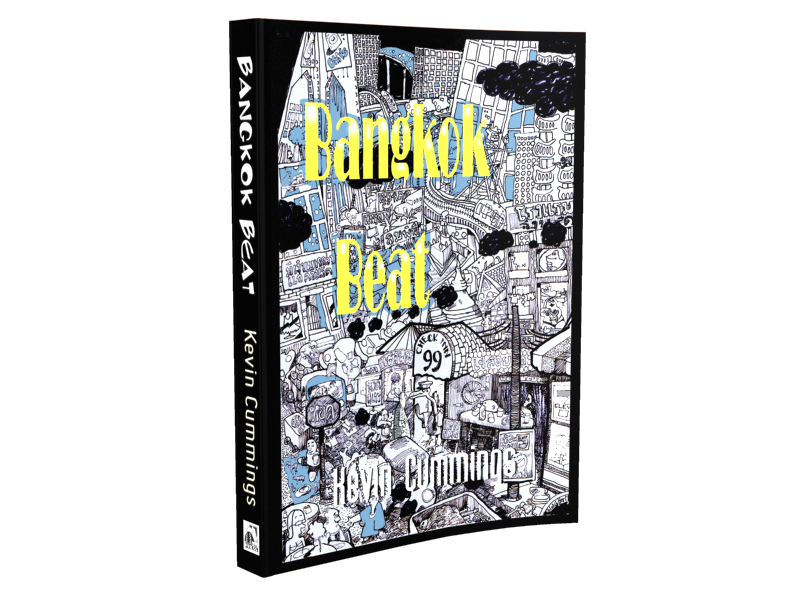
The paperback and Ebook will launch simultaneously, hopefully by late-March or Early April. It will contain new stories and previously published blog posts from Thailand Footprint. Plus a great chapter on the iconic Bangkok cabaret bar, Check Inn 99. In addition standalone chapters will include six noir poems written by the Poet Noir, John Gartland and a wonderful story written by Thom H. Locke about the legendary Mama-san of Check Inn 99, Mama Noi, titled The Beauty of Isaan. Stay tuned. Ebook price will be $4.99. Paperback $12.99.
I wrote Bangkok Beat to please two people: Check Inn 99 owner Chris Catto-Smith and me. We’re almost there. Anyone else it pleases will be a bonus.
One of my all time favorite writers is Kurt Vonnegut. Lately, I’ve been re-reading his book of short stories, the 50th Anniversary edition of Welcome to the Monkey House, which I picked up at The Elliot Bay Book Company, when I was in Seattle, Washington for a few days in May of 2014. I am really enjoying some of Vonnegut’s earliest brilliance. If you haven’t read any Vonnegut in awhile or never have, this is a good one to go back to in order to rediscover the genius of his writing. He is popular for a reason – he’s good. Here is what the original cover looked like when it first came out in the 1960s:

I cannot imagine a world without Vonnegut wisdom. It has served me well since I was a University Freshman and 18 years old. Here’s a quote I have always liked from his novel, A Man Without A Country:
“The arts are not a way to make a living. They are a very human way of making life more bearable. Practicing an art, no matter how well or badly, is a way to make your soul grow, for heaven’s sake. Sing in the shower. Dance to the radio. Tell stories. Write a poem to a friend, even a lousy poem. Do it as well as you possible can. You will get an enormous reward. You will have created something.”
― Kurt Vonnegut,
I agree with Vonnegut on the substance of the above quote, as I often do.
Here is where you, the reader, come in. Below is a poem. The author is not me – that’s all I will say at this point in time. What I’d like you to do, is read the poem and then take the poll, if you are so inclined. Most people are not inclined to take polls. I realize that, but we’ll give it the old college try. The poll will run for 48 hours – two days. Give it a go. It may be fun.
Here’s the poll. The poll is now closed. Thanks to all those who voted. I liked the poem. So did 11 other people. Only 3 against. You can view the results below. Thanks for the feedback. It was helpful!
Tonight we’ll light the neon. We’ll bring the wanderers home.
Spark up the coals and call the ships to port.
Come light up your contours from the inside and the shadows will fascinate the crowd.
You’ll see your will is marked when it’s lit from within.
The panic zone is all four walls, a melting realm of mirrors.
Complication is the comfort zone, mania the state of grace.
We are worms, pilgrim, we are tarnished coins.
It’s show time, your darkest hour.
You edge along the gills of the night, your heart aflame with burning songs.
You turn from your past for a more compelling now.
Facts are abandoned for superior fantasies, and who can stand to miss the fun?
Skiffs and brigantines glide like underwater shadows to ply the trade.
Come and set your fever loose to run between electric islands.
Welcome to the lucid trance where your quickened blood turns to ink.
The patient night is waiting for all you have to give.
It’s you again, walking into our midnight arms to create us.
You prowling sifters are mining the tangled gossamer yarns,
Paralyzing them in the amber strobe of your art.
You darken the doors, and then you darken the rest of the street.
You invite us, and we follow because we sense the importance of the journey.
A wheel has finished spinning – to pause and then reverse.
This blazing gyre is a vision of exhausted motion.
The city is busy erasing its inhabitants and their seasons.
You are only done when we are done with you.
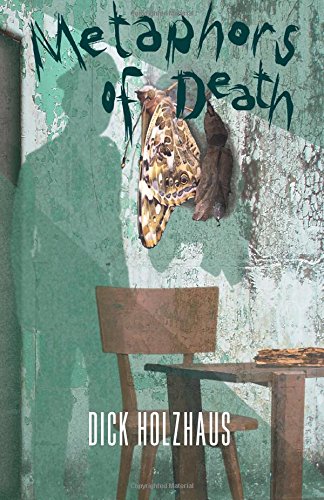
[Here is a book review I wrote for Chiang Mai City News a few months back but never got around to posting here]:
Metaphors of Death is written by former Chiang Mai resident and Netherlands author, Dick Holzhaus. The plot involves philosophizing reporter, Tom Terrence for LannaLife Online. In spite of the facts (or perhaps because of them) that Tom is a former glue sniffing teen from England, with drug and alcohol addictions, he has been offered a promotion from the food and entertainment magazine to that of Editor for a planned online legitimate newspaper. Tom’s also a misogynist or a whore lover, depending upon your point of view, with a penchant for variety of all kinds as long as it doesn’t involve material possessions.
The story opens with a poisoned batch of yaa baa making the rounds through the Rose of the North. Tom likes his medicine crazy, he buys a bag, smokes it and ends up spending a week in a coma. He awakes to learn that the same faulty meth he purchased has claimed the lives of three foreigners plus a Colonel in the Royal Thai Police. One of the dead may have been murdered and gay rape is involved because, why not? This gets the attention of the BBC who wish to take care of their own and take on the Thai police and military brass as well. A turf war and cover-up over major drug trafficking is in the mix. Jon a well-connected Thai national and owner/publisher of LannaLife Online cooperates with the BBC on the story and Tom ends up assigned as translator and peer for BBC journalist, Rick Drummond.
An international drug and death investigation story in tourist-town Mecca coincides with the launch of the online newspaper. The chance for Tom to become a real alcoholic-journalist appears to be in the cards. His future’s so bright he’s gotta wear Ray Ban’s. There is also a dogeared manuscript Tom has been working on for years as a struggling writer, preserved in a plastic bag. It is either potential kindling for a fire or Booker Prize material, depending on Tom’s meds. Our leading man still finds time for a genuine romantic interest to appear and she neatly doubles as a helpful editor.
I’ll let the brooding prose of Dick Holzhaus take over from here:
On Tom’s abode:
My one room apartment is deliberately depressing. I’m a prisoner of life so I live in a cell. It’s shabbiness reminds me of being a convict, my penal servitude lies on the rickety table against the wall.
On the mountains of Chiang Mai:
I like sitting in the dark on the mountainside next to someone who is new here and looks at it with different eyes. That really makes me belong here. Then I realize my confidence is backed by the cabin behind me. However familiar as a view, at nightfall the jungle becomes alien territory. This world turns pitch black for a change of shifts, pieces of bark and soil move and life forms that can see in the dark appear. Distant fires flicker through the canopy, not spreading their light, just glowing pin pricks in a black vacuum.
On Tom’s favorite philosopher:
Celine never theorized, he is the only philosopher that truly dissected the nature of humankind by describing revealing events. Maybe a proper war would help my writing.
On drugs and alcohol:
If I don’t take control soon, alcohol and drugs will be the end of me. Tonight is Friday, so that’s okay, everybody has a drink on Friday. I look at my glass, still half full with this treacherous stuff. Burping in my fist I realize I might be expelling pure alcohol fumes. I have to find out if I’m a dragon. I swallow air and burp loud at the candle on the table, it extinguishes.
On western women:
Straight western women have the worst deal here. Thai men find them big, smelly and bossy. The few white women that have relationships with Thai men are looked down upon by their peers. Having sex with animals would be less dishonouring.
On prostitution:
Our initial rent negotiations consisted of Adelina instructing me how she wants it and after some fine tuning that’s how she gets it … That’s how I earn fifty percent discount in weekly installments. After two months I still find the paying rent exciting. I like being a male prostitute.
On Tom’s view of Bangkok:
I don’t see a thriving society. Bangkok is way past livability. I would die here in two months. Everything is upside down; filth and crime have become integral parts of this pool of doom. The glamorous high rises are all paid for with drug money.
On Bangkok water taxis:
I would never sit inside a water-taxi. I can picture the scene when that thing hits a tow-boat at full speed. The captain and crew are in a world of their own. Thais change when they control motorized vehicles; no more sabai-sabai, no more graeng jai, no more smile.
On the BBC:
We are the bloody BBC! We are not impressed by police officers that think they’re bleedin’ emperors. We have two dead Brits here, murdered or killed in a popular tourist destination. We are going to find out all there is to know. Period.
On family:
…the front door opens and my older sister appears. Still living here; too ugly to marry, I guess. I point at her while I shout at my mother. “Why could she stay and I not?”
Despite the Gloomy Gus tone throughout the book, Metaphors of Death has a happy ending – several, actually. Things work out well for LannaLife and Tom’s career. I would have liked to have seen more of an antagonist character developed for Tom to take on, besides Bangkok and western women, I mean. The drug dealer was a possibility but he vanishes after the first third of the book. More of the well-heeled Jon and the minimalist Tom in the newsroom would have been another enjoyable scenario – like a reverse gender Perry White and Lois Lane from The Daily Planet.
For readers looking for a peculiar yarn, featuring a quirky yet oddly likable protagonist tethered mostly to an accurate Chiang Mai backdrop, Metaphors of Death by former ad man, Dick Holzhaus may be right up your alley. At 160 pages, it can easily be read on one long flight. Ebook may be found through Spanking Pulp Press, Amazon, Apple and Barnes and Noble.
.
.
For more information about the author go to: whatadick.wordpress.com/

Here is what people are saying about Bangkok Beat and Check Inn 99:
In a Bangkok which is quickly destroying all signs of its past glories in favor of shopping malls, Check Inn 99 stands as a beacon of hope to those of us old enough to remember it in all its mutations and still young enough to enjoy it as it is now. Bangkok Beat, in a series of short stories, up close interviews and artist profiles, chronicles some of the amazing history, people and entertainment found in Bangkok and often at Check Inn 99. Many of the stories have been provided by the very creative owner, Chris Catto-Smith and his dedicated staff.
Dean Barrett, author of Kingdom of Make Believe, Hangman’s Point, and Pop Darrell’s Last Case
Bangkok 2015 is like Paris circa 1900 or Berlin in the 1920’s & 30’s, a vortex of noir where artists, writers, poets, filmmakers, journalists and musicians search deep into the darknesss for a glimpse of humanity and hope…..Kevin Cummings is one of the brave souls walking on the edge of the darkness in order to document its depth and breadth.
Chris Coles, artist & author of NAVIGATING THE BANGKOK NOIR
A fascinating collection of interviews, literature reviews and stories from Thailand and the region. Kevin focuses on one of his favorite expat nightlife venues — Bangkok’s Check Inn 99 — with accounts about musicians, poets, authors and other night owls.
Melissa Ray, 4 Time Muay Ying Champion in Thailand and blogger of Muay Thai on the Brain
Chris Catto-Smith has a pig headed determination to give a voice to the often unheard talents of, writers, poets, actors, singers and artists. Check Inn 99 is a highly refreshing venue in a stagnating entertainment scene that only seems concerned with cheap copy bands that have churned out the same old tunes, forever. Chris, and those who support his vision, such as Thailand Footprint blogger Kevin Cummings whose new book, Bangkok Beat, is a collection of real events including entertaining stories involving the colorful history of Check Inn 99, could well drag Bangkok kicking and screaming into a brave new world, which it will be thankful for in the end because… it doesn’t get any better than this.
Kevin Wood, singer, musician, actor and author of, Opium Sparrows
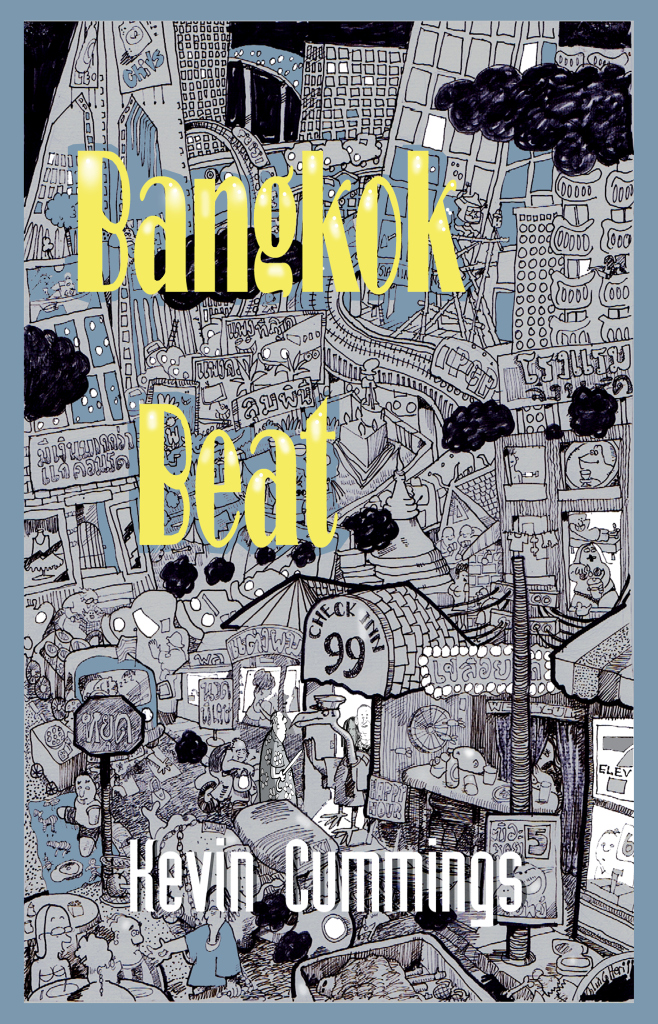
Bangkok Beat is now available at all Amazon and Create Space stores as well as

Oyster Books app


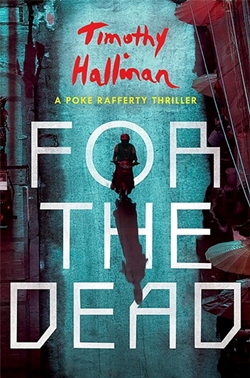
FOR THE DEAD by Timothy Hallinan – A Book Review by Kevin Cummings
If you’ve read any of the first five Poke Rafferty Bangkok Thrillers by Timothy Hallinan chances are you became a fan of the series. You do not get the Edgar Award, Macavity Award and Shamus Award nominations and have NBC develop your Junior Bender novels into a television series by Tweeting. You do have to write at least sixteen novels, though, plus a lessor known fact, Tim Hallinan has written a book of non-fiction on the works of Charles Dickens. For The Dead is now available for pre-order at Amazon.com and will be available at quality bookshops beginning November 4, 2014 – just two weeks from today.
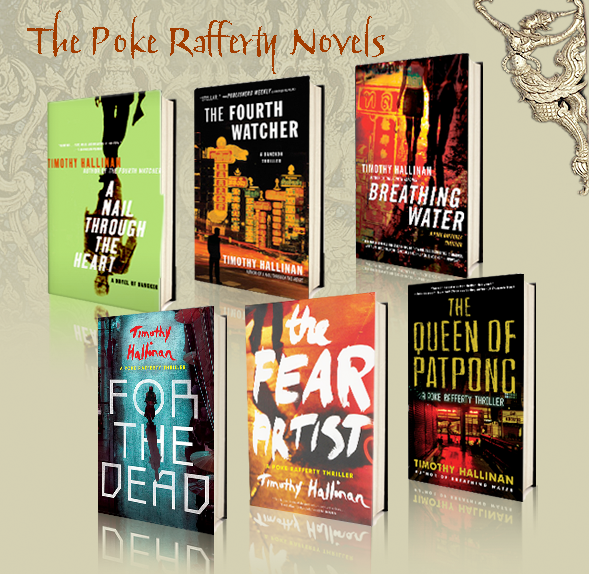
One of the more enjoyable posts I have ever written on Thailand Footprint and one of the most consistently read is titled: The Poke Rafferty Series by Timothy Hallinan – King of the Bangkok Fiction Hill? There I discuss Tim’s first five novels in the Poke series. They are in order: A Nail Through The Heart; The Fourth Watcher; Breathing Water; The Queen of Patpong and The Fear Artist.
Poke Rafferty is an American travel writer. He is a family man with an improbable family blossoming in the mud of an even more improbable city – Bangkok. His wife, Rose, the former lanky Issan country girl was once a Patpong dancing superstar until Poke rescued her or she rescued Poke. Love and marriage followed. They adopted a homeless street girl named Miaow. As I wrote in that earlier review written almost 18 months ago, “It is the patchwork nuclear family setting, for me, which sets the Poke series apart from much of the other available Bangkok based fiction. That and the brilliant prose of Timothy Hallinan.”

Edgar, Macavity and Shamus Award nominee, Timothy Hallinan
In that regard, not much has changed in For The Dead and yet a lot has changed. Miaow is now thirteen years old. For The Dead is, for the first time, primarily Miaow’s story. How best to describe Miaow to the unfamiliar reader? Hallinan does it superbly in the narrative thoughts of Rose:
Miaow, she thinks. The throw-away child, tossed onto a side-walk. As tough as she tries to seem, Miaow worries about everything. She double-checks everything. If she were hanging over a cliff, held only by a knotted rope, she would try and improve the knot. She has no idea how remarkable she is, how smart, how decent, how much she’s loved. Somewhere in the center of her being, Miaow is still the short, dirty, dark-skinned, frizzy-haired, unloved reject who tried to sell chewing gum to Rafferty on his second night in Bangkok.
For The Dead opens with a wonderful upcountry dream sequence. It concludes with heart-tugging laughter. What you get in-between, besides a fast paced thriller featuring technology, pulse pounding chase scenes and contract killings conducted at the highest levels by a corrupt Thai Police force, is what is missing in so many novels today: quality. Page after page of quality. What you read in a Timothy Hallinan novel has importance, it’s useful and it’s entertaining.
In For The Dead, Poke is happy, financially secure for once and learns that his family of three will in nine months time become four. Miaow helps her nerdish Vietnamese boyfriend replace his second lost iPhone with a used model during a skillful negotiation process with a Sikh merchant on a skipped day of school in India Town. They learn later the phone contains pictures of some very dead policeman. Poke would normally be an early confidant but news of Rose’s pregnancy was relayed in an awkward manner, creating domestic strife. Serious jeopardy ensues and leads to the heaviest of hit men.
You could make a good case that in the Poke Rafferty series the last three novels have been the best, although I very much enjoyed Breathing Water. For me, The Queen of Patpong had the perfect mix of thrills, antagonist and family. In The Fear Artist, I found myself missing the family at times, although again the thrills and antagonist were stellar, plus you got the intriguing character of Treasure, whom we last saw disappearing into the fire and explosions of her abusive home. For The Dead puts Poke and family front and center, plus Treasure gets an encore along with two memorable Bangkok street kids. The thrills are still there as is the terrific prose of Hallinan detailing in great depth the best and worst of mankind. My criticism of For The Dead is the antagonist didn’t live up to the level of evil or consistency of the last two, but Hallinan can take the blame for that one, for setting the bar so high. My suspension of disbelief also had to be ratcheted up a notch for a rather conveniently timed plot solution, no matter how much I wanted it to happen.
The Queen of Patpong is a Bangkok Thriller. My favorite Bangkok thriller of all-time. The Poke series is a Bangkok series when looked at in totality. For The Dead is, first and foremost, a human story – a story about a family and the bonds that hold them together.A story that could play within the backdrop of a dozen cities throughout the world – the corrupt police department and poor rice farmers notwithstanding. And that is not a criticism; that is a compliment to the story-telling ability and the multi-dimensional characters that Hallinan constructs in his writing. The Poke Rafferty series is no longer confined to the genre of Bangkok fiction or a simple mystery – this is first class literary fiction.
We are reminded often that we now live in a world where books, music, authors and musicians have all been devalued. But value is still out there if value matters to you. Smart and appreciative readers will always invest in reading good books by good authors. For The Dead is one such book and Timothy Hallinan has proven time and time again that he is one such author.
(Photo courtesy)
For more information about author, Timothy Hallinan and his novels you can visit his web site at www.timothyhallinan.com

This post may also be seen at Chiang Mai City News by clicking the banner above
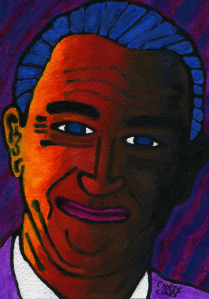
Portrait of Bangkok Noir Poet John Gartland by Chris Coles
Anyone looking for a respite from the lock down city of Bangkok or anywhere in Thailand for that matter, might want to consider the relative tranquility of Phnom Penh, Cambodia on May 31st and June 1, 2014 respectively. On those dates poet noir, John Gartland will be reciting his original poetry. On May 31st he will be part of a lineup that will include the man in black, Christopher Minko and his Khmer vocalists in Krom. John, Christopher and Krom have all been featured here at Thailand Footprint. Perform a simple search to learn more about them if you are not already aware. On June 1, 2014 John and Christopher will both be performing at the renown Meta House in Phnom Penh. Check them out if you are within a 90 mile radius.
John has allowed me to share some of his original poetry here again. Chris Coles has also, once again, permitted his art to be shown here as well. Enjoy the art and poetry wherever they may find you:
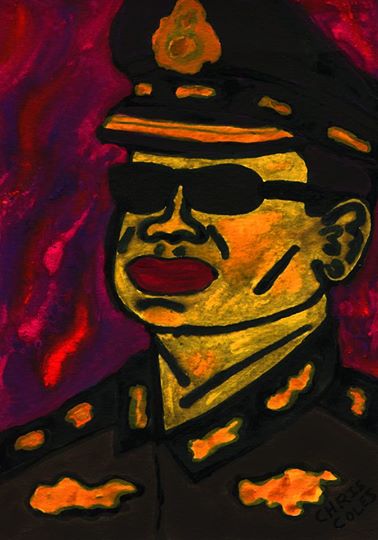
THE GENERAL in the Bangkok Night by Chris Coles
The Eye: 1
Man, I’m an ex-Private Eye, I can strike a cool pose
while listening to others’ production-line prose,
self-published wunderkinds who believe their own hype,
burned-out actors on valium bogarting the mike,
tales of drug-hauls and bar girls and crooked police,
and hard-drinking dicks who’ve adopted the east.
Look! I‘m old-school detective, I’ve seen the whole bag,
Spillane-heads, in trenchcoats, Dash Hammett in drag.
Just a crime-writers’ gig, at the Mambo hotel,
but outside it’s for real, and they’re guilty as hell.
THE EYE : 2
It ‘s a crime-writers’ gig, at the Mambo hotel,
where whorehounds had partied for fifty odd years.
But life, like a crime scene’s not all it appears;
the old cathouse is cabaret, now; it’s a fact,
and, under new management, the riskiest act,
would be squeezing the original mama san’s hand,
which once, like the anthem, could make a room stand,
and left a broad smile on the girls in the band,
at the Mambo Hotel.
Two floors of short-time ghosts,
a locked up beauty shop, and dust;
now pulp-writers rap about crime here,
and must shoot the fictional breeze on stage.
But, as the Eye on the case, I’ll cut to the chase,
the major heist is on the street,
and there’s fresh blood on the page.
THE EYE: 3
Bent judges and psychopaths, hustlers and has-beens,
professional liars, Bangkok is a crime scene.
Hey, I was an Eye, wrestled crime for a living,
and still have a hunch for who’s making a killing.
The patriots and flag sniffers, feeling the force,
play patsy for billionaires, hit men, and punks,
they’ve closed down the city and cheered themselves hoarse,
till the tourists and hookers are packing their trunks.
Man, the hacks know the issue, but no one dares say;
destabilization is sent from upstairs,
since they can’t get joe public to vote the right way.
More generals than doormen, tear-gas everywhere,
there’s gold braid enough here to carpet a whorehouse,
gridlock on the streets, and a coup in the air.
Look, I’m just an Eye, with an odd tale to tell,
at a pulp writers’ gig at the Mambo Hotel.
But, outside? It’s for real, pal.
They’re guilty as hell.
You’d better believe it, they’re guilty as hell.
John Gartland

CIRCUMSTANTIAL EVIDENCE
We have your co-ordinates, and know precisely your destination.
It is election time, and in the street of the plastic surgeons,
posters of men in white uniforms and fixed grins flap in unison.
This is a one way street, and a u-turn invokes serious penalties.
Traffic proceeds at breakneck speed through the great arch of autocracy.
By the pantheon of patriarchs, diseased birds slumber on the frozen plumes
of bronze headgear, mildew eating at ceremonial swords. Stay in lane.
The great highway of charlatans is multi-lane, crowded at all hours
and will bring you invariably to hypocrisy monument, where all roads meet.
One way. Vendors swarm with incense sticks, crystal meth and dreams,
gold leaf to flatter a glowering idol at the revered corner of errors;
a bottleneck, as many pilgrims buy merit from the four faced god here;
dead slow as beggars kneel in the road, abandoned to divine protection.
Proceed by the grand plaza of pointless purchases, and slow down for
heavy traffic at narcissus mall, street of six names for your inferior.
You must pass through the groveling gate, temple of the abject loop;
this is street of six titles for your superior, leading to the institute
of impregnable ignorance, graced with a royal charter. Take a right
on the grand drive of distracting flags, to the causeway of embalmed kings.
Go forward to the mall of the eternal flame. At karaoke heaven,
superlative banality may cause your ears to bleed. Accelerate away.
Proceed. Traffic circles perpetually round the academy of harlots;
whores, constantly renewed, wind silk around the sacred trees,
disrobe, and leave a mekong to appease priapic spirits.
You must drive through the emporium of envy and unsatisfied desires,
bypass the chaotic terminus of transsexuals for denial drive,
speed on past Guess Wat buddhist theme park, en route for meth mall,
where it is always rush hour, and the men at Jamaica corner sell oblivion
in small packs to foreigners, who are ransomed by the tourist police.
Near the fountain of corrupted thought, pass beggar children
fishing for coins and fever in the catfish dark of drains:
at last you are near your destination, on a street of fortune tellers.
Here, gamblers with their cards and severed fingers,
taking pains to keep their face white and uncompromised,
play endlessly, and disregard their loss.
Your tinted windows let you pass unrecognized.
This dusty cul-de-sac is yours. Abandoned
lottery tickets blow across the nameless street,
and withered wreathes are strewn
about some broken idol’s feet. It is election time.
New posters of the white and smiling uniforms
wallpaper every space. This final cul-de-sac is yours;
self-hatred and the breath of street dogs, foul upon your face.
John Gartland

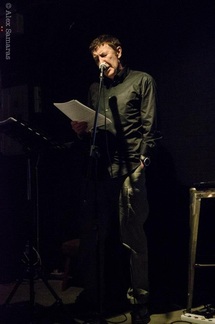
For more information about the poems and performance schedule of poet John Gartland go to http://www.johngartland.net or click picture, above.
.
This blog post may also be viewed at Chiang Mai City News by clicking the banner, above:

Last week I wrote an essay titled in part, WHAT IS A WRITER? If you had to choose a picture of someone to put next to the definition of writer in a dictionary one choice could very well be, Stirling Silliphant, the Oscar award winning writer for the screenplay, IN THE HEAT OF THE NIGHT. Stirling was, in a word, prolific.
In television he wrote for shows from The Mickey Mouse Club, Alfred Hitchcock Presents, Route 66 and The Naked City to name just some. He worked with dozens of Hollywood legends including Bruce Lee.
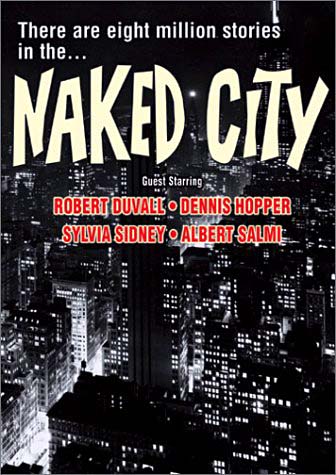
Stirling was also the creator of LONGSTREET, which I remember watching as a kid. It was unusual in that it featured a blind detective played by James Franciscus.

His movie credits are equally impressive.My favorite Hollywood story about Stirling was when he was the screen writer on Route 66. They were shooting in San Antonio, Texas and the producers told Stirling if he could come up with another episode set in San Antonio, they could save $100,000 instead of returning the whole crew back to Dallas, Texas. In short order – hours that never reached 3 figures – Stirling wrote a new episode of Route 66. They flew in the guest star, shot the episode where they were and saved a huge sum of money, at the time, in the process. Stirling to the rescue.

Stirling Silliphant left large footprints wherever he lived and he chose to live in Bangkok, Thailand for the Third Act of his life. A quote by Stirling Silliphant is featured in one of my favorite posts, NEVER GO TO THAILAND … And The Reasons I love It. The quote comes from the excellent book by Jerry Hopkins featuring legendary Bangkok expatriates titled BANGKOK BABYLON. It’s a great quote and it is worth repeating here:
I came to Thailand to die. I needed to be surprised. I wanted to be shocked. Bangkok is unpredictable and it delivers if you give it a chance. Even the small adventures are memorable. – Stirling Silliphant
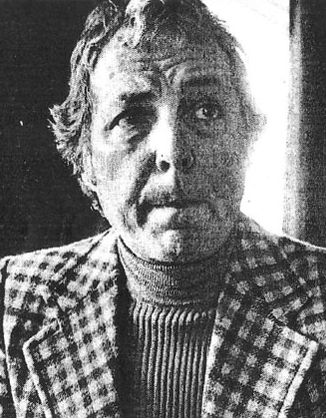 Stirling Silliphant – Born January 16th 1918 Died April 26th 1996
Stirling did die in Thailand 18 years ago today of prostate cancer. There are many things I love about Thailand and Thai people. One of them is their beliefs about death and spirits. It is not my desire to make an argument for or against those beliefs, I choose only to celebrate them. My own personal beliefs are that Stirling Silliphant had a spirit and it is plainly evident to me that his spirit lives on.
It got me thinking about what kind of Spirit House Stirling should have? He earned a classy one if my opinion matters, like the Chris Coles image of a Spirit House above. In memory of the life of this talented writer, who set out to die in Bangkok and lived an extraordinary life for 78 years before he did, Thailand Footprint celebrates the spirit of Stirling Silliphant on the 18th anniversary of his death. It occurred at a Bangkok hospital. Everyone dies but not everyone lives like Stirling did.
So today I am going to imagine some things that might be useful to place in a Spirit House custom built for Stirling.
Whether a Spirit House is seen as containing the actual spirit of a loved one or as a nook for honoring the still-fresh memories of the family is just a matter of vantage point. – Alasdair McLeod, Bangkok writer, photographer and videographer
These are some of the things I would place in my imaginary Spirit House for the spirit of Stirling Silliphant to enjoy for eternity:
1. A miniature Smith Corona typewriter and a mini-pallet of typing paper.

2. A mini stretch limousine to represent his Hollywood days, with a fully stocked mini bar in the back.

3. A small notepad and a good pen. One that can handle the heat of Bangkok City.
4. A miniature statue of Oscar. Why not?

5. A memento of the Little Oscar mobile, a car driven by a dwarf named Little Oscar, which Stirling must have seen often in his Southern California days in the 1960s, as I did growing up there during that time.

6. His own personal 7 11 Convenience store because I want eternity to be convenient for Stirling’s spirit.
7. A bottle of good drinking water and a Coca Cola placed out front every day. It’s important to keep hydrated even for spirits. None of that red Fanta stuff for Stirling.
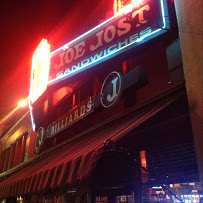
8. A good neighborhood bar for Stirling to meet up at. Something likes Joe Jost found in Long Beach, California that attracted working class people and celebrities alike.
9. A mini tuk tuk for the shorter trips.

10. Figurines of Thai ladies from all classes, upper, middle and lower. This will create a little tension from time to time and perhaps some conflict, which is good for any writer living forever in the Big Weird.

11. A mini pool table. I don’t know if he played pool but I bet he had friends that did and the spirits of Stirling’s friends will no doubt drop in from time to time.

12. A box of matches. The good kind with the wooden sticks to represent the creative flame of Stirling that still burns on.

13. A good book to read, which he couldn’t have read before, to remind him a bit of The Naked City on those hot Bangkok nights.

So that’s my baker’s dozen items and thoughts on the life and spirit of Bangkok expatriate, Stirling Silliphant. If you have something you’d like to add to Stirling’s House, feel free to drop a comment here. Space is still available. And eternity is a long time.

This post also appears at Chiang Mai City News and may be found there by clicking the banner below:
 Thailand Footprint: Impressions left by the books, people, places and music of Thailand and South East Asia