Thailand Footprint: The People, Things, Literature, and Music of Thailand and the Region

Posts from the ‘Happiness’ category

Television

Telly

The most important thing we’ve learned,
So far as children are concerned,
Is never, NEVER, NEVER let
Them near your television set —
Or better still, just don’t install
The idiotic thing at all.
In almost every house we’ve been,
We’ve watched them gaping at the screen.
They loll and slop and lounge about,
And stare until their eyes pop out.
(Last week in someone’s place we saw
A dozen eyeballs on the floor.)
They sit and stare and stare and sit
Until they’re hypnotised by it,
Until they’re absolutely drunk
With all that shocking ghastly junk.
Oh yes, we know it keeps them still,
They don’t climb out the window sill,
They never fight or kick or punch,
They leave you free to cook the lunch
And wash the dishes in the sink —
But did you ever stop to think,
To wonder just exactly what
This does to your beloved tot?
IT ROTS THE SENSE IN THE HEAD!
IT KILLS IMAGINATION DEAD!
IT CLOGS AND CLUTTERS UP THE MIND!
IT MAKES A CHILD SO DULL AND BLIND
HE CAN NO LONGER UNDERSTAND
A FANTASY, A FAIRYLAND!
HIS BRAIN BECOMES AS SOFT AS CHEESE!
HIS POWERS OF THINKING RUST AND FREEZE!
HE CANNOT THINK — HE ONLY SEES!
‘All right!’ you’ll cry. ‘All right!’ you’ll say,
‘But if we take the set away,
What shall we do to entertain
Our darling children? Please explain!’
We’ll answer this by asking you,
‘What used the darling ones to do?
‘How used they keep themselves contented
Before this monster was invented?’
Have you forgotten? Don’t you know?
We’ll say it very loud and slow:
THEY … USED … TO … READ! They’d READ and READ,
AND READ and READ, and then proceed
To READ some more. Great Scott! Gadzooks!
One half their lives was reading books!
The nursery shelves held books galore!
Books cluttered up the nursery floor!
And in the bedroom, by the bed,
More books were waiting to be read!
Such wondrous, fine, fantastic tales
Of dragons, gypsies, queens, and whales
And treasure isles, and distant shores
Where smugglers rowed with muffled oars,
And pirates wearing purple pants,
And sailing ships and elephants,
And cannibals crouching ’round the pot,
Stirring away at something hot.
(It smells so good, what can it be?
Good gracious, it’s Penelope.)
The younger ones had Beatrix Potter
With Mr. Tod, the dirty rotter,
And Squirrel Nutkin, Pigling Bland,
And Mrs. Tiggy-Winkle and-
Just How The Camel Got His Hump,
And How the Monkey Lost His Rump,
And Mr. Toad, and bless my soul,
There’s Mr. Rat and Mr. Mole-
Oh, books, what books they used to know,
Those children living long ago!
So please, oh please, we beg, we pray,
Go throw your TV set away,
And in its place you can install
A lovely bookshelf on the wall.
Then fill the shelves with lots of books,
Ignoring all the dirty looks,
The screams and yells, the bites and kicks,
And children hitting you with sticks-
Fear not, because we promise you
That, in about a week or two
Of having nothing else to do,
They’ll now begin to feel the need
Of having something to read.
And once they start — oh boy, oh boy!
You watch the slowly growing joy
That fills their hearts. They’ll grow so keen
They’ll wonder what they’d ever seen
In that ridiculous machine,
That nauseating, foul, unclean,
Repulsive television screen!
And later, each and every kid
Will love you more for what you did.

Roald Dahl
Leave a comment

An essay by  about reading, literature and the impact of Henry Miller’s, THE BOOKS IN MY LIFE …An excerpt:  “For Miller, to express himself about what he read is equal to do self-examination, to recount not what he consumes with his eyes and thought, but what he really is. Just the same as with food, we also are what we read. Perhaps that is why Miller insists that we should learn to read less and less and not more and more, because quality matters more than quantity.” In the Thick of the Life – a WordPress blog

Emilia Almanza Towgood's avatarIn the thick of life

Versión en español

There was one book in particular that inspired me to do this blog and that gave it the tone it has. I could have made a book review blog or a blog where I plainly shouted out what I had on my bare chest (as I have done before). But this blog does not intend to be either of those possibilities.

the books in my life

The book that inspired me was The books in my life by Henry Miller. And when I say that it inspired me I mean it in the most literal way: it gave me air, I felt I could breathe again. Forgotten oxygen came back into my cells. Before me I found a text that reaffirmed my feelings about knowledge and reading, and through which I felt like coming home after roaming the deserts.

For Miller, to express himself about what he read is equal to do self-examination…

View original post 540 more words

Leave a comment

alice cooper 051107

School’s out for summer. School’s out forever. Kindle school, that is. I’ve learned what I need to learn. I’ll glean what I need I need to glean. My third Kindle has broken. It was a free replacement for my second Kindle, which also broke. I ain’t going to Kindle, no more. It has nothing to do with the customer service at Amazon.com USA. The best corporate customer service I have encountered, ever. It has everything to do with paper. I prefer it.

I like picking up a paper novel that I have going in mid-stream and reading 4 pages of content before my brain cells kick in and tell me, “You’ve read these pages before.” No harm; no foul. It’s a good book. They were good pages. Better two times than never at all.

398px-Chethams_library_interior

Does this mean I will never read an Ebook again? No. Just not on a Kindle, Nook or any tablet that is primarily a reader. In the last two years I have probably been 60% Kindle 30% paperback writers and 10% hardcover. Guesstimates. Margin of error: huge. But a man needs a plan. My plan is to go 80% paper and 20% electronic. How? I’m not downloading free books anymore. Yes, there are some good ones out there. But there are more crap ones. I don’t have time for crap, anymore. And those T. Jefferson Parker novel’s for $1 are a pretty good deal, I have to admit. But 9 times out of 10 I never read that $1 book. Ever. So, the plan is, pay the ten bucks or so for the real deal. Read it. Then put it on a shelf or loan it to a friend, face to face not electronically. We do enough stuff online. Online banking is good. Online loaning books to a Facebook friend you’ve never even met in person? Not so good.

No Kindle

This is not meant to be a persuasive post. Forget yourself and forget any inferences you may have drawn. To each his own. There is no right and wrong when it comes to reading. Reading is generally good as long as it’s not a “How To” bomb-making site or anything that encourages hate. Hate = Bad. Period.

As for the 2 out of 10 books I plan to read electronically, I’ll do that on my Kindle Cloud reader via my Samsung 10 inch Google Chromebook. Problem solved.

I do plan to download the free samples and ARCs from NetGalley.com when available, though. So any authors out there, please make those as long and as frequent as possible. Some of you are generous. Some of you skimp a bit too much. But too many times, after reading a good, free sample, I bought the Kindle version and then later bought the paperback. No more. Free sample + paper book if it passes the acid test is part of the plan. Wish me luck. Time for some music.

the-beatles-paperback-writer-parlophone-2

7 Comments
Henry Miller,  ink and acrylic on wood by Jamie Lawson - 2010

Henry Miller, ink and acrylic on wood by Jamie Lawson – 2010

Life moves on, whether we act as cowards or heroes. Life has no other discipline to impose, if we would but realize it, than to accept life unquestioningly. Everything we shut our eyes to, everything we run away from, everything we deny, denigrate or despise, serves to defeat us in the end. What seems nasty, painful, evil, can become a source of beauty, joy, and strength, if faced with an open mind. Every moment is a golden one for him who has the vision to recognize it as such. – Henry Miller

2 Comments
Elsie Evans - Proprietor, instructor and artist at Attic Studios

Elsie Evans – Proprietor, instructor and artist at Attic Studios

I love all things Google. Last Thursday I plugged in “ART LESSONS + BANGKOK” into the almighty search engine and up popped http://www.attic-studios.com. Who am I to argue with their algorithm magic? My wife is a talented artist whom had her talent repressed by logical Thai society and ended up being an accountant for many years. Did she like being an accountant? A story for another day. I, on the other hand, have zero artistic talent but face the reality, daily it seems, that I will die one day – hopefully not soon. We thought it would be fun to take art lessons – together. We’re dare devils at heart. She, to increase her talent and me to face my fear head-on and jump outside the box. In this case clear up into the Attic. Attic Studios in Bangkok, Thailand to be more precise.

So it was that same morning we headed down, brilliantly without an appointment and in my case a clue, to Attic Studios. It turns out that just one block over from the Dead Artist Bars of Sukhumvit 33 in Bangkok you can find a lot of actual live artists and breathing art studios on and off of, Sukhumvit 31.

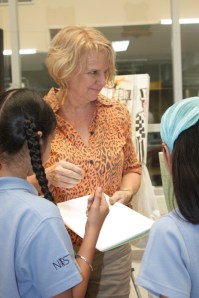
Upon entering Attic Studios we found several children in the middle of a group art lesson painting at easels while looking at a live model dressed in traditional Thai costume. We were only on the ground floor of the three story art studio. Elzan, the young assistant to Elsie Evans, was very pleasant, very helpful and very informative. She pleasantly informed us that we couldn’t have chosen a worse time to drop in (my bad) but we should go up the stairs to the second floor and wait for Elsie, whom was teaching on the third floor until 1:00 p.m. or 30 minutes away. It seems I was standing in front of the live model and this made it rather difficult for the kids to do their assignment. So we did. We went upstairs.

children

The second floor of Attic Studios looked amazingly like what you would expect from an art studio. Bookshelves full of art books – color coded, no less. And I mean tons of books. A comfortable couch for waiting. Tea and coffee available. And clutter. But not the kind of clutter I produce. No. This was artistic clutter. The kind of clutter that looked cool. The kind of clutter you want to leave as is because … well, because it looks cool. The kind of clutter you wanted to learn how to make, which in my case was why I was there.

art_supplies

As we waited I felt I was in a time warp: adult students came down from the third floor. Parents came up from the first to wait for their children to finish their lesson. And they all looked like they lived in Santa Cruz, California, which once made a Top 100 Artist’s Towns in the USA with populations under 100,000. Only I was in a South East Asian City of 9 to 12 million people, depending on whether she is in yin mode or yang mode, so it was all a bit surreal.

life-drawing

Elsie came down and let us know that she was in the middle of teaching but would be happy to talk to us in about 15 minutes. No worries. It may have been the worst possible time for them but I was enjoying myself. My wife tactfully reminded me that people do make appointments in civilized society and I nodded my head as I looked at the canvas paintings stacked about the walls.

Elsie_4FRG0166

Elsie came down a second time, apologized for the clutter that I was envious of, and proceeded to be charming, inquisitive, patient and most of all genuinely interested in what both my wife and I were interested in, which happened to be quite different from each other. Elsie also gave us a tour of the third and final floor – the main studio, which was also very cool. Cool is cool. It’s as good a word as any to describe all three levels of Attic Studios. As a bonus, Elsie and I both share Scottish ancestry. In Elsie’s case she was born in Scotland before coming to Thailand over twenty years ago. You get the feeling that Elsie has seen every level of art student and in my case every level of fear and her solution seems to be: start. Casual, modest, comfortable and obviously talented with people and art is how I describe Elsie Evans.

Henry Miller, when he went into his Big Sur phase, where he painted a lot, had a security guard to keep unwanted visitors out. And those that were allowed in, were required to read a long hand-written note posted the old fashioned way by Henry on his gate, reminding people, among other things : “When you come please be so kind as to check your neuroses and psychoses at the gate.” I can surmise that Elsie Evans has the type of personality that would have earned her a first name basis with Henry’s security guard and a visit to see Henry any time, had she wanted to. A visit Henry would have looked forward to, not dreaded as he must have with some of his visitors/fans.

Henry Miller's notice to visitors at the gate to his modest Big Sur home

Henry Miller’s hand-written notice to visitors posted at the gate to his modest home now resides at The Henry Miller Memorial Library in Big Sur

There is a quote on the Attic Studios web site, attributed to Elsie that I particularly liked. Since I am doubtful about my artistic ability, it is comforting to know that someone as good and as interesting as Elsie Evans also had that thought. I suspect it is just one of many reasons that make her a good instructor:

Over the years I have painted many portraits in pastel, oil and acrylic. I started them initially because I thought I couldn’t do them ……Wow I was right!!!  They were awful. But the human face, all around us, young, old handsome, ugly is fascinating, I had to persevere, still have to. The fluidity of the face is what interests me the most. – Elsie Evans

My hope is, this will not be the last post on this blog about Attic Studios. That I, too, will persevere. Being good at something provides a certain comfort level. Not being good at something and doing it anyway is a whole different ballgame. I am looking forward to learning the rules of the game from Elsie Evans.

corporate

Attic Studios provides Adult Workshops; Junior Workshops; Life Drawing Classes; Corporate Events; School Visits; First Friday Events as well as Mural Paintings and Art Restoration. For more information visit their web site,  where all the photos used in this blog post came from: http://www.attic-studios.com/ or LIKE them on Facebook at Attic Studios.

2 Comments
Henry Miller at Big Sur

Henry Miller at Big Sur

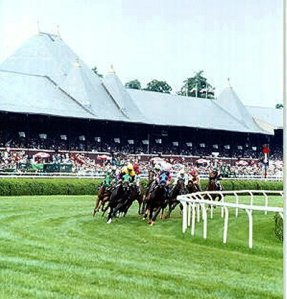
On the About / Mission page of this blog a Henry Miller quote concludes with, “Forget yourself.” What did Henry mean by that? Only he would know for sure. In my initial interview with Legendary Surfers author, Malcolm Gault-Williams, I asked him if he agreed with the entire quote? Malcolm did agree, except for those two commanding words. It was a good answer but it was not the answer I expected. Not the one I wanted. How often do we ask a question with our answer already in mind? Too often, for me. People can be like the guy at the race track that has already decided which horse he will bet on because of the name of the horse or the color of the jockey’s silks but then goes to the racing form for information to back up his unwavering choice. Malcolm is right – when you write you cannot forget yourself, entirely. You need to add that special ingredient, as he puts it, to make the writing unique. But the best story, in my opinion, is almost always elsewhere.

“Develop an interest in life as you see it; the people, things, literature, music – the world is so rich, simply throbbing with rich treasures, beautiful souls and interesting people. Forget yourself.”― Henry Miller

Years ago I met someone for the first time at my Bangkok gym. We would later become friends. On that initial meeting I was on a weight machine. Dick, the name of my future friend, was on the next machine over. As he rested he struck up a conversation with me. My first impression of Dick was, “fat cat”. He was older than me by a good 20 years, heavy but in good shape and very tan, which made his blue eyes look even bluer. He wore a singlet and had a thick gold chain around his neck. A lot thicker than the $100 string I was wearing. Circumference does matter to some, I’m told, when it comes to gold. He was friendly enough but I was probably terse with him as I have this peculiar idea that gyms are for exercising not so much for socializing. In short, I was thinking about myself at the time, as we humans tend to do, rather than thinking about the opportunity to meet a new friend that didn’t fit the mold of my friends back in California.

Over the next few years I would share many meals with Dick and my circle of friends in Thailand. And a few beers too. Dick was always fun to be around. I would also tend to run into him from time to time, even when I was out of town. He always made room for a bit of conversation and sometimes those bits would lead to a few more beers. He came to our family Christmas party one year with a video recorder running as he entered the front door and was very entertaining all evening, yet always polite. We shared some things in common, Dick and I. He also split his time between Thailand and the USA – in his case, Maine. Our schedules were similar: winter and spring in Thailand. I always enjoyed catching up after not seeing each other for six months. Dick was generous, with his time and with his compliments. He was the opposite of a balloon chaser – the type of guy who would be a regular at a pub and then stay away when they had a free meal promotion, figuring someone else could use the seat and the meal that day more than he. One year he came back and his thick, heavy gold chain was missing. “Where’s your gold chain, Dick?” I asked when I noticed right away. “Oh, I gave it to my nephew. He always liked it and he’s a senior on his Florida high school football team this year”, he replied with his trademark smile. Dick was always proud of his family members back in the USA. It turned out that Dick wasn’t really a fat cat at all. He was a retired accountant that was more of a cool cat, even at over 70 years old. Dick was one of those guys whom you were always happy to see and when you left you always felt a little better. And I was never exactly sure why that was?

Henry Miller while paiting

Henry Miller while painting

After about 5 years of friendship and good memories I learned, from a mutual friend while I was in California, that Dick died of a heart attack, suddenly, during a visit with family members in Florida at the age of 76. His funeral was to be held in Maine. I didn’t go and like most regrets I have it is the things I didn’t do which I regret most. But I did get a chance to communicate with his son, a few times via email and once we spoke on the telephone. During the course of that conversation I expressed to his son that Dick was a friend and I liked him very much. I told him I used to tell his dad that he reminded me of my Uncle Al, a very important man in my life. I also told him how Dick had a way of making everybody around him feel good. His son responded, “My dad was the kind of guy that was always interested in what you were interested in.” And he was. And that was it – that’s what I couldn’t put my finger on. Henry Miller, I suspect, would have liked Dick a lot. Because Dick understood what Henry meant. Dick was confident in who he was, just as I believe Henry Miller was confident, on most occasions, with who he was. They both knew, more often than not, that the best story, the best moments in life, were not about them.

When you are interested in what other people are interested in, you find what Henry Miller found: interesting people. Will it happen every time? No, but often enough, that I would bet on it.

saratoga

6 Comments

Buddha's Brain
There are many reasons why I like the book, Buddha’s Brain. I refer to it often. Author Rick Hanson hails from Northern California and gives a nice introduction to the basics of neuroscience while combining that with Buddhism and dharma principals. A key element to Hanson’s teaching is helping the reader understand the negativity bias that exists in the brain. Being aware of the negativity bias is the best way to shift to a more positive outlook on life and everyday experiences. It didn’t take much convincing for me to believe scientific evidence is out there to prove the negativity bias; one need only engage the world to find the anecdotal evidence to go along with it.

Hanson is a neuropsychologist who has practiced mindfulness for many years. I prefer Hanson’s style to that of Jon Kabit-Zinn, although I like Kabit-Zinn and his books as well. Hanson gives us evolutionary background of our brain and how the brain’s negativity bias was useful at one point in our development but not so much now. As he likes to say, “It was better to think there was a tiger in the bush one thousand times and be wrong each time than to think there was not a tiger in the bush and be wrong one time.”

What Hanson delights in teaching is that the brain can be reprogrammed by focusing on the good to create new, positive pathways in the brain which change the way we think. Why not? His simple task of “taking in the good” I found most beneficial. Because we do not register our positive experiences in the same way or with the same emphasis as we do our negative experiences – but we should and we can. For me it gets back to the footnote tag line in this blog, by Voltaire – appreciation. Appreciating the little, positive things that life offers every day helps reprogram the brain away from its negativity bias. I like that.

Rick Hanson, author of Buddha's Brain and Just One Thing

Rick Hanson, author of Buddha’s Brain and Just One Thing

Hanson reminds us we will have painful events in our life. Those are unavoidable. But how we react to those events is more in our control than we realize. The book is actually a “how to” manual, which is another reason I like it. Hanson doesn’t just tell you why, he tells you what you need to do about it. What I like about his style is he doesn’t preach an hour a day of mediation – although he is not opposed to that – rather he lets us know we can and should be mindful anytime and grab moments of mediation when they are available. And that could even be while you are in your car, waiting for the light to turn green. Minutes add up at the end of the day.

It is the combination of research about the brain along with practical steps anyone can take to increase their sense of well being that I appreciate about Hanson’s writing style. The East vs West angle I always enjoy. Hanson helps explain, scientifically, why Buddha got it right. My kind of non-fiction book. I highly recommend Buddha’s Brain and another non-fiction book by Rick Hanson, Just One Thing. Hanson’s YouTube videos of his lectures are also very good. For a free newsletter and more information about author, Rick Hanson go to http://www.rickhanson.net or click his picture, above.

2 Comments

Anais Nin on Henry Miller and Writing – Picture shows Henry Miller at his studio located in Big Sur, California where he spent much of the later years of his life.

PensAleas's avatarThe Eloquent Madness

Henry Miller

“Henry’s recollections of the past, in contrast to Proust, are done while in movement. He may remember his first wife while making love to a whore, or he may remember his very first love while walking the streets, traveling to see a friend; and life does not stop while he remembers. Analysis in movement. No static vivisection. Henry’s daily and continuous flow of life, his sexual activity, his talks with everyone, his cafe life, his conversations with people in the street, which I once considered an interruption to writing, I now believe to be a quality which distinguishes him from other writers. He never writes in cold blood: he is always writing in white heat.
It is what I do with the journal, carrying it everywhere, writing on cafe tables while waiting for a friend, on the train, on the bus, in waiting rooms at the station, while my hair…

View original post 50 more words

Leave a comment

Henry Miller was an artist as well as a writer. Below a letter and tribute from his daughter, Valentine can be found. More information regarding Henry Miller and his art can be found at http://www.henrymiller.info

hm_print_twoheads_sml
Two Heads by Henry Miller

June 7, 2005 marks twenty-five years since my Dad passed away. It seems impossible but I miss him more each year. He was a great listener as well as a fascinating raconteur. He had a very warm persona, treating everyone he came in contact with as though they had something special to say and often they did. His curiosity in his fellow man came across as being genuinely interested in all people. He was generous in every way, from sharing his home, giving to anyone who asked for money (if he had it), he gave his watercolors away, happy that they were admired. He had many friends throughout his life that were true lifelong relationships. He was a loyal friend. He loved to laugh and share meals and wine, always exchanging ideas about literature and art. He truly enjoyed life and made the world a better place by his wholehearted embrace of the world. He was tolerant, kind, inspiring, droll, genuine, loving, intelligent, thoughtful, a wonderful combination of many talents, humble as well as proud.

I love you Dad,

Your daughter,
Valentine

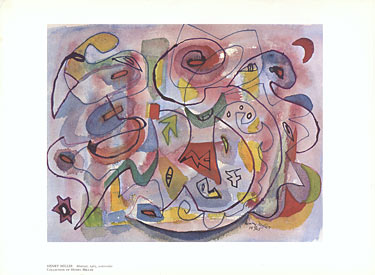
hm_print_abstract_sml
ABSTRACT by Henry Miller

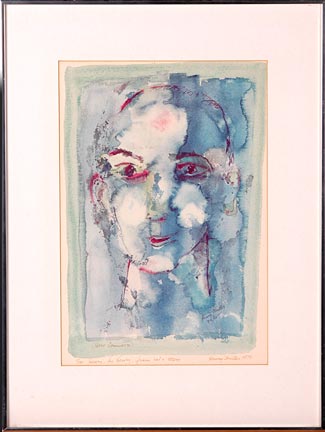
blueface_HenryMiller
BLUE FACE by Henry Miller

hm_insomnia9_sml
From the INSOMNIA SERIES by Henry Miller

Leave a comment

Today’s maiden interview at Thailand Footprint is with Malcolm Gault-Williams. He is the father of three grown sons, a husband living up in Baan Noen Soong, Pleui Nong Bua Lamphu, Thailand, an ex- radio disk jockey, a surfer for more than 45 years while growing up around Santa Barbra, CA, a writer and author of LEGENDARY SURFERS – Three Volumes and growing. You can learn more about Malcolm living in the Thai countryside from his Blog, “THE ISAAN: My Life in a Thai-Lao Village.” at  http://the-isaan.blogspot.com .

This interview initially had a working title of, “The Most Interesting Facebook Friend I have Never Met …Yet”. After spending thirty minutes with Malcolm on a Skype video call today, I knew I had to change the title. Not because my opinion had changed. Far from it. It’s just that the new title fits Malcolm and his story so much better.

Living in Santa Cruz, CA as I had have done for all or parts of the past 20 years, I know that surfing is a soulful past time. And Malcolm Gault-Williams, not surprisingly, comes across as a very soulful man. The type of soul Henry Miller tells us is out there, if we look for them. Malcolm has been going in his own direction since he first took to the waves in the mid-1960s and is still going his own way, in an Isaan village near the Laos border in 2013.
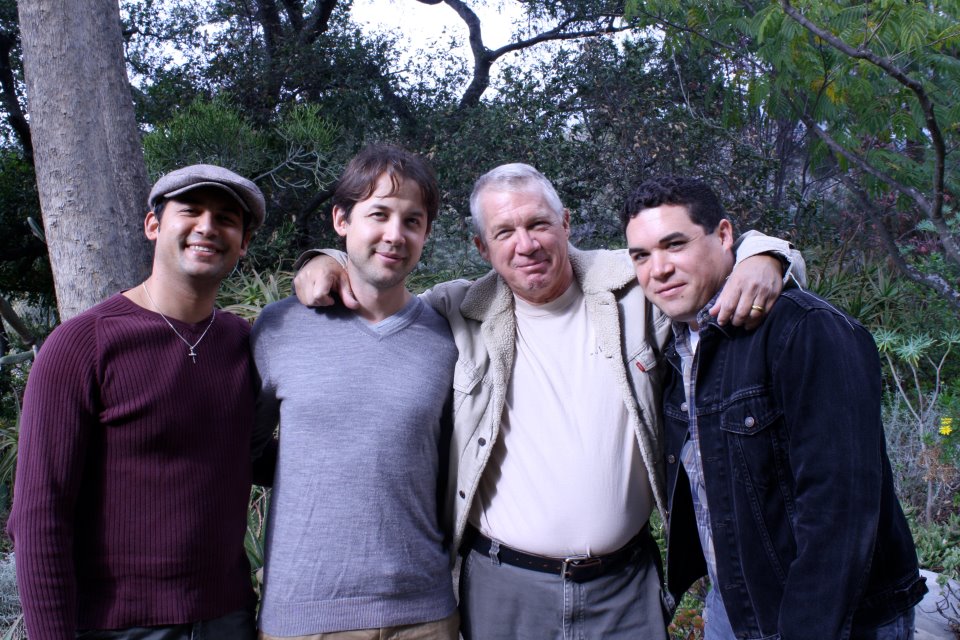
Malcolm with his three sons
Malcolm Gault-Williams, three times proud …

TF: Malcolm, I want to thank you for agreeing to be interviewed. This is my first conducted interview for Thailand Footprint so you are being very gracious.  You are the perfect first guest because you have left a lot of foot prints in the sand.

I’ve never been an investigative reporter, Malcolm but since you have authored books on surfing, and your email contains the words “legendary surfer”, I am going to guess you were pretty good and knew other great surfers. When did you start surfing, how old were you and what memories do you have of that first year in the water on a board?

MGW: Kevin, you are too kind. I am far from being a “legendary surfer.” I just write about them. I have been writing since 1963. I began writing about surfing’s heroes, history and culture, when I was in the midst of a career change. I asked myself: given my abilities and interests, if I had 6 months to live and had to make some money somehow, what would I do?

Well, I knew I could write OK and I loved to surf, plus I’ve always had an interest in history, so writing about legendary surfers seemed like a no-brainer.

And that’s the way it’s been. Of course, I’ve had to have “day jobs” along the way, but I’ve always worked toward who I wanted to be when the chips were down.

I was 18 when I got interested in surfing. My first board was a Weber Performer.
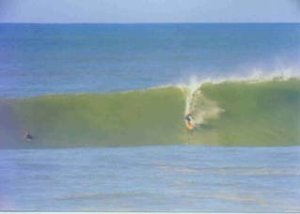
Malcolm Big Wave

Six-foot tall Malcolm Gault-Williams and big wave at a spot between Santa Barbara and Ventura Counties

TF: When did you first begin writing about surfing history. Who or what inspired it? How many books have you written since? Have you written or do you plan to write a book on anything other than surfing?

MGW:  I began research on surf history in 1993 and throughout the 1990s had several notable articles published in surfing’s best magazines. I finally self-published my first volume in 2005, after a decade as a contributor to the online community. Some people have, as a result, dubbed me “the most plagiarized surf writer of all time.”

I was inspired to write about the history of surfing due to the work of surfer and writer Gary Lynch whom I later worked with on the definitive history of Tom Blake. I was also inspired by Steve Pezman,  a former editor of “Surfer” magazine and the genesis behind “The Surfers Journal.”

I have written three volumes on surf history, in chronological order, and will continue working to present day, until my time comes.

Other publications include articles about East Timor and West Papua, and a history book on the student protests during the Vietnam War in Santa Barbara entitled “Don’t Bank on Amerika.”

TF: Most parents, if they are lucky, give their children roots and wings. Most expats that end up living in Thailand have the necessary wings to get here, but not necessarily the roots. Tell me about your roots, your family?

MGW: My foster father is a retired Methodist minister and he was the one who got me into reading, doing well in school, and constantly try to improve my thinking and my actions. These lessons kind of set the tone for my own nuclear family.

I’m fortunate that I have never really had a problem with my (three) sons. My first wife nurtured them well and I give her a lot of credit for how they turned out. Of course, I’ll take some credit, too. I think that if you are true to yourself and treat your kids as your true embodiment, everything’s gonna go good.

I came to Thailand via my third wife Thiphawan, who is Thai-Lao and absolutely the sweetest person I have ever known. We initially met via the Internet and have been together now for 13 years.

Malcolm and family
Malcolm with Thiphawan and family pictures

TF: I have heard stories that you were a bit of an activist in your college days at UC Santa Barbara. And yet now you are the proud father of a California State Assemblyman. What similarities, if any, do you see between activism, which you participated in during the turbulent 60s and present day politics in California.

MGW: During what Americans call “The Vietnam War,” the United States grew very polarized. You had to pick sides. I chose to be counter-cultural and active. In later years I was active in the anti-nuclear movement and much later than that, served on a couple of governmental boards.

My oldest of three sons, Dohassen Gault-Williams (aka Das Williams) grew up with politics part of his daily life. When he grew older, he volunteered in a county supervisorial campaign and saw that a good candidate can lose by as much as one vote (in that campaign it was four votes). That spurred him on to more political involvement and to where he is, today. He serves as the California Assemblyman for the 37th District, which comprises principally Santa Barbara and Ventura counties.His progressive position on issues is excellent. He likes his work and it comes naturally to him. You can imagine how proud I am. I just wish there were more people like him in governments all over the world.

Das Williams and Dad

California Assemblyman Das Williams with Dad after a day of weaving waves

TF: Tell me more about those three Volumes of Surf History. What are their names. How far back did you go and what is the most surprising or interesting thing you learned in your research on the history of surfing? What’s the current volume you are working on? How long did a typical volume take from start to finish?

MGW: With non-fiction, I usually write chronologically.

Volume 1 of LEGENDARY SURFERS  (http://files.legendarysurfers.com/surf/legends/ls00_vol1.html ) covers 2500 B.C. to 1910 A.D.

Volume 2 of LEGENDARY SURFERS (http://files.legendarysurfers.com/blog/2007/12/discount-thru-dec-7.html ) takes it from 1910 to 1930.

Volume 3 of LEGENDARY SURFERS            (http://www.legendarysurfers.com/2013/01/ls-v3-1930s-contents.html ) is all about the 1930s.

I am currently working on Volume 4 and that will cover the 1940s. It’s hard to guesstimate how long a volume takes to write because when I get down to putting it all together, it’s really just a matter of pulling in what I’ve already written and having it make sense as a whole. I’d say a year per volume.

I build my writings on the history of surfing around the quotes of the people who lived it. Not afraid to include excerpts from other surf-writers, my work is heavily footnoted not only for the reader, but for future historians. My stuff is not for the coffee table. I write for surfers who want to know the details of the heritage we are blessed to be part of.

The most interesting thing I’ve learned in all of this is that we really do not know how old surfing is and that it is probably much older than we imagine.

TF: You mentioned being plagiarized a lot.  Discuss the pros and cons of publishing in a digital age. Are your books available in print and E-books or only one format? Is plagiarism always a bad thing? Is there any benefit, like there often is in the music business?

MGW: Plagiarism isn’t a big thing for me, really. I write to be read. If I’m not credited, lao boa die. It would be nice to be credited, but my ego’s not so big that I would go hunting down the people who copy my work and not attribute it. My time is much more valuable to me than to waste it on something like that.

I self-publish paperback books and ebooklets. I haven’t put together an ebook, yet, but plan to, soon. What’s held me back is the lack of control when things go viral. I had a friend once, who asked for one of my books in digitized format, that she could use in her classroom. So, I made it for her and then discovered that almost 100 of her students also downloaded the file and I didn’t get a baht or cent out of it. I felt a bit burned by that.

Nowadays, you can distribute digitized works that have a unique identifier with a unique password, so if you’re careful, it’s much easier to protect your work than it used to be.

Malcolm Gault-Williams is on a mission to record oral histories as told to him by as many of our great surf elders as possible, in scholarly fashion, before they are lost forever.” Steve Pezman, Publisher Surfer Magazine 1971-1991, Editor, The Surfer’s Journal

TF: Contrast your life now with how it used to be, living in a California surf town and talk about your own blog at  http://the-isaan.blogspot.com . What do you like best about Thailand? What do you miss most about California?

MGW: Well, I used to be a surfer/writer and now I’m a country boy/writer; very different realities. I miss the ocean and wave weaving and I also miss my sons and parents. Not much I can do about the salt-water thing, but with family, I do my best to stay connected via the Internet. I particularly like Skype video calls
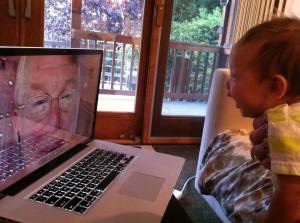
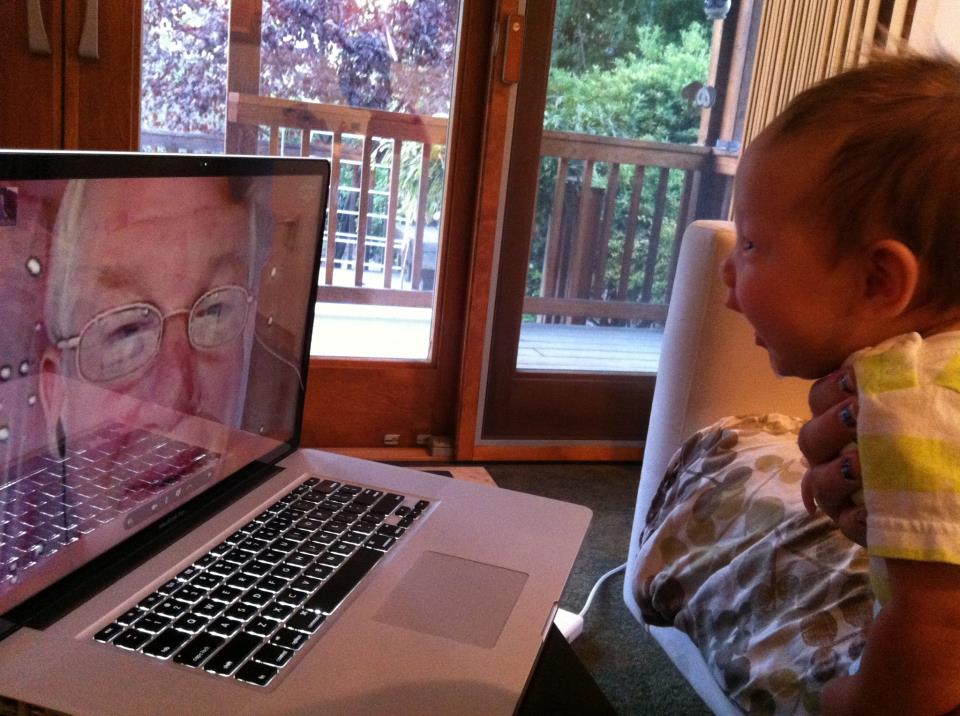
Malcolm Gault-Williams and his first grandchild on Skype video call.

Malcolm on Skype with Grandchild

Yes, I’m having fun with my blog, “THE ISAAN: My Life in a Thai-Lao Village.” I’ve always written biographical vignettes, but this is the first time I’ve ever put personal stuff up for everyone to see. Similar to my surf writings, I like to write about the details of everyday life. They are SO interesting to me because my daily life is so new to me. It’s like the title of one of my posts: “Learning a New Way.”

Malcolm Gault-Williams with monks, upcountry, in back of pick-up

Malcolm learning a new way (or not) to travel in Thailand

TF: Malcolm, can you talk about the benefits of writing, for you.  I started this blog with an idea that came from Henry Miller about how  best to engage the world:

Develop an interest in life as you see it; the people, things, literature, music – the world is so rich, simply throbbing with rich treasures, beautiful souls and interesting people. Forget yourself.”
― Henry Miller

Do you agree with the Henry Miller quote and how would you sum up your own philosophy of living?

MGW: Well, I agree with most of that quote by Henry Miller, except for the very last part. Anybody can write, but not everyone can craft and in order to be a good craftsman, you have to put yourself into it. It has to be part of you in some way. If you “forget yourself,” as I understand the quote, you are not adding that special ingredient that makes your writing unique.

As I mentioned earlier, I’m 64 and have been writing in one form or another for the past 50 years. It’s just something that I’m driven to do. I don’t know why, really, except that the more I did, the better I got and now I really appreciate the skill I’ve developed. I’m not a very creative or entertaining writer, but I can put a story together that makes sense to the reader by the time they’re done reading it. Not everyone can do that.

TF: Who are some of your favorite authors? What authors influenced you growing up? What authors do you read now? What percentage of your time is spent reading on the internet as opposed to real books or even e-books?

MGW: Growing up, I was most influenced by the writings of Jack London, Charles Dickens and Alexander Dumas – in that order. Later, I was very much influenced by the writings of Jack Kerouac, Baba Ram Dass, Mao Zedong, Carlos Casteneda, and James Willard Schultz (Apikuni).

My most favorite writer is David Cornwell (John Le Carre). In recent years, I have enjoyed the Vincent Calvino series by Christopher G. Moore and the Bernie Gunther series by Philip Kerr.

I’m embarrassed to say that I don’t read much, these days, nor do I watch TV. Last year, I think I only read three books. With the exception of “Carthage Must Be Destroyed,” which I read in America on my son’s ipad, I haven’t read anything thus far this year, although I am working my way through “A New History of Southeast Asia.”

I write several hours each day, but am in a phase right now where I’m not reading for fun or pleasure. When I do, it’s most always on paper.

TF: I’ve really enjoyed this. Thank-you again for being the first Footprint Maker to be interviewed on Thailand Footprint. One final question: can we meet face to face some time in the future – either in the Big City where I live or up in the countryside where you live?

MGW: Thank-you, Kevin. Of course.

——————————————————————————————————————————————–

legendary sufrers

For a complete list of writings and interviews by Malcolm Gault-Williams and more about Legendary Surfers, click the banner above.

1 Comment