There is nothing more grotesque than somebody going around saying, “I’m a writer. I’m a writer. I’m a writer.”
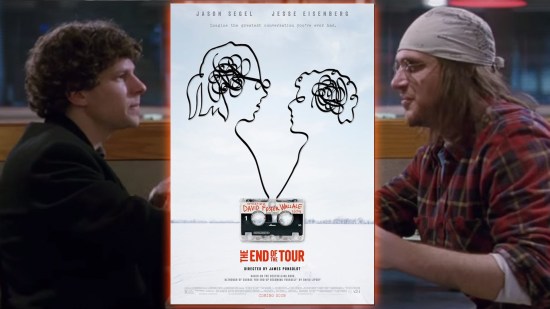
The above line, said during a car ride (dotted with numerous fast food franchises on each side of the road) between the two lead characters, is one of dozens that resonated for me during the one hour and forty minute biopic, The End of the Tour. The film depicts Rolling Stone on probation writer and author of negligible success, David Lipsky -played by Jesse Eisenberg, and the famous author of Infinite Jest, David Foster Wallace -played by Jason Segel, on the tail-end of a USA book tour in the snowy Midwest.
Lipsky pitches the idea for doing a story on a man he believes to be a “once in a generation” writer – like Hemingway or Fitzgerald – to his editor. A bold move given his status at the magazine and that Rolling Stone had never before interviewed a novelist. It’s a period film set in 1996 with early and late flash forwards to 2008 when Lipsky learns of the suicide of Wallace.
It would be easy to portray this movie as a tale of two writing Davids, one successful and uncomfortable with that success, one aspiring and envious of the other. It is more than that – it is about the upside and downside of discovering truths, illusions, and what it means to be human. The movie will have plenty of appeal to writers even though it is not a celebration of the art; it is more a dissection of the myths.
We learn many things about David Foster Wallace and his interrogator Lipsky, although I suspect with Oliver Stone like revisions when deemed suitable for this consumable product. The two form a suspicious friendship with Wallace being the more cautious one, as he needs to be. The Rolling Stone editor reminding Lipsky, in one of many telephone conversations shown in the film, to “get the story” and telling him he wasn’t sent there to be David’s friend. Yet it becomes a buddy/road trip movie of sorts focused on conversations in diners, cars, hotels, bookshops, and frozen tundra. It is not action filled, a welcome break from Hollywood norms. The USA culture is portrayed well and in uncomplimentary fashion.
One can’t help but like the strengths and foibles found in Wallace, (even if he didn’t have a picture of John Updike on his wall) as he tells Lipsky, “Be a good guy.” Wallace was a long-time professor of creative writing at Illinois State University, a job he enjoyed. The classroom scene with his students shows that he was a good teacher even if the professor seems less sure of that fact. Two frequent characters in the film are the black Labradors of the author, Jeeves and Drone – one of whom had been abused in his youth. We learn that fame doesn’t prevent one from having to pick up dog shit inside the home.
There is much talk of relationships past by both writers and on the subject of marriage in the future. Wallace makes small but wise observations about men and women, at one point declaring, “It is so much easier having dogs.” Female characters are present in the form of a past Wallace classmate and an admiring fan plus Lipsky’s girlfriend back in New York City. Wallace frequently analyzes the interview process – the tactics employed by Lipsky, real or imagined, create tension and distrust between the two. Wallace also worries about the seduction of fame and, worse yet, that he might actually enjoy it. He doesn’t mind appearing in Rolling Stone but he doesn’t want to appear as someone who wants to be in Rolling Stone. Dr Hook he is not.
Wallace is reticent to confess all, particularly when Lipsky presses him late in the film about rumors of heroin addiction. Wallace frets how the story will be shaped, given his history of depression and a hospitalization during his short Harvard stay. Wallace knows that some addictions are sexier than others and his, he maintains, are “typically American”.
A central question to the film is, why? Why do people want attention? Why do people fear attention? Why are people lonely? Why do we up our dosages of things that harm us when we know that low dosages are fine? Big questions and not all the answers are or can be provided.
One tenet of the film that is not explored much is Wallace’s faith. He has a quote from St Ignatius posted in his bathroom and he likes to dance inside a Baptist church. Considering Wallace is the son of atheist parents, who were also academics, I wish that aspect of his life had been made clear.
There is a school of thought out there that an author’s work is the end all, and that his/her life is minutia or trivia by comparison. I disagree. I won’t be reading Infinite Jest anytime soon. But I will peruse the essays of David Foster Wallace. I’m better for having learned about versions of these two writers by watching this as good as it gets biopic. In the end, neither loving dogs or a loving wife could save Wallace from himself.
The End of the Tour is a movie about conversations, amidst chewing tobacco, cigarette smoke, soda cans, Big Gulps, hamburgers and french fries. The worst nutrition the USA has to offer. And probably the best conversations you will hear in 2016. Seek it out.
Special thanks to Hong Kong based author Jame Dibiasio for steering me towards this movie. You can read Jame’s review of The End of the Tour at his blog found here
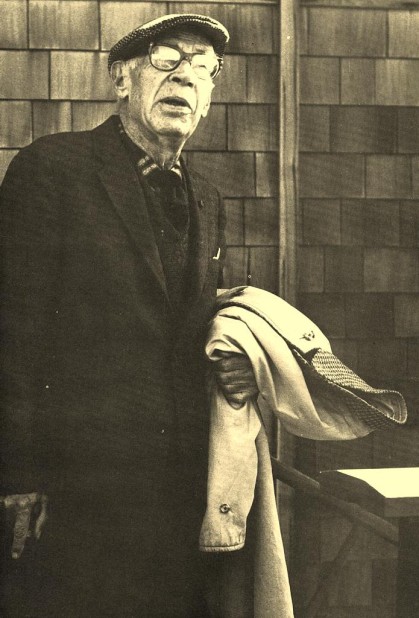
Every month I post a Henry Miller quote. And every month it is like a memory test – to see that I don’t post a duplicate. Fear of early onset Alzheimer’s, perhaps. So far I do not believe there have been any double entries. I could be wrong. Here’s one I rather like on the subject of humanity:
The man who is forever disturbed about the condition of humanity either has no problems of his own or has refused to face them. – Henry Miller
Career journalist David Armstrong has led and is leading an interesting life. Currently living in Kamphaeng Phet, Thailand. At my request he agreed to reflect back and look forward on his experiences spanning nearly fifty years, including the good luck and the bad. No small task. I thank him for the opportunity:
KC: When I was a boy I was a regular viewer of the television series, Superman – starring George Reeves. I never wanted to be Superman; I wanted to be like Perry White. You actually lived my dream. Can you talk about the highlights of your career in the newspaper business, beginning with your Jimmy Olson Days, including the different Metropolis cities you worked in?
DA: I was keen on the old Superman series, too, but I liked the Clark Kent role: no matter what he did as Superman, he still had to rush back to the office, hit the typewriter and file a story. But I didn’t aspire to be either Perry White or Clark Kent. I went to university to study medicine. The examiners, however, thought I would be better off if I studied something else. So I started on a liberal arts degree, majoring in history.
I think two key factors in my career were luck and persistence. You need more than whatever talent God gave you. My first piece of luck came in 1969, when I was appointed editor of the university newspaper (called Tharunka, which is an Australian Aboriginal word meaning message stick). The really lucky part involved a newspaper, called The Australian, which Rupert Murdoch had set up in 1964. The paper was trying to develop readership among academics and students and a small part of their strategy was to offer a modest scholarship to the editor of Tharunka. And that led to a job as a junior reporter on The Australian. I had wanted to work on The Australian as it was a national paper, dealing with big issues – not parish-pump stories like the city papers. I spent the next 15 years reporting and editing with The Australian and a news-magazine called The Bulletin, that was an Australian equivalent of Time or Newsweek. Like The Australian, it dealt with national politics, the economy, the arts, international news and business.
In 1985, I was appointed editor of The Bulletin, published by the late Kerry Packer’s Australian Consolidated Press. It was a great job: the magazine was more than 100 years old and had a national reputation as the publisher of great Australian authors, poets, artists and cartoonists.
But it wasn’t to last. In 1986, Kerry appointed a new editor-in-chief of the company’s magazines and he thought The Bulletin should be turned into a lifestyle magazine. In a moment of candour, I told him I disagreed and, if that was what he wanted I probably wasn’t the right person for the job. He was to come to the same conclusion. I left.
That was bad luck but I also had some good luck. While working at The Australian I had grown close to News Corp’s Australian chief, Ken Cowley, who was Rupert’s right-hand man. Developing a friendship with Ken was the biggest single piece of good luck in my career.
Through Ken I was offered a job as a political commentator in the Sydney Daily Telegraph. The parish-pump stories turned out to be not so boring after all, especially when I could scoop the rival Sydney Morning Herald.
But Ken had other plans. In 1989 he asked me to go back to The Australian, this time as deputy editor.
Towards the end of the year, Ken fell out with the editor, who was removed and re-assigned as a columnist. I was appointed editor, the first journalist to start his career at The Australian to move on to the top job.
At that time News Corp also owned the South China Morning Post in Hong Kong. Ken and Rupert decided to offer me the job there when it was next due to fall vacant. But first, there was another task.
Ken and Rupert were close to Kerry Stokes, the owner of the Seven television network. Kerry also owned the Canberra Times and wanted to appoint an editor from the outside, to bring in some different ideas. So I was sent on “loan” to Canberra for 12 months. I loved that job: producing a national newspaper with a small team (Canberra was not a big city), relying on their enthusiasm, skills and hard work. It was fabulous.
In 1993 I went to Hong Kong – a great adventure. SCMP was a paper with a strong local and international reputation and a time of immense change in Hong Kong and China. I had been there six months or so when Rupert sold the paper to the Kerry Group, under Robert Kuok. Robert asked me to stay on and I did. After a while the job was upgraded to editor-in-chief of the daily and Sunday papers. But the role had a time limit on it. When I was appointed my late wife Deb Bailey also got a big job, as managing editor of the Australian edition of She magazine. We decided to try to manage a long-distance marriage, visiting each other as often as possible. We did it but it was very hard. If I had known Deb wad to die a few years later, at the young age of 48, I would not have gone to Hong Kong.
After three years I went back to Sydney, where Ken Cowley asked me to go back to The Australian, as editor-in-chief. I did the job for more than 5 years but Deb died in 2001 and although I pushed on I didn’t have the strength or the energy to continue for much longer. The next year, I stepped down.
And that, I thought, would be the end of my newspaper career. I took on a corporate role with News in Sydney but in 2003 Ean Kuok, the chairman of the SCMP Group, asked me to come back to Hong Kong, as group editor-in-chief. I thought if I worked in HK for three years or so, I could build up a decent retirement bank. At that time, SCMP was a big investor in Post Publishing in Thailand, the Bangkok Post company. Post Publishing was without a permanent managing director: one of the board members was filling in until they could find one. In 2005, a deal was done to make me effectively managing director in Bangkok, while having a role called editorial director in HK, splitting my time between the two cities. After a year or so, however, SCMP decided it wanted a full-time editor-in-chief again, while I now found I wanted to stay in Bangkok. So I parted company amicably with my friends in Hong Kong. I continued as managing director until the end of 2008. It was more or less retirement time, although I did spend two fascinating years as chairman of the Phnom Penh Post company and some time as a consultant to the Myanmar Times company.
In the meantime, I had met and later married Nichapa. And that led to a new career.
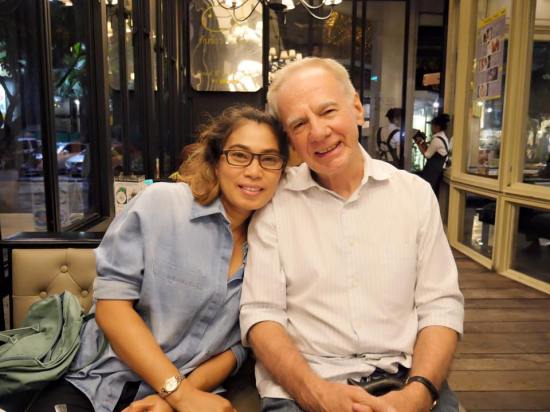
Nichapa and David during a visit to Bangkok
KC: Looking back at your tracks, pick one decade that you would consider the most newsworthy or news filled one. What were the stories that stand out during that 10-year period? They can be major ones that everyone would recognize and/or an important one for you personally.
We had a dress circle seat for a play called History. – David Armstrong
DA: Decades don’t start with years ending in “1” and finish with years ending with “0”. When we think of the 60s, for instance, we think of the explosion of rock music, rock concerts, sex, dope, student protests and all-you-need-is-love. But that era didn’t really get underway until about 1963, when rock and the changes it spawned pushed pop aside and got rid of a lot of the starch and stiffness of the 50s. So my best decade professionally began in 1993, when I went to Hong Kong to edit the South China Morning Post. There, it was not such much a matter of individual stories that stand out as two big long-running stories: the brawling between Britain and China over the return of HK to Chinese sovereignty and the emergence of China as an economic powerhouse. We had a dress circle seat for a play called History.
One of the challenges was to work out how the newspaper could play a constructive role, for HK and for China, as the handover approached. We were told the paper was influential, that it was read by some important people in Beijing. If true, it meant SCMP was being read by people who would not react kindly to direct criticism. We decided we would work by explanation and persuasion, doing a lot of editorials on why HK was different and why China’s approach would be unproductive or counter-productive.
One of our lines was that China should not be so belligerent and negative towards HK, that it was going to inherit a great jewel and it should be reassuring the HK people and trying to be positive about tackling some of the problems it saw. I took some satisfaction when China started to calm down as the handover drew nearer. Undoubtedly, their own common sense got them there but I like to think we may have played a small part in Beijing’s deliberations.
When I went back to Australia, many of the big stories seemed to involve indigenous matters. One was a High Court judgment that junked the convenient notion that Australia before the British arrived was terra nullius – that no one owned the land – opening the way to more extensive Aboriginal land rights. Another big story was a report into the stolen generations, a reference to the practice in the not-so-distant past of removing Aboriginal children from their families. I was proud of our original reporting into problems in indigenous communities, such as domestic violence and the young lives wasted by glue- or petrol-sniffing. These were no-go areas for some in the media who saw this kind of reporting as demeaning (if not defamatory) for Aboriginal people, rather than as necessary first step in helping to tackle the problems. We also had the first Government decision to turn back migrant/asylum seekers trying to get to Australia by boat – an issue that still inflames passions in the country.
There were, of course, some very big international stories, including the death of Princess Di, the dotcom crash, the Bali bombings, and the tragedy of 9/11 and its aftermath. And one of the most exciting stories in that time was the Sydney Summer Olympics in 2000, two weeks literally of fun and games.
One story that had immense personal meaning was printed in The Australian in 2003, closing off the decade for me. My wife Deb had died in 2001 of motor neurone disease (ALS, or Lou Gehrig’s disease). I subsequently gave a talk on caring for a terminally ill loved-one. In 2003 we set up a foundation in Deb’s name and The Australian, under Chris Mitchell, the new editor-in-chief, ran an edited text of the talk. I got more comments on that than on any story I had written during my career.
KC: You educated me regarding headline type used in the serious newspaper industry vs tabloid journalism but I am still curious, what is the tallest headline you ever had during that 10-year period?
DA: The Australian and the South China Morning Post were both broadsheet newspapers and tended to have modest headline styles. Often the main headline was only 60-point (0.83 of an inch) although we did range up to 96-point (1.3 inches). But when Aboriginal athlete Cathy Freeman won the 400m gold at the Sydney Olympics, we gave the next day’s front page a magazine treatment: a full broadsheet page with just one picture – Cathy with her medal. I suspect the heading was more than 96-point that day.
KC: Let’s fast forward to present day. You’ve decided to build and operate a resort on the Ping River in Thailand with the able assistance of your wife, Nichapa. That must make many of your friends think you have figured out the ideal way to live the good life in Thailand. Then again, some friends might think you have gone crazy? Tell me about operating a resort in Thailand.
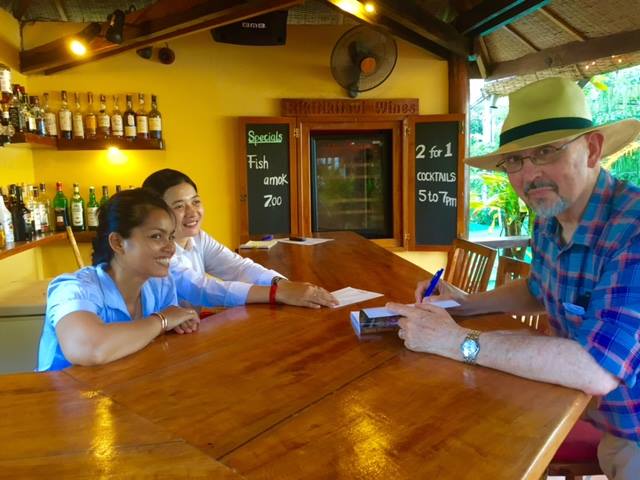
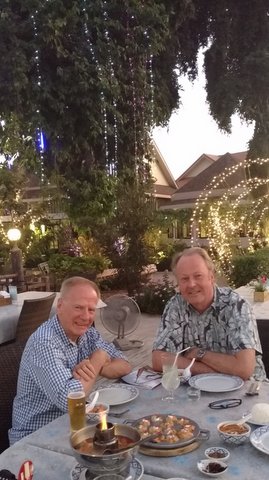
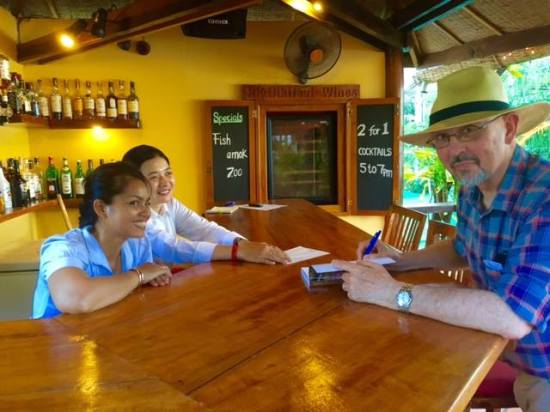
David Armstrong and Kevin Cummings at Maeping Mango Riverside Resort – January 15th, 2016
DA: I can see why people might have either perception but I think I’m very lucky.
Just to correct the record: it is my brilliant wife Nichapa who has built and now runs a resort and restaurant by the Ping River in the Kamphaeng Phet, a World Heritage town halfway between Bangkok and Chiang Mai.
Nichapa is a fabulous cook and she is also an accountant by training and worked as a logistics officer for two international IT companies.
She supervised the construction and now runs the operation – the restaurant and the resort. Nichapa comes from Kamphaeng Phet and we bought the land in 2008. We started building at the end of 2013 and opened two years later.
After about a year, the owner of the construction company we were using pulled out to work on other projects. So Nichapa managed the project from then on – in detail.
Are we (or me) nuts? Nichapa is working very hard but she has a job that uses the full range of her skills and she is doing it very well. I am the support act.
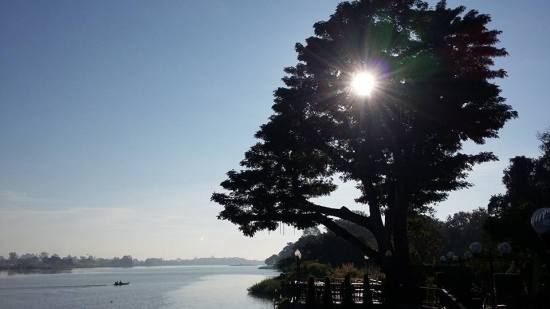
We have a house by a wide expanse of river, in a beautiful garden setting. I have breakfast sitting on the veranda, watching the sun rise and the river flow by. At night, I get a table in a riverside restaurant and eat some of the best food in Thailand. I spend most of my time in Kamphaeng Phet. My original plan, in 2008, was to split my time between the resort and Bangkok. Since then, I have grown eight years older and the communications have become eight years better. So I’m not isolated. I also have a few tasks, like managing social media and the website, that give me something to do, something to keep my brain ticking over, in my declining years. This is important to keep me occupied, as I can’t play golf.
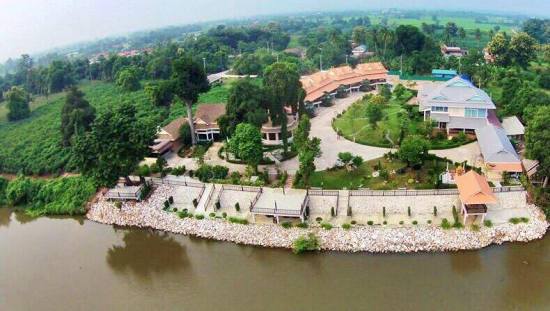
Aerial view of Maeping Mango Riverside Resort shortly before the 2015 opening
One of our guests said Maeping Mango was a perfect place in which to do nothing. He meant it kindly: that the garden is peaceful, the river is calm and soothing, the air is fresh, there’s no noise and the food is first class. You can decide if that’s crazy.
Click the above picture to be directed to the Maeping Mango Resort Facebook page
(Photograph by Ratree)
An interesting September 2012 video interview of David which I came across after our interview was completed. It makes a nice addition to the record of David’s distinguished career in print journalism, and his new life along the Ping River.
Mark Fenn shown in blue shirt in far left on the night of July 26, 2015 at Checkinn99
(Photograph by Alasdair McLeod)
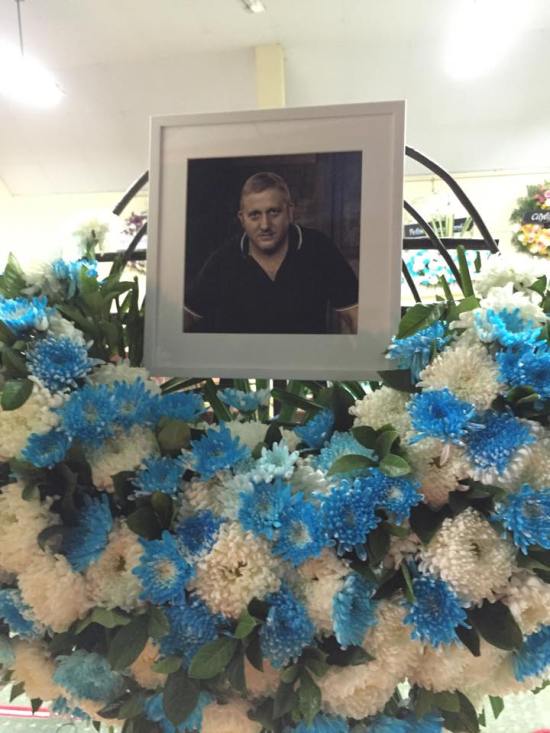
Mark Fenn was, among many other more important things, the Editor in Chief for my lone book, Bangkok Beat. Mark died in the early morning hours at his home in Chiang Mai a little over one week ago. It was and is a shock. To me and to many.
In an age when people don’t talk on the phone as much as before, Mark and I did so a fair number of times. I would comment that Mark, with his British accent, always sounded so polite. Mark would always take that comment, politely. There was a nice balance of professionalism, candor and humor whenever I talked or chatted with Mark.
I sought Mark out for the job because I knew he had recently parted ways as Editor at Chiang Mai CityNews. I also knew there would be a lot of work involved, turning dozens of blog posts and a handful of new stories into a readable book. There was. Mark never complained. He did the hard work and he turned the 90,000 words mess I gave him into a book I am proud of, and a book Mark enjoyed reading. He told me so – many times. Authors can go through periods of doubt and I was no different. Mark made it clear that he enjoyed the stories in Bangkok Beat. “It’s the kind of book I like to read”, he said. Then he would reassure me by adding, “I’m not blowing smoke up your ass.” I needed that. Beyond our phone calls there were over 700 text messages regarding the editing of Bangkok Beat over many months. That’s a lot of messages.
I would finally meet Mark face to face at the book launch for Bangkok Beat on July 26th, 2015. Mark and his wife had taken the overnight bus from Chiang Mai to be there and Mark was pleased to have gotten a good Hotel room along the Chao Praya River. Mark was a history buff so it was no surprise he chose the River of Kings over a closer Sukhumvit Road location to spend time with Ning. Mark warned me that he had grown a mustache and that reactions were “mixed”. I liked Mark Fenn and I am saddened at his early passing. I will remember that night fondly for many reasons including Mark’s wife, Ning, being so helpful and pleasant throughout the event.
Realistically I would say that Mark and I were not close friends. We had a mostly professional relationship. Yet we shared thoughts and words that even close friends do not share. And that is why I feel I have lost more than a Facebook friend. I feel I have lost a true friend. I expected the best days were ahead.
I used to joke with Mark that I didn’t know how bad a writer I was until I got around good editors. I received editorial advice from many but Mark did the heavy lifting.
One can learn a lot from writing a book. And the lessons are not about writing. They are about the journey and the people you meet along the way. I am fortunate to have met and gotten to know Mark, briefly, during mine. I did not go to Mark’s Buddhist funeral in Chiang Mai. I regret that. But a friend of mine who lives in Chiang Mai went and lit a candle for me in Mark’s memory. He took the picture below. I appreciate that.
With or without the mustache, Mark Fenn was a good and loyal man. I will miss him.
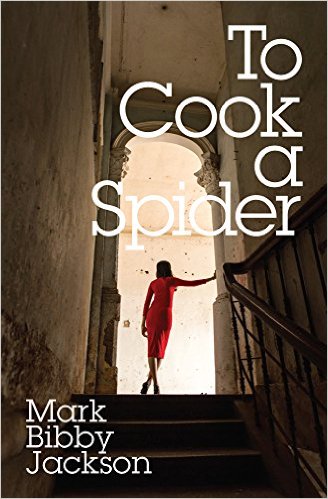
The debut novel of Mark Bibby Jackson is To Cook a Spider. Mark is the publisher and founder of AsiaLIFE Cambodia and editorial director of Horizon Thailand as well as a freelance travel journalist.
Mark Bibby Jackson is a first time novelist with the novella Always in his list of credits. My expectations are kept low with first time novelists, particularly ones with Southeast Asia themes that weave in the nightlife. To Cook a Spider is different and should not be categorized as a bar girl book. If anything, similar to author John Burdett, Jackson paints a sympathetic picture of the women and girls working in the various entertainment professions – not so for their clientele. Both mood and tone are excellent throughout the book. To Cook a Spider conjured up images of another first novel, The Lady in the Lake by Raymond Chandler. That’s not necessarily high praise as I believe Chandler’s later novels are much better. But like Chandler, Jackson is a very descriptive writer of places and things occurring in big cities or small towns. In Jackson’s case the cities are Phnom Penh and Paris with a sprinkling of Bangkok added for additional expat flavor. Unlike Chandler, who wrote his first novel in 1943, Jackson does a better job describing what goes on inside the heads of his characters – the classy ones and the classless ones. The visuals I had going on in my head as I read To Cook a Spider were all in cinematic black and white. The opening is particularly artful as one old friend in need uses the modern day version of a Western Union telegraph message, Facebook, to lure in a London based long lost friend indeed, to visit him and his wife at their French Colonial restaurant and guesthouse in Battambang, Cambodia. Jackson shows patient and believable writing, particularly in the first third of the story, with a good mixture of dialogue and narrative.
Expats familiar with Cambodia and Thailand are sure to enjoy most if not all of the familiar backdrops and characters found in the region. This is a moody mystery more than a thrilling thriller, which keeps you turning the pages because you know something is about to happen and you’re reasonably certain that something will be bad. There are not a lot of characters to like in this novel. No one stands out as the brightest burning incense stick in the pack but that just adds to the believability and entertainment.
An interesting back story is the culinary arts scene of Cambodia complete with the idea for a collaborative cook book. I often find this kind of add on provides more distraction than benefit, for me, in moving a story forward but Jackson does a good job here. Foodies should enjoy the attention to detail. One desert gets so many mentions I felt sure someone would be poisoned by it before the finale but that never happened; that’s a good thing. You don’t want to guess too many plot points correctly in any mystery. There are healthy portions of diabolical murders, love triangles and betrayals served up in To Cook a Spider.
This is not a flawless novel; there are convoluted plot points and some that take a high dose of disbelief suspension. There is the needed explanation of motives – perhaps too much at times for veteran mystery fans. For the bulk of the story Jackson writes intelligently, with great word economy and shows the ability to create believable characters and believable plot twists.
Just as Raymond Chandler’s best novels came after 1943, I suspect Mark Bibby Jackson’s best novels are yet to come. He’s got all the tools in the toolbox. I’d like to see him up his game by constructing a novel with a tighter plot that is character driven and not dependent on material that is better served up in a travel guide or a nightlife blog.
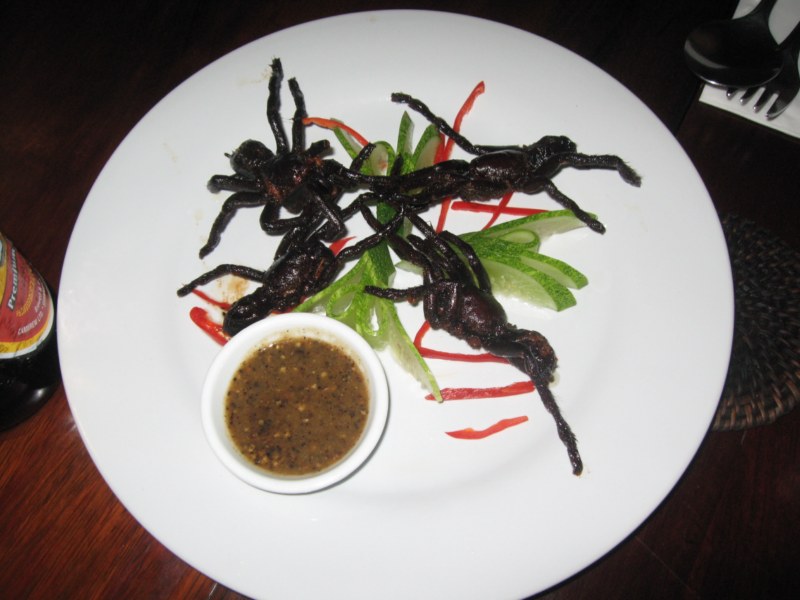
I enjoyed the Author’s Note and the recipe for Crispy Tarantulas with lime and Kampot black pepper dip offered after the optimistic ending. That’s not a spoiler. Just a tasty tidbit. I recommend To Cook a Spider for anyone who likes a good Southeast Asian mystery with a bit of neon and plenty of shady characters.
The Beauty of Isaan is a non-fiction short story which first appeared in the book, Bangkok Beat published in June of 2015. It is being republished here with the permission of the author.
The Beauty of Isaan
By Thomas Hunt Locke
I jumped on the skytrain. “Exit at Nana, directly opposite the Landmark Hotel, you can’t miss us. Look for the sign, Checkinn99.”
The ‘you can’t miss us’ comment I later understood as Aussie humor. A glance at my watch showed I was early. I grabbed a beer and retreated back to the long entranceway I had just passed through. A Marlboro was torched. The photos lining the tunnel had not been missed. I now gave them the attention they deserved. A story, somewhat haunting, was on display.
The story of my appearance is worth noting. Stuck at a crossroads in my book, 450 pages in yet no ending in sight. Actually, the ending was clear, but how to get there? I’m a sleuth. No stranger to the labor of historical research, the answer lay close. A day or two, perhaps, and an article, an interview was found. The blog was titled ‘Stickman Bangkok’. I had never read it but the name was not unfamiliar. A name came to my attention. Mama Noi.
It would have been easy to walk into the bar, call her over, ply her with drinks, and get the information I was seeking. But, I had come down to the Big Smoke from up north. I needed to make sure the elderly mamasan would be on the premises. I needed to make sure she’d talk. Plus, an introduction to the owner seemed the polite course of action. My characters are often brusque. I am not.
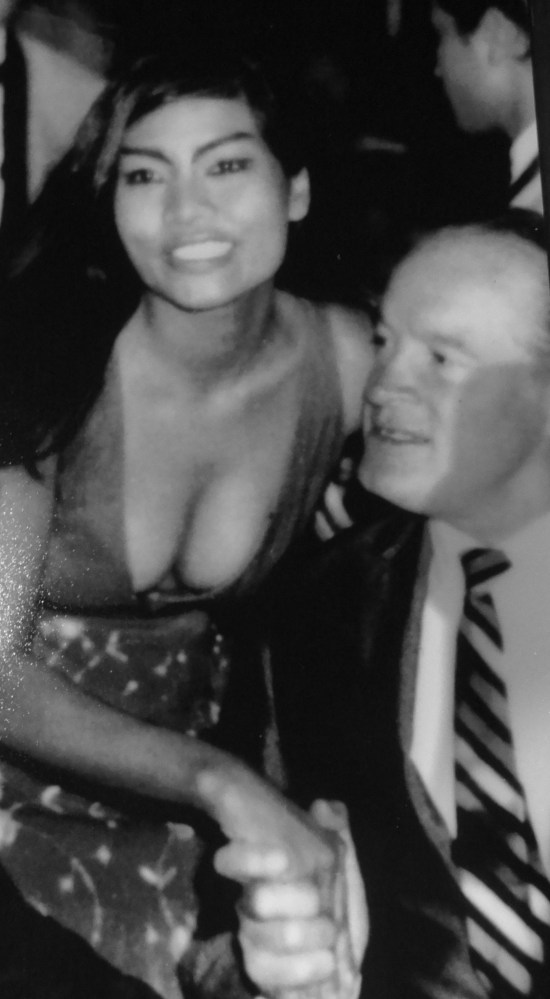
Luckily I acted prudently. A friendship was born. The owner, Chris Catto-Smith, enthusiastically approved my request and encouraged Mama Noi to sit for the interview. A certain photo caught my eye. My mug was refilled. I lit up another stick. Bob Hope, a half-smirk caught in time, a stunning lady on his lap with an ample cleavage on display, acknowledged my presence. “This is a Sam Collins’ type of joint,” I murmured. An idea clicked in my mind. The ending to Jim Thompson Is Alive! crept ever closer.
The butt stubbed out, I was ushered to a shabby chic lounge chair and settled in. I had conducted several interviews to try to develop a sense of the times within which Jim Thompson maneuvered. One such interview, with a former US State Department official, had been quite helpful. Another, with a person prominent in the Thai art world, much less so. Both had been engaged with significant preparation. Mama Noi I would wing.
The interview actually began as I followed her movements around the club. The lady known as the Beauty of Isaan glided from one corner of the club to the next, four pillars observed, at each one a Buddhist ritual conducted. Strangely, I was taken back to my altar boy days at St Agatha’s. The thought then struck me, wryly, that back in her day Noi had likely taken many a lad not far removed from the frock. My mind was clicking. Sam Collins too was a Boston boy. Would a part of his past emerge leading him to Jim Thompson?
“Sir, would you like a drink?”
I noted Mama Noi walk past. “Sure, a jug of Heineken please. And what does the mamasan prefer?”
The comely young waitress smiled with a wink. A hint of Kampuchea (Cambodia) shone through her Thai eyes. My order arrived with my interview subject.
“Can I help you, darling?”
Dark tantalizing eyes bore into me. They seemed so familiar. Had I come across her before? Indeed I had. I was looking at the sexy young lady who had occupied Bob Hope’s lap those many years ago. Beauty fades. It does not desert. I was sitting with one of the most beautiful women I had ever encountered. My heart skipped. I fumbled with my words, an awestruck kid trying to find just the right tone of seduction. A shot of Crystal Head Vodka made its way to me.
“Chris, boss, sorry he late. Here, drink up, on the house.”
The shot of courage helped me find my groove. Mama Noi was funny, a fountain of information, and so at ease with her place in life.
“I came down to Bangkok from Ubon Ratchatani. Only 17, maybe 1960, and I found my way into this life.” She waved her arms around the room. “It was different then,” she said. Her voice was resigned yet not sad.
“Different how?” I asked.
“The name in those days was the Copa. The club I mean,” she clarified. “My name always Noi.” Mama flipped her head back in a deep laugh. She then squeezed her breasts. “Noi mean little. But the boys liked these, big.” I joined her revelry.
“Tell me about Bing,” I prodded. It was time to dig deep. Mama Noi was legend. She had seduced and been swept away by Hollywood royalty. When I exited out of the tunnel of memories, I wanted to know the story. I wanted to feel 60s Bangkok. Noi wasn’t just some girl in some club. The Isaan beauty was the girl in the club.
“We Thai do not, cannot, talk about people from a higher status. And it was so long ago…” Her voice faded away. “My memory is not so good.”
The waitress came to tend to our drinks. She refilled my mug. Another lady drink was ordered for Noi. The Crystal Head was smooth and quickly washed down.
“Where are you from?” she asked, her eyes beaming back to life.
“Boston,” I replied.
“Ah,” she laughed. “I remember the snow! The Boston Park Plaza. Bing loved to spend time there – ’66 or ’67, not too long before I returned.”
She seemed to relax into her reminiscence, and events of another era came flowing back to life. And it was quite a whirlwind adventure she had enjoyed with her Hollywood icon. Atlantic to Pacific, trips to Mexico and a bit of mischief in Paris. A lifetime in a fling. I let her go, us both enjoying the ride.
She finally, abruptly even, stopped. “You’re writing a book.” Her voice contained a dash of suspicion.
“I am.”
“Surely not about me.”
“No. I am writing a novel around the disappearance of Jim Thompson. Did you know him?”
“Oh no. But Bing and Bob would visit him at his house, you know, now a museum, from time to time.”
“And you never joined?”
“I was the mia noi, the second wife. I knew my place. But, even if I had, Thompson, from what I heard, wasn’t the type you got to know.”
I was puzzled at what she said. Cryptic. I tried to get her to elaborate but she danced easily away. Finally she held up her hand. “You see, every night I visit the four corners of our home. It is to keep the spirits happy so they will keep the ghosts away. Darling, you talk of a ghost.”
Mama Noi looked deeply in my eyes, then leaned over the table and kissed me gently on the cheek. “I hope you find what you are looking for. He is not here.” With that she was off.
In that respect Mama Noi was wrong. In that evening, within that moment, Noi led Sam Collins exactly where he needed to go. My voila moment had arrived.
Mama is now a friend. I always look forward, on my trips to the Big Smoke, to a night at Checkinn99. My first order of business is to buy the Beauty of Isaan a drink and sit for a chat. There is no talk of ghosts, just two acquaintances catching up. But, on your next trip, or if it is your first walk down the tunnel, buy a drink for the lovely lady from Ubon Ratchatani and let yourself be escorted into yesteryear.
Noi seen with Bob Hope in 1968. (Picture published with permission by Chris Catto-Smith and Checkinn99.)
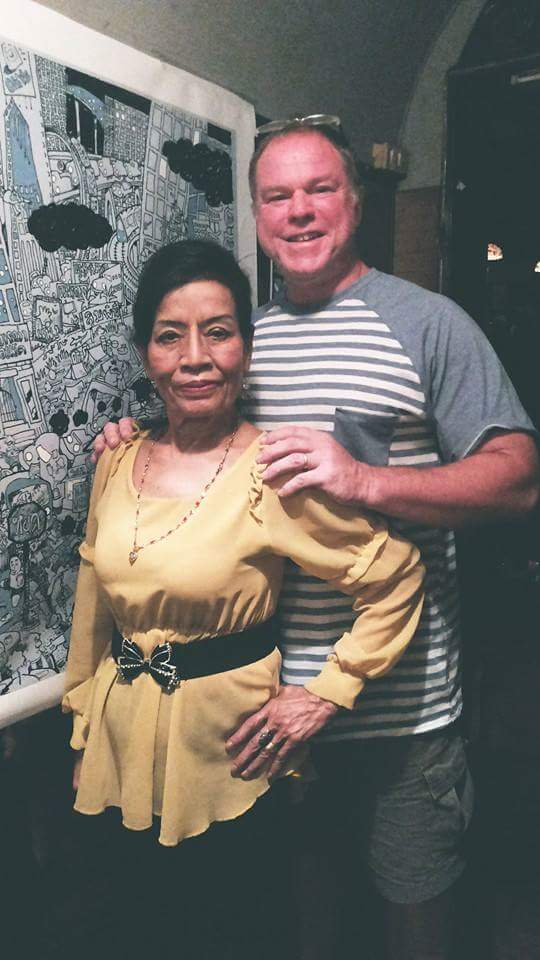
The present day Legend, Mama Noi seen with author Thom Locke in the picture laden and history filled tunnel entrance to Checkinn99
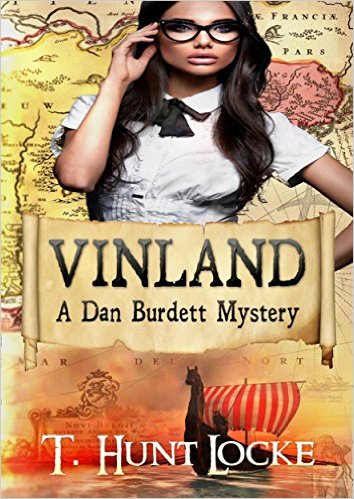
T Hunt Locke is the author of four novels to date: Jim Thompson is Alive; The Ming Inheritance; The Chiang Mai Chronicle; and his latest Vinland – A Dan Burdett Mystery.
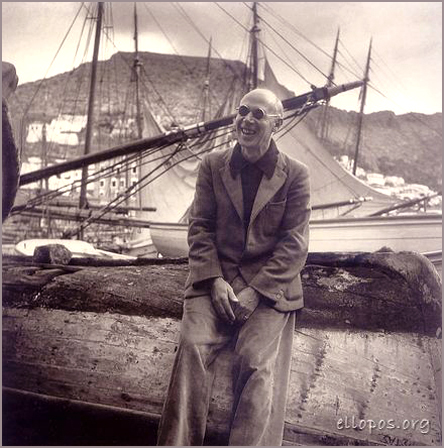
“Everybody goes the wrong way, everything is confused, chaotic, disorderly. But nobody is ever lost or hurt, nothing is stolen, no blows are exchanged. It is a kind of ferment which is created by reason of the fact that for a Greek every event, no matter how stale, is always unique. He is always doing the same thing for the first time: he is curious, avidly curious, and experimental. He experiments for the sake of experimenting, not to establish a better or more efficient way of doing things.”
― Henry Miller, The Colossus of Maroussi
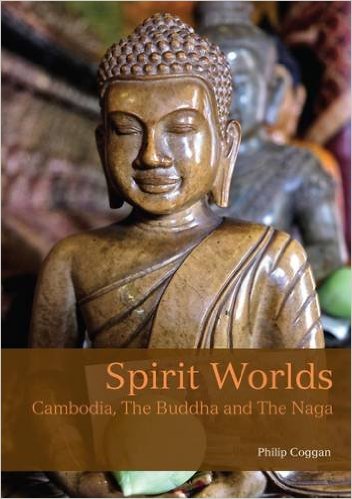
Spirit Worlds by Philip Coggan (John Beaufoy Publishing 2015) is a spirit catching and spirit explaining book which also catches the eye. Being mindful of the Contents page of my non-fiction reads is not my normal practice. As I opened the cover of Spirit Worlds showing the Buddha image, found in the museum gallery at Angkor Wat, I took my time looking at and reading the two pages that outline the fourteen chapters of the 159-page book dealing with the spirit world, Buddhism, colonialism, and the monarchy. The book deals primarily with Cambodia although many countries are discussed for historical perspective, including India, Thailand, China, France, the USA, and Viet Nam. The Contents page includes six color photographs, which serve as a prelude to the over forty geographically unique color photos found throughout the book, including a dozen which are full-page in size.
With Chapter titles such as: The Buddha’s Tale; Domestic Gods; Tales from the Shadow World; The Dead; and, Inside the Crocodile, there was an initial temptation to jump around during the read, but that proved to be unnecessary. I read the book from cover to cover in three enjoyable sittings. Spirit Worlds is filled with interesting facts, passages and stories, as my now, much thicker than originally, dog-eared book will attest.
Spirit Worlds is factually written mainly about fascinating myths, superstitions, ghosts, life after death and religion. All religions have their myths and superstitions and dwell on the afterlife but what Coggan has done, in addition to including what would serve the novice well as a primer or refresher on Buddhism and life as a Buddhist Monk, is tell the reader the reality of the religion and the myths, while recapping the ideal, and the everyday ways that the spirit world is encrypted into Cambodian life (and death) – particularly Cambodian village life. Religion in Cambodia is blurry, as noted at the beginning of Chapter Two:
“Cambodian religion is a complex blend of Hinduism, Buddhism, and animism. Hinduism provides the Khmer with gods, Buddhism with an ethical framework, and animism a rich world of spirits. All three together make up the mandala of Cambodian spiritual life.” Spirit Worlds by Philip Coggan
Coggan explains Cambodian spiritual life in a variety of ways. For a picture filled book it is a dense read at times because it is so fact filled – the research done is evident, extensive, and impressive. First person accounts of the spirit world are told by common villagers and revered shamans alike to balance out the factual and historical citing’s, which when coupled with the color pictures makes for a smooth read.
My nit with the book is I wish the author had interjected his own presence more often, as he does in Chapter 9 – Earthly Powers, The Boramy’s Tale. Here we get one of the few true conversations. There is plenty of dialogue, but it tends to fly solo, without the benefit of a co-pilot.
One of my favorite chapters is Chapter 12 – The Four Faces: King Jayavarmin VII, King Ponhea Yat, King Norodom and King Sihanouk are discussed. I particularly enjoyed learning about King Sihanouk, his family and his ties to Thailand.
As I neared the end of Spirit Worlds the author seemed to be reading my mind. I was thinking how is he going to write about all these kindnesses, white magic (plus black magic) and superstitions without bringing up Pol Pot and the killing fields? Chapter 13 – an unlucky number in many western cultures – does this and does it well in a chapter which serves as a fulcrum for the book, propelling Cambodia into present day and its uncertain future. Inside the Crocodile discusses the crocodile years of Cambodia and answers the question of how a Buddhist country, which teaches non-violence and morality, could conceive of and follow-though on the execution of so many fellow Cambodians during the Khmer Rouge years. Cambodian civilization has survived the Khmer Rouge but certainly hasn’t thrived. As Coggan notes, “Today, it faces its greatest challenge ever: modernity.”
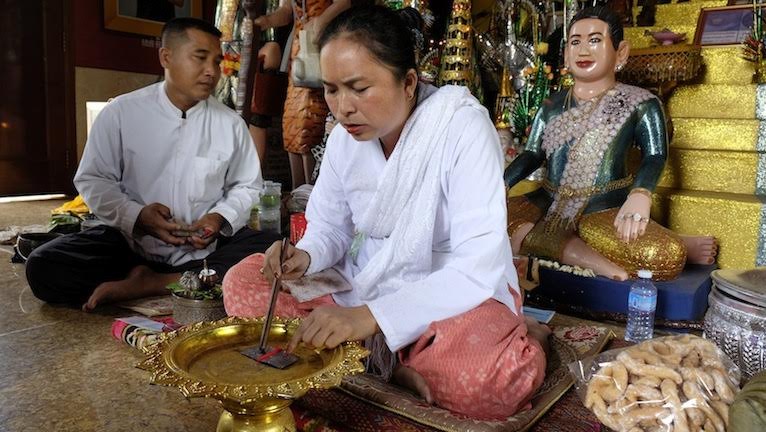
Daun Phann prepares an amulet – A lead plate inscribed with magic
Spirit Worlds – Cambodia, The Buddha and The Naga is chock-full of stories and story tellers much better than I can convey in this review. For all its compact size it is worthy of leaving out in plain sight. In its next larger incarnation, I could see it coming back as a hardcover coffee table book, hopefully with more stories directly involving the author. At $19.95 Spirit Worlds is not inexpensive. It does, however, offer good value, in an age of cheap books, for discerning readers and thoughtful gift givers looking for a spirited book about the living, the dead, and a Cambodian culture under siege.
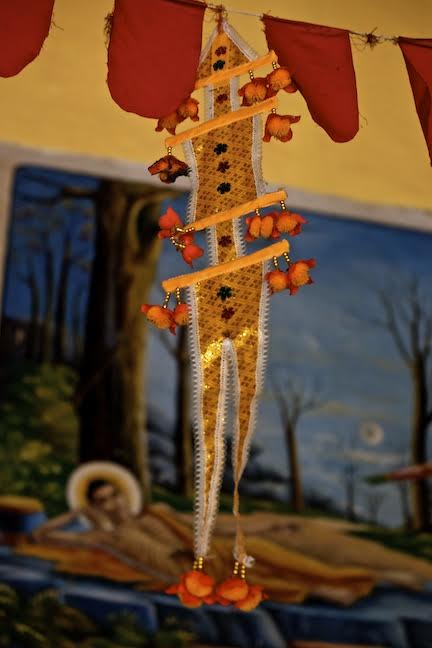
Spirit Flag
This Review also published on December 23, 2015 in The Weekly for the Khmer Times
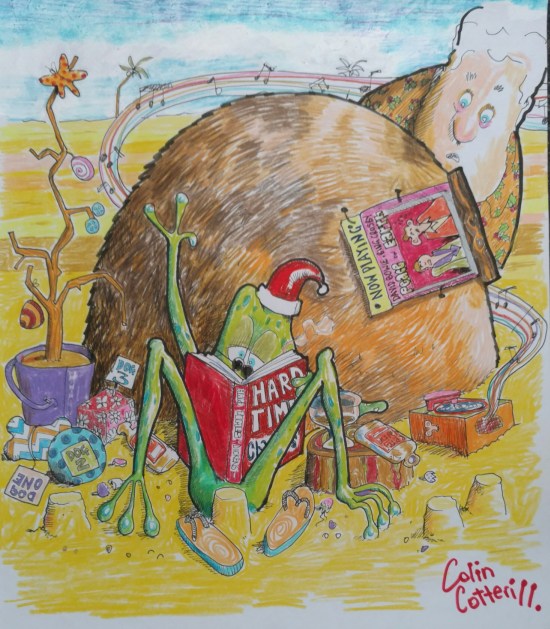
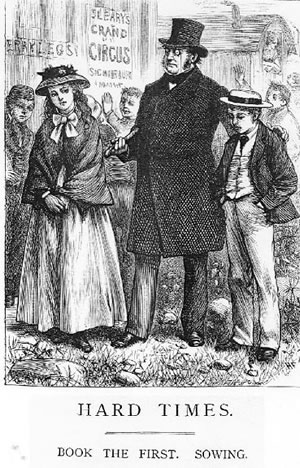
I am reading Hard Times by Charles Dickens for the first time. The novel was first published in serial form 100 years before I was born. Unlike many of the critics back then, I rather like it. It is the 10th and shortest of the Dickens novels. I picked it up new as a Signet Classic for 150 baht. (About $4.20 US.)
The hard times Dickens writes about of Victorian England are still recognizable today, anywhere, particularly his take on capitalism, education and the use of one’s imagination. He bashes, as many do, but he bashes fairly as some don’t. The book is in three parts: 1. Sowing 2. Reaping 3. Garnering
From the introduction by Frederick Bush:
Dickens was a man of great courage who took on his nation and his times. He also challenged a shadow of himself, thrown onto the pages of his novel, as he wrote the humiliation of Josiah Bounderby, a “writer” who imagined a new life for himself, and lied it into existence while he wrote his mother out of it. Dickens, then, confronted his harsh, hard times, and he confronted any writer’s cruelest opponent: himself.
My lone book, Bangkok Beat has now been out six months. I do think anyone who writes a book, if my experience counts, will learn a great deal about their cruel opponent. In my case most of the things I learned I liked – some I did not. The key is to learn and make adjustments where necessary.
To authors like Timothy Hallinan who writes two novels a year, and Christopher G. Moore who has penned over 25 novels and 30 total books in his writing career, and Charles Dickens too, who was incredibly prolific at a young age and for a long time, I have no idea how they did it but I am glad that they did. I am also thankful and grateful that I was able to write and publish one book of non-fiction in 2015 before my 61st cycle around the sun was completed. That’s the pace I will stick with. Look for my second book shortly before my 121st birthday. The blog will continue into 2016 with a little luck from the gods or the actuaries.
Here is to wishing everyone a Merry Christmas and Happy New Year. These continue to be hard times if not horrific times for many around the globe. That makes it a good time to count your blessings and do what you can for who you can. Read a good book. Buy a good book. Give a good book. There are plenty of them out there.
Christmas According to Gop
I’ll leave you with the Bing Crosby / David Bowie YouTube video of Peace on Earth/Little Drummer Boy recorded in 1977. Bing Crosby died the following year if memory serves. You never know which Christmas season will be your last. Enjoy it while you still can. The song and the season. Peace on Earth. Wouldn’t that be a miracle?
And for those compulsive shoppers who want/need an original piece of art from a cartoonist living down south, (some of the art is even heavy) click the link below. Probably too late for this Christmas but there is always next year. He’s a bit busy writing a novel or something. But, if you feel lucky …. click link below and let the games begin:
Flying Bird 15″ w x 11″ h $35 (plus shipping & handling) Close-up view 1965, watercolor collection of Henry Miller
printed by Museum Reproductions in Alhambra, CA
I am here on earth to work out my own private destiny. My destiny is linked with that of every other living creature inhabiting the planet – perhaps with those on other planets, who knows? I refuse to jeopardize my destiny by regarding life within the narrow rules which are now laid down to circumscribe it. I dissent from the current view of things as regards murder, as regards religion, as regards society, as regards our well-being. I will try to live my life in accordance with the vision I have of things eternal. I say “Peace to you all” and if you don’t find it, it’s because you haven’t looked for it. – Henry Miller Reunion in Brooklyn, Sunday After the War 1944




 And for those compulsive shoppers who want/need an original piece of art from a cartoonist living down south, (some of the art is even heavy) click the link below. Probably too late for this Christmas but there is always next year. He’s a bit busy writing a novel or something. But, if you feel lucky …. click link below and let the games begin: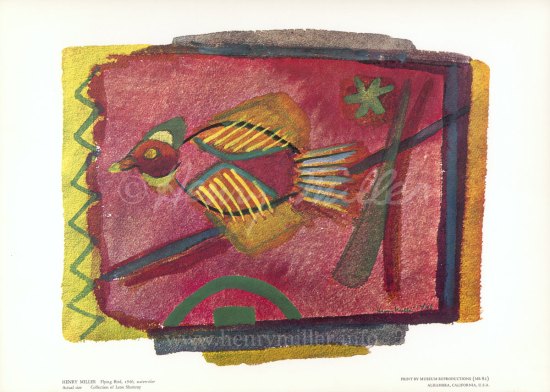
 Thailand Footprint: Impressions left by the books, people, places and music of Thailand and South East Asia